
Civic Science Observer
Did You Know: Kirtland’s Warbler Festival in Michigan is engaging the local community in celebrating and conserving the once-endangered songbird through educational events

This past June, the village of Roscommon, Michigan, held its annual Kirtland’s Warbler Festival, a weekend-long celebration of the songbird.
The weekend featured educational events such as bird banding demonstrations, where numbered bands are attached to a bird’s leg for tracking, sightseeing tours of the Kirtland’s Warblers in their jack pine ecosystem, and information booths set up by a dozen nature organizations, according to Mike Petrucha, the chair of the Kirtland’s Warbler Festival and board member of the Gahagan Nature Preserve.
The festival also included youth activities held by the Michigan Loon Preservation Association and the Gahagan Nature Preserve, a presentation on the art and science of making Kirtland’s Warbler habitats by the American Bird Conservancy, an art contest, and a silent auction.
The weekend-long events and other efforts throughout the state to provide the public with information on the Kirtland’s Warbler stem from the songbird’s historical endangerment.
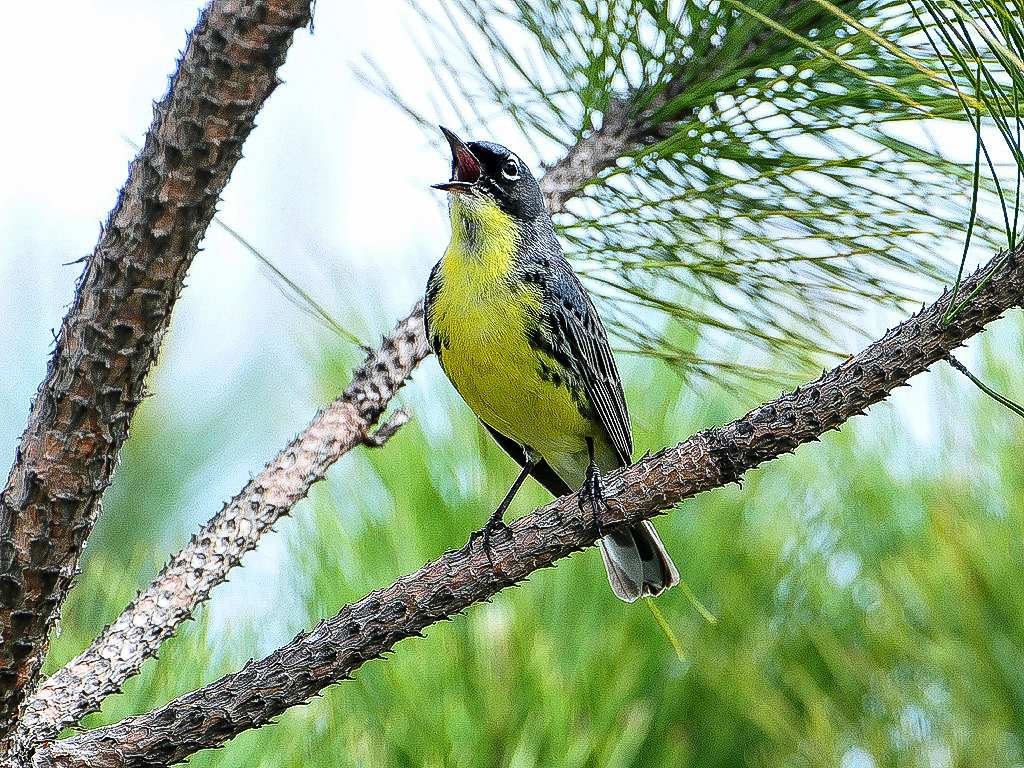
Kirtland’s Warblers are neotropical songbirds that “spend the winter in the Bahamas and nest primarily in Northern Lower Michigan,” Petrucha wrote in an email to the Civic Science Media Lab. Currently, 97% of all Kirtland’s Warblers breed within the state, with 92% being found within six counties.
But in 1967, the Kirtland’s Warbler was placed on the Federal Endangered Species List, according to the U.S. Fish & Wildlife Service, resulting from a reduction in wildfires, “a natural ecological process vital to producing its habitat.”
In the following decade, fewer than 200 singing males were surveyed annually. As a result, the Kirtland’s Warbler Wildlife Management Area was developed in Michigan to support “the need for more land dedicated to the recovery of the Kirtland’s Warbler.”
The Kirtland’s Warbler Recovery Team (later renamed the Kirtland’s Warbler Conservation Team) was also formed to produce a plan for the songbird’s recovery, according to Petrucha.
The festival was first held in 1994 in the community of Mio, then was taken over by Kirtland Community College in the following years until 2011, when funding was cut. Four years later, the celebration was revived in Roscommon and is currently funded entirely by local businesses and organizations.
In 2019, the Kirtland’s Warbler was removed from the Federal Endangered Species List, with the most recent numbers surveying 1,522 pairs. But Petrucha noted the importance of continued conservation efforts.
“Despite being delisted, Kirtland’s Warblers are still conservation-reliant,” Petrucha wrote, “which means they still need habitat and other management to continue to maintain their numbers above the level that would land them back on the Endangered Species List.”
The festival currently works with the Kirtland’s Warbler Conservation Team and other agencies on educational efforts, providing information and presentations about the songbird to the public and other organizations.
Moving forward, Petrucha added that he hopes to have more volunteers and attendees. This past year, the festival gathered at least an estimated 500 attendees, the most during the festival’s history in Roscommon. Yet, a small volunteer committee of seven people planned the event, with only half a dozen additional volunteers helping during the weekend.
The festival also seeks to improve each year by adding new activities and changing out less popular events. Petrucha also strives “to make the festival about more than one species and include and engage as many outdoor organizations as possible.”
“The main goals are to provide a fun, quality, and educational festival,” Petrucha wrote. “The Kirtland’s Warbler Festival is an educational celebration of the Kirtland’s Warbler, its habitat, and the communities located in the jack pine ecosystem.”
What follow-on actions did the insights above spark for you?


Jennifer Shim is a recent graduate of Brown University where she studied applied math. She is interested in exploring the impacts of scientific research on local communities.





Did You Know: A museum dedicated to the brain is being developed in Southern California?

Peer teaching as empowerment? Exploring NeuroBoricuas with Dr. Christian Bravo-Rivera

STEM Unbarred: What the initiative is learning about hands-on science for incarcerated youth

San Francisco Bay Area climate resilience group helps local communities talk about extreme heat

Did You Know: Kirtland’s Warbler Festival in Michigan is engaging the local community in celebrating and conserving the once-endangered songbird through educational events

Questions, biology-based environmental stewardship, and accessibility are at the center of Bio4Climate’s annual conferences
Did You Know: Kirtland’s Warbler Festival in Michigan is engaging the local community in celebrating and conserving the once-endangered songbird through educational events
San Francisco Bay Area climate resilience group helps local communities talk about extreme heat
STEM Unbarred: What the initiative is learning about hands-on science for incarcerated youth
Peer teaching as empowerment? Exploring NeuroBoricuas with Dr. Christian Bravo-Rivera
Did You Know: A museum dedicated to the brain is being developed in Southern California?
STEM Unbarred: What the initiative is learning about hands-on science for incarcerated youth

Exploring workforce needs and intergenerational learning in informal STEM education

Making a Mini-Forest: participatory science afforestation across the globe

18 months later, Casey Lardner from Genspace says, “we’ve been really focused on building systems”
Contact
Menu
Designed with WordPress