
Civic Science Observer
Libraries can play a key role in expanding participatory science involvement, SciStarter founder says
“The libraries can take a citizen science project and really add those community roots, so people end up taking action more.” — Darlene Cavalier

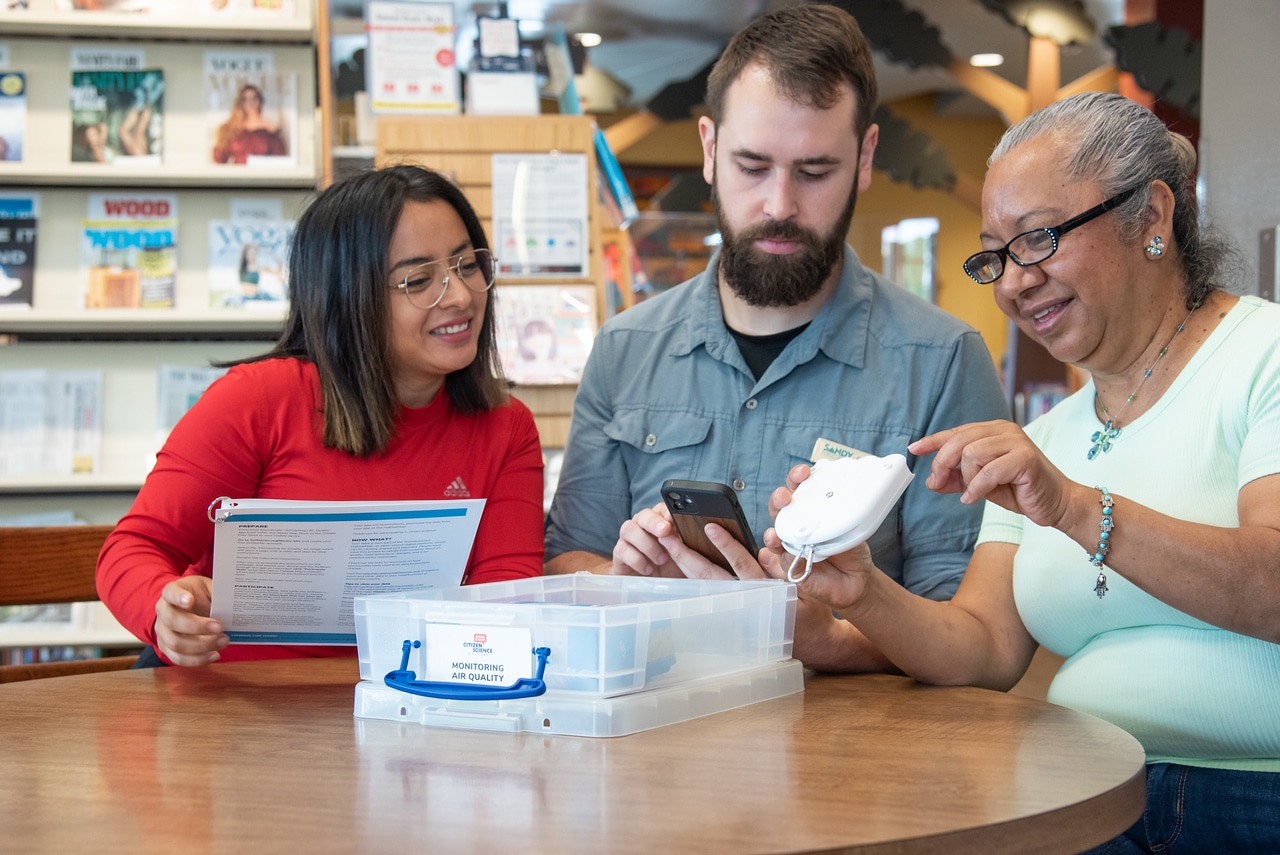
What if libraries could serve as a resource for people who want to get involved in participatory science? That’s what Darlene Cavalier, founder of participatory online database SciStarter, sought to find out.
This question about libraries’ potential role actually came from discussions with citizen scientists themselves, according to Cavalier, who also serves as a professor of practice in the School for the Future of Innovation in Society, a unit of the Rob Walton College of Global Futures at Arizona State University (ASU).
SciStarter had garnered funding from the National Science Foundation in 2016 to track what happens to projects when they leave SciStarter, she said. SciStarter also used APIs to track how frequently people engaged in projects.
SciStarter found that one of the reasons why everyday people became less engaged with projects over time was that some of the projects required tools or equipment that weren’t easily found around the house. Phone calls with over one hundred project participants confirmed that volunteers were more apt to disengage from projects if they didn’t have the right supplies.
It was project participants who suggested to SciStarter that libraries have these materials available to aid citizen scientists in conducting research. Their suggestion birthed a pilot project where ASU and SciStarter worked with six libraries in Arizona to supply the materials that citizen scientists needed.
Funding for this project was provided by the Institute for Museum and Library Services (IMLS), a federal agency that provides library and museum grants, and the Gordon and Betty Moore Foundation, which provided a 2017-2019 grant to pilot the program at the six libraries in Arizona. The foundation later awarded a supplement grant in 2020 to scale the initiative throughout Arizona.
The team soon discovered that libraries can function not only as a place where citizen scientists can get supplies but also as places where they can connect with each other, according to Cavalier.
Libraries also excel in their outreach to the populations they serve. For example, libraries can quickly get the word out about participatory science projects by including information about participatory science projects in their newsletters. Libraries also serve a variety of audiences, from teenagers to senior citizens to indigenous groups in Arizona.
“It actually became apparent that the libraries are not actually just a place to borrow things. They actually help address barriers to entry for a lot of different participatory programs,” Cavalier said.
Another appealing aspect of libraries is their ability to foster community so that citizen scientists feel like they are not just individuals collecting data for a project, but that they are part of a larger group.
“Libraries are a safe convening space. They bring people together. They’re very accessible. They’re free,” Caliver said. “So, we started thinking more about how we can leverage libraries” and address the barriers that prevent people from continuing their engagement with participatory science, she continued.
SciStarter determined that it could use libraries to highlight participatory science projects that are tailored to the communities that the libraries serve, according to Cavalier. For instance, projects studying stormwater runoff may yield different results in Philadelphia, where rainwater is abundant, than in Arizona, where it is scarce.
Libraries can also have the resources to provide context on participatory science projects, which may be helpful if the lead researchers are not local, Cavalier continued. They can put together and customize citizen science kits and make them local and relevant.
“They really enhance somebody’s experience, so you’re not just a data collector. They really do a very good job of figuring out what the value proposition is for the volunteer in a way that a single researcher or website really can’t,” Cavalier said.
Libraries can also have follow-up meetings on the projects, “and that’s another missing thing that most citizen science projects do not have. You sometimes don’t hear back from that researcher for years until the paper is published, because that’s how science works,” Cavalier said.
“The libraries can take a citizen science project and really add those community roots, so people end up taking action more,” she continued.
“We’re still trying to help navigate different resources and tools that enable libraries to do that more directly. But my point is, they became more than just a lending machine. They’re very important collaborators in some of this work.”
Scaling the project nationally
The early work with the libraries in Arizona, as documented here, has helped scale this endeavor nationally. During the pilot, the majority of librarians reported being satisfied or very satisfied with the project, while 92% of surveyed participants said they were likely to borrow another citizen science kit from their library.
What also helped were matching funds from IMLS and the Moore Foundation from 2021 to 2025.
So far, the library initiative has scaled to library systems in Arizona and Pennsylvania, with plans to reach thousands more across the U.S. The group also hopes to eventually take this model that they’ve designed for libraries and move it into museums and other third spaces, according to Cavalier.
As the initiative scales, its offerings have also expanded. One way that the team has helped to finesse libraries’ involvement in participatory science projects is to develop reproducible resources, such as creating do-it-yourself versions of participatory science kits for each library and providing instructions for circulation. It also includes providing sample social media posts that a librarian can then customize, Cavalier said.
“We said, here are six options, but also you can use our framework if you have a favorite project… Here’s the templates for them, and that’s scaled to 100 libraries in Arizona,” Cavalier said.
In addition to developing libraries as participatory science hubs, SciStarter and ASU have also developed professional development training for librarians to develop these kits and localize citizen science projects.
Instructional designers at ASU have developed an online training module for citizen science facilitators called Foundations of Citizen Science Training. The team created this training with the hope that volunteers at the library can help the libraries with some of the heavy lifting involved in making libraries a source for citizen science involvement.
This is in addition to SciStarter’s citizen science training through the Foundations of Citizen Science badge, which has been completed by nearly 100,000 people and is used in coursework and prerequisites in some universities, according to ASU.
“We’ve been very, very fortunate to keep finding funds to just create high-quality, field-tested trainings,” Cavalier said.
And just recently, the Moore Foundation gave the university and SciStarter $2.6 million to scale the initiative even further by supporting SciStarter’s Ambassador program. According to an ASU release, SciStarter works with ASU and North Carolina State University as a research affiliate to connect registered SciStarter members to citizen science projects.
SciStarter and ASU hope to power all this growth with thousands of volunteers across the country, who collaborate with others at the library or in their local communities or facilitate people’s involvement with participatory science projects.
Indeed, the overarching goal of the library initiative, the volunteer network, and the trainings is to establish an evidence-based distribution network that enables researchers to find the citizen scientists they need for their projects, instead of hoping that their project will catch the eye of major media outlets like the New York Times.
By establishing this kind of network, “a researcher can come in and say, I have easy-to-build sensors, or I just need data collected, and it would be better if it were from people who had telescopes,” Cavalier said.
“We’re now getting to a point where we can slice and dice that and become very efficient in our recruiting efforts, because we will know where people are. Do they have access to certain tools? Is it something that could be discussed at a library? We hope that this becomes just a very, very useful and helpful mechanism for them too.”
What follow-on actions did the insights above spark for you?


Joanna Marsh is a freelance writer and journalist based in Washington, D.C. For The Civic Science Observer, she reports on new developments across the citizen science landscape, covering both new research and on-the-ground practice. Her work highlights how local communities are engaging with scientists to contribute to ongoing scientific research and lessons being learned by the involved stakeholders.



Did You Know: A museum dedicated to the brain is being developed in Southern California?

Peer teaching as empowerment? Exploring NeuroBoricuas with Dr. Christian Bravo-Rivera

STEM Unbarred: What the initiative is learning about hands-on science for incarcerated youth

San Francisco Bay Area climate resilience group helps local communities talk about extreme heat

Did You Know: Kirtland’s Warbler Festival in Michigan is engaging the local community in celebrating and conserving the once-endangered songbird through educational events

Questions, biology-based environmental stewardship, and accessibility are at the center of Bio4Climate’s annual conferences
Did You Know: Kirtland’s Warbler Festival in Michigan is engaging the local community in celebrating and conserving the once-endangered songbird through educational events
San Francisco Bay Area climate resilience group helps local communities talk about extreme heat
STEM Unbarred: What the initiative is learning about hands-on science for incarcerated youth
Peer teaching as empowerment? Exploring NeuroBoricuas with Dr. Christian Bravo-Rivera
Did You Know: A museum dedicated to the brain is being developed in Southern California?
STEM Unbarred: What the initiative is learning about hands-on science for incarcerated youth

Exploring workforce needs and intergenerational learning in informal STEM education

Making a Mini-Forest: participatory science afforestation across the globe

18 months later, Casey Lardner from Genspace says, “we’ve been really focused on building systems”
Contact
Menu
Designed with WordPress