
Civic Science Observer
“We want to infuse them with the spirit:” Earthwise Aware’s unique approach to community building and collaboration in participatory science
Claire O’Neill: “Some people come and stick because they find their tribe. Because they found, somehow, a language that talks to them, you know, a set of people who speak the same language.”
Scientific research shapes many aspects of everyday life. Citizen science, also known as participatory science, offers one way for non-experts to directly participate in the scientific process. In a 2020 survey from the Pew Research Center, only about one-in-four U.S. adults said they had ever taken part in citizen science activities at some point in their lives.
However, increasing participation is only one part of the challenge. Equally important is creating meaningful experiences for those who do participate. Earthwise Aware (EwA) is one organization doing just that.
Established in 2016, EwA is a nonprofit that uses volunteer-based participatory science to promote data-driven environmental stewardship in the greater Boston area. They contribute to existing projects and design new ones through thorough ecological documentation.
At the center of the work is EwA’s cofounder, Claire O’Neill. She’s an introvert on a mission and a naturalist with a dedication to data science who spends her days in the field noticing and recording alongside a team of citizen scientists.
Over the past decade, EwA’s strong commitment to collaboration and the naturalist cause combined with community building led to widescale volunteer support for its participatory science activities in the Boston area and beyond.
In 2025 alone, EwA hosted 1287 events (including field trainings, community meetings and webinars) and documented 5926 volunteer hours. This represents an 11% increase from 5334 volunteer hours in 2024, and a 29% increase from 4581 hours in 2023.
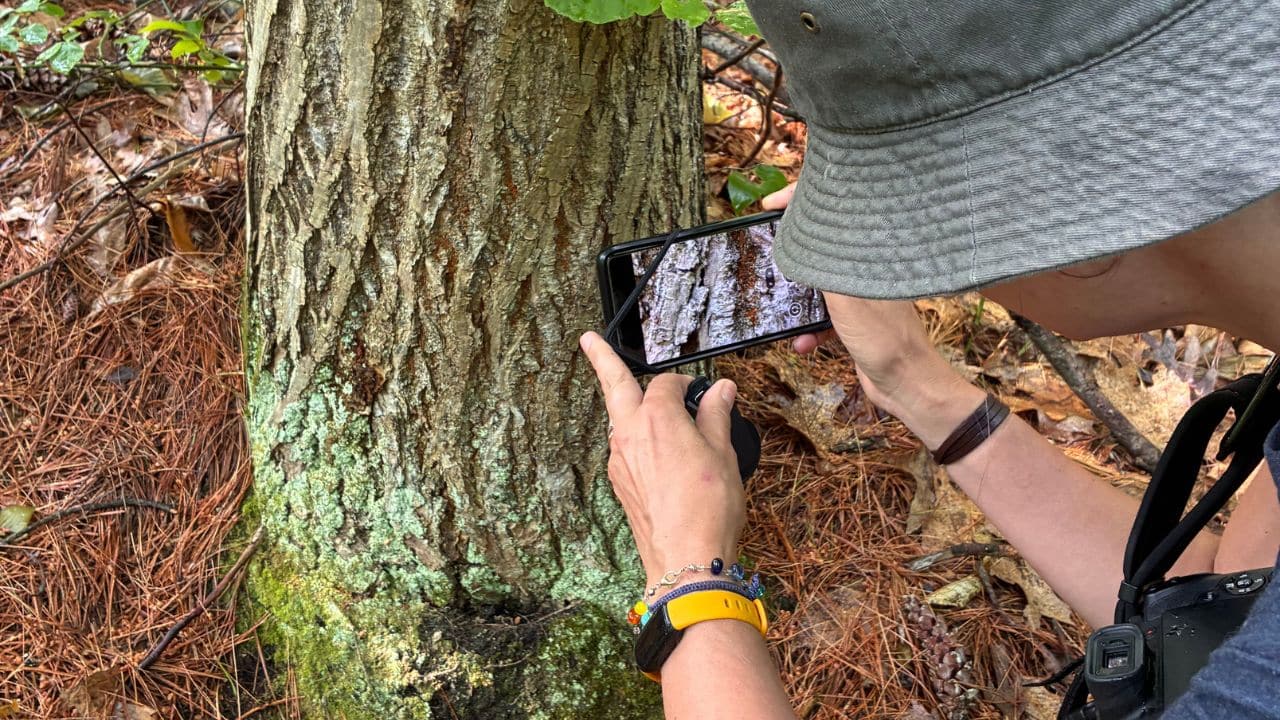
At first, word-of-mouth led volunteers to join them. O’Neill and the team would invite interested parties to join them in the field, offering trainings and field ethics.
“We want to infuse them with the spirit, so they can understand what they are getting themselves into,” said O’Neill. They weren’t so concerned with retaining all the volunteers, but maintaining those that truly want to learn and contribute. The ones seeking community.
EwA’s volunteer base really took off back in 2020, around the time of COVID-19 lockdowns.
During the height of lockdowns, they ran regular “Nature Hours” virtually. They discussed natural history to complement field work. As naturalists, the team at EwA document and observe plants and animals in their ecosystem, a practice that is rooted in natural history.
“We are natural historians, right? That’s what we do. Natural history is about, you know, studying nature, and also the narrative of nature to the public, right? So… we are about story, we are about narrative.” O’Neill explained. “It’s about the system. It’s about that thing in the larger system… and telling the story. I think that the narrative is key… for environmental causes.”
EwA’s Nature Hours provided regular opportunity for community learning during a time that felt isolating for many. It helped provide context to the work they do in the field, and encouraged volunteers to connect more deeply. Snippets of the Nature Hours are featured on EwA’s YouTube channel.
Soon enough, the volunteers returned to outdoor spaces for surveys and walks. At the end of each field day, participants reflect out loud.
“And then often, at the end of the walk, they realize that one person was attracted to a mushroom, but they heard about the bee, the other one heard about the plant, etc.,” O’Neill said. “And then they realize, through this circle of sharing, that everyone came with a slightly different angle at the very beginning, but then ended enjoying the whole [experience].”
These moments of reflection provide opportunity for the volunteers to learn from each other, and for EwA leaders to learn from the volunteers. They continue this dialogue on online community forums. At EwA, citizen scientist observers shape protocol and surveys more directly than other organizations.
Originally, EwA used platforms such as Nature’s Notebook via the National Phenology Network to contribute to pre-designed projects tracking arthropods, pollinators and phenology, or the study of life cycle events and timing. Over the past decade, they’ve transitioned to predominately using Anecdata to host the new projects, an open-access database for field observations.
They create new projects to complement ones previously established.
Anecdata allows them to easily adjust survey questions and has less site-specific restrictions that are present on other platforms. It has a forum for community members to discuss ideas. It also allows O’Neill to review volunteer observations.
“And then, you know, [each] observer learn[s] how to make notes to say, ‘oh, I feel that, oh, I’m tracking that [characteristic],’” O’Neill said. “And after a while, I’m like, okay, it looks like there is a need for that [option].”
The EwA team will then make the appropriate adjustment to the surveys, allowing flexibility and collaboration in a field that is often opaque.
O’Neill has a background in data science. She emphasizes the importance of effective data collection throughout EwA’s projects, encouraging volunteers to contribute to the datasets they publish.
One EwA project, on habitat fragmentation, was conceived when volunteers returned to the Middlesex Fells Reservation during COVID-19. They noticed an increase in invasive foot traffic, from well-intentioned individuals seeking fresh air and venturing off trails. O’Neill and the team realized, “we better take data so that we can really raise awareness about what’s going on.”
They began recording habitat fragmentation by mapping the rogue trails visitors forged in the Middlesex Fells during the height of lockdown. A volunteer pointed out intrusion areas, or trampled spots that weren’t yet footpaths, and argued that they should include this information in their observations.
The EwA team agreed, integrating intrusion sites into their survey queries.
They took this and future reports to the Massachusetts Department of Conservation and Recreation, which is responsible for reservation upkeep. Additionally, EwA issued suggestions to mitigate habitat fragmentation and support recovery, referencing specific high-priority areas.
In collaboration with the Department of Conservation and Recreation as well as the Friends of Middlesex Fells Reservation, EwA has successfully closed rogue trails as a result of their rigorous documentation.
With data in mind, each EwA project is born. They now record everything from vernal pools, invasive flora and rat poison to tiny arthropods. They operate at four different main locations, but encourage observations anywhere there is life to observe.
EwA Buggy, which documents multidirectional arthropods, currently has 456 members on Anecdata. The Invasive Flora Patrol has 411 members and Pheno Lite, which tracks phenology of common flora species, has 413. The projects cover a large range of topics in an effort to study entire ecosystems.
EwA uses social media, partnerships with universities, and Idealist to advertise volunteer and internship opportunities. New volunteers will approach EwA with one interest in mind but often leave with broader interests.
“No, we’re not going to just look at the birds,” O’Neill said in response to volunteers who have a single interest. “Because the birds are tied to their habitat.”
EwA does not record retention or returning volunteers. They define success as cultivating naturalists and encouraging participants to engage with ecological observation and practices for a lifetime, even if they pursue that independently from EwA.
Volunteers have even joined EwA while working in an unrelated career then discovered a new love in ecology and gone on to pursue a degree, leaving the organization in the process.
Regardless of initial interests, EwA encourages participation no matter the level. With an emphasis on accessibility, commitment to inclusion, and staunch naturalist values, they’ve reached a decade since their founding.
“We take people at the value with which they’re coming.” O’Neill said simply. “Some people come and stick because they find their tribe. Because they found, somehow, a language that talks to them, you know, a set of people who speak the same language.”
 +
Add CSML on Google
+
Add CSML on Google

Sofia Baah recently completed a MA from the School of Journalism at Northeastern University’s College of Arts, Media and Design (CAMD). She is Special Assistant & Program Manager for external partnerships at the Northeastern University Oakland Campus, where she manages small business community engagement initiatives. She is passionate about accessible science and sustainability, with interests in science communication, nonprofit work, and the biological sciences.



Did You Know: Kirtland’s Warbler Festival in Michigan is engaging the local community in celebrating and conserving the once-endangered songbird through educational events

Questions, biology-based environmental stewardship, and accessibility are at the center of Bio4Climate’s annual conferences

Lessons learned from Small Town Universe: A post-screening conversation with Katie Dellamaggiore

Exploring workforce needs and intergenerational learning in informal STEM education

Making a Mini-Forest: participatory science afforestation across the globe
Lessons learned from Small Town Universe: A post-screening conversation with Katie Dellamaggiore
Questions, biology-based environmental stewardship, and accessibility are at the center of Bio4Climate’s annual conferences
Did You Know: Kirtland’s Warbler Festival in Michigan is engaging the local community in celebrating and conserving the once-endangered songbird through educational events
Exploring workforce needs and intergenerational learning in informal STEM education
Making a Mini-Forest: participatory science afforestation across the globe

18 months later, Casey Lardner from Genspace says, “we’ve been really focused on building systems”

Lessons learned from OBSERVER: A post-screening conversation with Sarah Goodwin

What it takes to include Deaf voices in scientific research
Contact
Menu
Designed with WordPress