
The Observer
US based nonprofit Engineers & Scientists Acting Locally (ESAL) receives a $100k unrestricted gift to support its civic engagement work
“The plan is to expand ESAL’s support services for local projects and events led or supported by scientists and engineers.” — Taylor Spicer

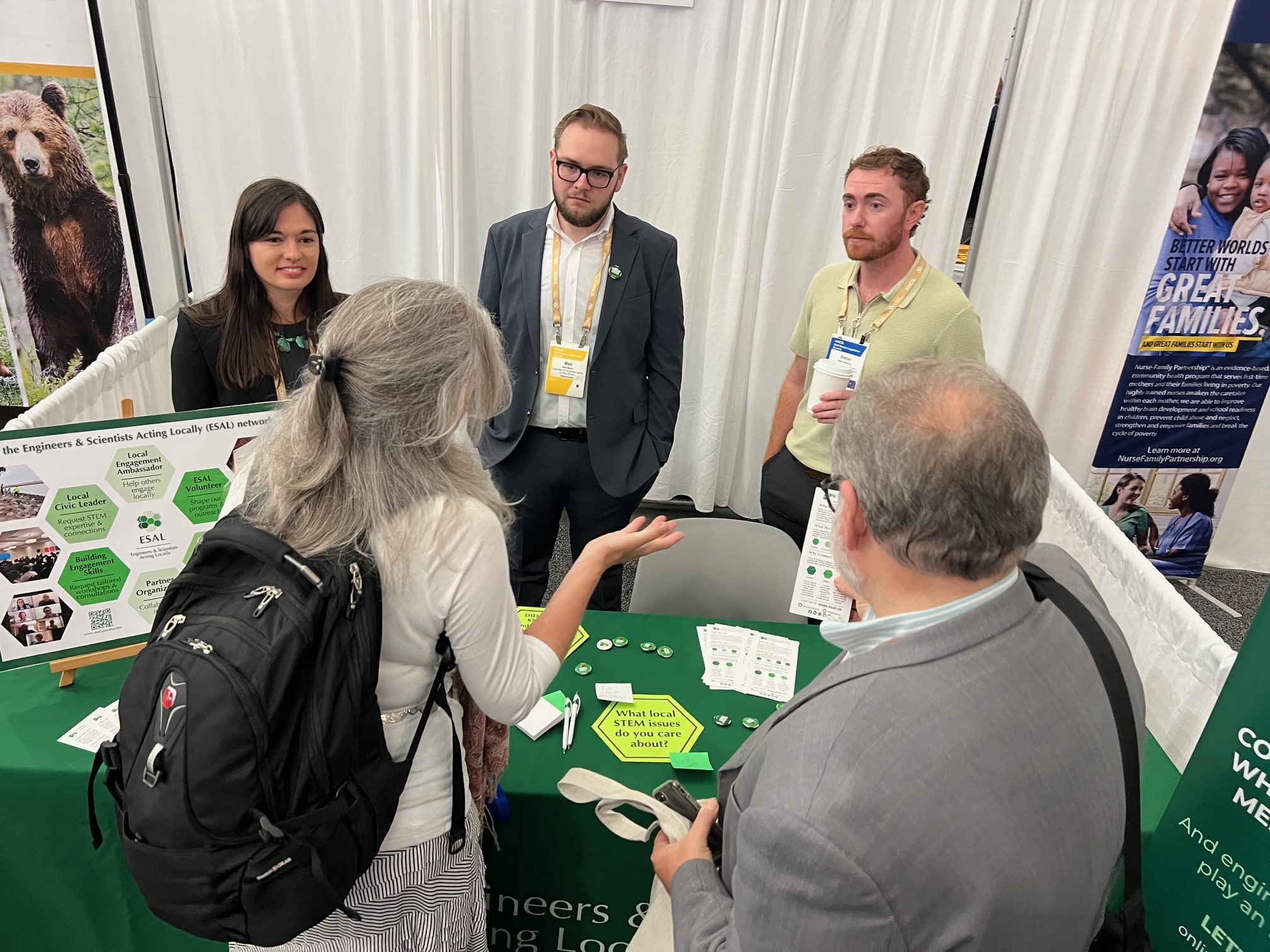
Engineers & Scientists Acting Locally (ESAL), a national nonprofit organization dedicated to increasing local civic engagement by people with backgrounds in science, technology, engineering, and mathematics (STEM), has received a $100k unrestricted individual gift for general operating needs. The contribution comes from Drs. Gayatri and Surendra Garg, the parents of ESAL founder Arti Garg, as the organization approaches its 10-year anniversary in 2027.
The gift reflects the donors’ confidence in ESAL’s mission and gives its team much-needed runway to address priorities across the growing organization. It also highlights the important role of longstanding donor relationships in securing support. Unrestricted funding to nonprofits appears less common than restricted funding, though this varies by donor and context. For example, Candid found that the median foundation in its survey allocated 32% of its grant dollars to general operating support in 2022.
In our conversations with civic science organization leaders, we routinely pose a thought experiment: what would they do with an unrestricted gift of around $100k? The question consistently resonates, opening up insights about priorities they would pursue if they had the flexibility. Watch a recent response below from the STEM Unbarred Initiative, based in Washington, DC.
Turning that thought experiment into reality often means finding creative ways to connect an organization’s mission with people and companies willing to support it. With that in mind, corporate partnerships offer one route. For example, Dare to Care Food Bank invites companies to provide unrestricted annual support, while Letters to a Pre-Scientist (LPS), a nonprofit that connects students with STEM professionals to demystify career pathways and inspire interest in the field, combines corporate funding with opportunities for employees to volunteer as pen pals.
Lucy Madden, LPS’s chief executive officer, recently shared on LinkedIn that the organization raised $180k from 12 companies through corporate partnerships. Madden added that a large proportion of their corporate partners return each year, stating that this “has become a powerful, predictable growth engine for our work.”
In an email to the Civic Science Media Lab (CSML), ESAL executive director Taylor Spicer writes that their organization is working to fill “clear gaps to lower barriers and increase access to civic engagement by people in STEM in communities across the country.”
She tells the CSML that “ESAL has been fiscally sponsoring small grants for community cleanups, civic engagement workshops, and statehouse engagement opportunities.” She adds that the organization has also served as a fiscal agent in partnership with the Scientific Citizenship Initiative to support the launch of a state science and technology policy program.
For ESAL, the key question now is how it will use this new support to expand what it is already doing.
“The plan is to expand ESAL’s support services for local projects and events led or supported by scientists and engineers,” writes Spicer. She mentions that “volunteers and active local STEM leaders will gain access to mentorship, how-to resources, and seed funding up to $250 for science policy, science communications, community-building, and outreach events and projects, such as candidate forums, community science initiatives, and skills training.”
Such seed funding could reveal what works and what doesn’t under different local community conditions. The question then is how those lessons will be documented and shared. The new funding provides a case study to follow as ESAL implements the work.
Access the CSFINDEX to explore more financial insights from civic science organizations.
What follow-on actions did the insights above spark for you?


Fanuel Muindi is a former neuroscientist turned civic science archivist and documentarian. He is a professor of the practice in the Department of Communication Studies within the College of Arts, Media, and Design at Northeastern University, where he leads the Civic Science Media Lab. Dr. Muindi received his Bachelor’s degree in Biology and PhD in Organismal Biology from Morehouse College and Stanford University, respectively. He completed his postdoctoral training at MIT.






US based nonprofit Engineers & Scientists Acting Locally (ESAL) receives a $100k unrestricted gift to support its civic engagement work

Did You Know: Boston’s Museum of Science is opening a Public Science Common? Here are some questions to consider

Did You Know: A museum dedicated to the brain is being developed in Southern California?

Peer teaching as empowerment? Exploring NeuroBoricuas with Dr. Christian Bravo-Rivera

STEM Unbarred: What the initiative is learning about hands-on science for incarcerated youth

San Francisco Bay Area climate resilience group helps local communities talk about extreme heat
STEM Unbarred: What the initiative is learning about hands-on science for incarcerated youth
Peer teaching as empowerment? Exploring NeuroBoricuas with Dr. Christian Bravo-Rivera
Did You Know: A museum dedicated to the brain is being developed in Southern California?
Did You Know: Boston’s Museum of Science is opening a Public Science Common? Here are some questions to consider
Did You Know: Boston’s Museum of Science is opening a Public Science Common? Here are some questions to consider
Did You Know: A museum dedicated to the brain is being developed in Southern California?
STEM Unbarred: What the initiative is learning about hands-on science for incarcerated youth

Exploring workforce needs and intergenerational learning in informal STEM education

Making a Mini-Forest: participatory science afforestation across the globe
Contact
Menu
Designed with WordPress