
CSML Images Desk
Photo Essay: Junior Scientists at Harlem BioBus celebrate a year of discovery

On June 10, 2026, the Junior Scientists at Harlem BioBus celebrated the conclusion of their year-long internship.

High school students in three programs—Women in STEM, New York City Virus Hunters, and Harlem Science—met once a week at the BioBus community lab to develop their projects and receive mentorship from college students and industry professionals. They presented their final projects during the Research Symposium, received certificates, and said their goodbyes to peers and mentors they’d spent the last year with.


As they began developing their research, the students were put together in groups based on their common interests. The community-based program serves the Harlem, Inwood, and Washington Heights areas of Manhattan – two Junior Scientists, Penelope Cid and Jonathan Perkins, wound up on the same project after playing basketball together as kids and seeing each other around the neighborhood.

“I’ve pretty much known him since I was 7,” Penelope, a high school junior, said. Their project examined the effects of environmental stress on oriental grass shrimp, a small, translucent crustacean that lives in brackish water.
“Even though they’re small, they are very aggressive,” said Penelope. “As someone who stands at 5’, I like to say don’t underestimate a small person, or a small shrimp,” she laughed.
The students divided the shrimp into two groups. One group received a small pellet of food to share for a whole week and had limited space to move around. The other group had an abundance of food and space.
“What would happen if a shrimp, or any other species, lacked the basic resources they needed to survive?” Penelope said. “I wanted to see that survival instinct in action.”
“Our data didn’t match our hypothesis,” Jonathan said. They had hypothesized that the hungry shrimp would be more aggressive, fighting over the food. The shrimp with limited food and space were lethargic, while those with abundant food and space engaged in more aggressive behaviors. Because both food availability and space differed between the groups, the experiment did not isolate the effect of hunger.
“They were just sitting there, I guess, conserving their energy,” he said about the hungry grass shrimp. They did, however, demonstrate more food-hoarding behaviors.


Penelope was inspired to do the experiment by her mother, who instilled in her an interest in behavioral psychology from a young age.
“I wanted to do a project on how one’s development and circumstances affect who they are,” she said. “My mom wanted to be a lawyer. She couldn’t really pursue that career because she had my brother at the age of 20,” Penelope said, but her mother kept her passion alive. “We would watch documentaries together, she was always talking about criminal justice.”
Penelope plans to attend John Jay College, become a lawyer, write a book, and open her own law firm. “I’ve pretty much had my life planned since I was twelve,” Penelope said. “She taught me all of this law stuff, and I just went crazy about it.”


Other research included testing the effects of minimally and ultra-processed foods on fruit flies, the effects of nicotine on fruit flies, and the effects of PM 2.5 air pollution, also on fruit flies. Junior Scientist Genesis Vasquez spoke about working with Drosophila.


“It was really an obstacle, because they have to go through conditions to be put to sleep, and then we have to flip them over and let them rest, and then flip them back, so it was a big process,” she said. Her team’s project tested the effects of dietary iron on mutant flies with either iron deficiency or excess, inspired by her own family member’s experience with PKAN disease.

After the presentations, the BioBus team held a certificate ceremony for the outgoing Junior Scientists. Some had been introduced to BioBus as young kids through the organization's mobile lab, and kept coming back – one, Harvey Larsen, had been with BioBus for eight years.


A key element of the program is the mentorship they receive from current undergraduate students. Along with advising the Junior Scientists on research methods and scientific thinking, the college students can speak to the current state of admissions, research opportunities, and the job market. One such volunteer mentor, Francisco, spoke about his motivation to work with young people in the program.

“I wanted to help them get inspired, and just be more confident as scientists,” Francisco said, emphasizing how important confidence is in the early stages of their careers. “It helps you to have agency to make the decisions that you want to. Even if you make mistakes, you’re going to learn from them,” he said.


Grace Castillo, another mentor, was part of the Women in STEM program.
“I never got that representation when I was younger,” she said. “If I did…I would have had a much easier way of knowing what the next step was, understanding what the path was, what college I should go to, being able to explore those opportunities early on.”
“Being able to give back to your community is really a big thing in my life,” Grace said. She just graduated from John Jay College with a degree in forensic science, concentrating in toxicology and microbiology. “Especially because I’m from Harlem, this is very much a Harlem-based community, these are kids from underrepresented schools and communities and races, so I want to give back to them.”
After graduating, Grace began working as a research technician at Columbia University. She hopes to one day earn her PhD in pharmacological science. “I want to be that mentor that I never got to have.”
What follow-on actions did the insights above spark for you?

Kenna Beban is a photographer based in Brooklyn, New York. She received her bachelor’s in Journalism and Environmental Studies from NYU before getting started in visual storytelling. She currently works as a field interviewer in public health research while doing freelance photojournalism.



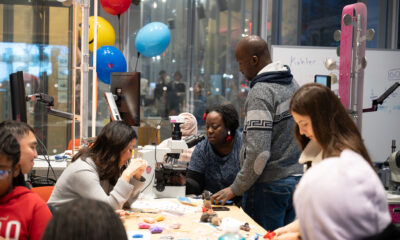



Photo Essay: Junior Scientists at Harlem BioBus celebrate a year of discovery

US based nonprofit Engineers & Scientists Acting Locally (ESAL) receives a $100k unrestricted gift to support its civic engagement work

Did You Know: Boston’s Museum of Science is opening a Public Science Common? Here are some questions to consider

Did You Know: A museum dedicated to the brain is being developed in Southern California?

Peer teaching as empowerment? Exploring NeuroBoricuas with Dr. Christian Bravo-Rivera

San Francisco Bay Area climate resilience group helps local communities talk about extreme heat

STEM Unbarred: What the initiative is learning about hands-on science for incarcerated youth
Peer teaching as empowerment? Exploring NeuroBoricuas with Dr. Christian Bravo-Rivera
Did You Know: A museum dedicated to the brain is being developed in Southern California?
Did You Know: Boston’s Museum of Science is opening a Public Science Common? Here are some questions to consider
Did You Know: Boston’s Museum of Science is opening a Public Science Common? Here are some questions to consider
Did You Know: A museum dedicated to the brain is being developed in Southern California?
STEM Unbarred: What the initiative is learning about hands-on science for incarcerated youth

Exploring workforce needs and intergenerational learning in informal STEM education

Making a Mini-Forest: participatory science afforestation across the globe
Contact
Menu
Designed with WordPress