
Civic Science Observer
A participatory science project during an eclipse studies how awe in nature fosters science identity and belonging
“One of the most exciting takeaways we can document here is that folks who participate in these participatory science or citizen science projects can benefit from it. They do feel awe, and that does increase their feelings of science identity and belonging to STEM.” — Kelly Lynn Mulvey

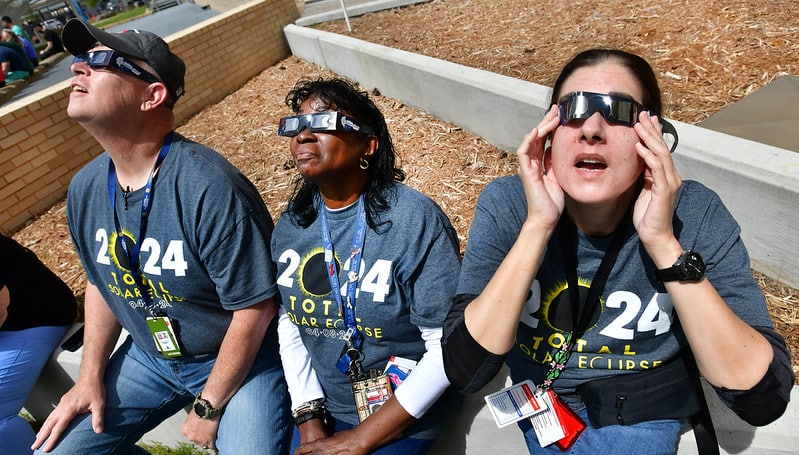
Look up the word “awe” in the Merriam-Webster dictionary, and you get this definition: “an emotion variously combining dread, veneration, and wonder that is inspired by overwhelming greatness (as in beauty, power, or size).”
Awe may be an appropriate word when describing the motivation behind scientific research. But what role does it play in shaping feelings about science, particularly when non-experts engage in scientific data collection? A team at North Carolina State University decided to find out.
Professors Kelly Lynn Mulvey, Caren Cooper, Adam Hartstone-Rose and their students set out to see whether awe could be documented among local publics who were trained as participatory scientists to collect data during the 2024 total solar eclipse in North America.
The research built on work Hartstone-Rose, a professor of biological sciences, published based on findings from the 2017 eclipse, in which his lab found changes in animal behavior during the eclipse.
As the 2024 eclipse neared, he and his collaborators wanted to expand this animal behavior research by engaging participatory scientists to gather data and evaluating how participating in this work made them feel.
That’s where Cooper, a professor of forestry and environmental resources, and Mulvey, a professor of developmental psychology, came in. Cooper is a renowned expert in participatory science, having explored how the generation of large-scale data can visualize the interactions between social and ecological systems, and Mulvey is an expert in social development with a particular focus on social factors that can help broaden participation in STEM.
For the eclipse study, Mulvey wanted to examine how the experience of awe, during an event such as an eclipse, could connect everyday people to science. While there has been some literature on this topic, “we wanted to expand on that,” Hartstone-Rose said.
“I am always interested in what kinds of impacts important scientific experiences have on folks,” Mulvey said. “We were interested in how awe serves as a mechanism that might drive changes in science identity and belonging.”
As a result, another element of the research initiative entailed capturing the impressions of participatory scientists as they collected data on animal behavior during the 2024 eclipse. These impressions would form the study that sought to explore the relationship between observing a total eclipse in nature, feeling awe, and reinforcing science identity and belonging.
To capture the sense of awe that citizen scientists experienced, Mulvey and her team used validated items from the Awe Experience Scale that the participatory scientists could respond to, such as “I had the sense of being connected to everything” and “I experienced something greater than myself.”
The findings of Mulvey and her team were detailed in the recently published paper, “Awe in nature fosters science identity and belonging in participatory scientists during an eclipse.”
“We weren’t asking people to reflect on whether they thought the animals’ behavior changed. We just asked them to do these recordings, and it turns out that when we calculated changes in behavior, these were significantly related to their measures of awe as well,” Hartstone-Rose said.
One of the findings that struck Mulvey and her team was that participants of all ages involved in the research effort, ranging from ages 8 to 80, experienced feelings of awe that were related to increases in science identity and belonging.
“One thing that I was really excited about and surprised by was that the findings were consistent, no matter how old you were,” Mulvey said. “It didn’t matter how old or young you were—you had a similar experience of feeling more connected to science after participating in this.”
She continued, “And that’s really exciting, because we’re always interested in how to engage children and adolescents in STEM activities, but I think we also need to recognize that older adults are also ready to participate in science, ready to learn about these things. The effects are the same, regardless of how old you are. I think it’s really cool.”
The research also enabled Mulvey and her team to document and model how the concept of awe is a driver in establishing a connection with and an identity in science.
“One of the most exciting takeaways we can document here is that folks who participate in these participatory science or citizen science projects can benefit from it. They do feel awe, and that does increase their feelings of science identity and belonging to STEM,” Mulvey said. “I think that’s an exciting finding, because we were able to document that in a very systematic way.”
Mulvey is continuing to study the concept of awe in her lab, including looking at awe in relation to artificial intelligence, quantum physics and quantum mechanics, and other exciting scientific phenomena, she said.
“It’d also be fascinating to look at cross-cultural differences. There are eclipses, total solar eclipses, happening across the globe in the upcoming years in some really, really exciting cultural locations, like Australia and New Zealand,” Mulvey said.
As Mulvey considered what takeaways other scientists can glean from the eclipse research, she mentioned two areas: measuring social-behavioral outcomes when conducting a participatory science project, “because we were able to document really exciting ways in which participating in this was associated with changes in science identity and with feelings of awe,” and partnering across interdisciplinary teams.
“We are faculty in three different colleges here, and we had students on board ranging from a student in a medical school to students who were data scientists—undergraduates, graduate students. I think large interdisciplinary teams can bring really exciting perspectives to these types of projects because you each have a different lens on what might be interesting.”
While this project was funded by NC State’s Data Science and AI Academy, it is challenging to find funding for this type of interdisciplinary work around rare phenomena, but “it’s also what makes it potentially really exciting, not just from the perspective of researchers, but from the perspective of the public,” Hartstone-Rose said.
Awe in nature fosters science identity and belonging in participatory scientists during an eclipse
This article is based on an open-access research article published in People and Nature by Kelly Lynn Mulvey, Ashley R. Deutsch, Caren Cooper, Rhianna Absher, Nhaturie Atkinson, Brandon Wilson, Jacqueline Cerda-Smith, Martha Batul, Lara L. Martens, and Adam Hartstone-Rose.
Read the study →What follow-on actions did the insights above spark for you?


Joanna Marsh is a freelance writer and journalist based in Washington, D.C. For The Civic Science Observer, she reports on new developments across the citizen science landscape, covering both new research and on-the-ground practice. Her work highlights how local communities are engaging with scientists to contribute to ongoing scientific research and lessons being learned by the involved stakeholders.




Did You Know: A museum dedicated to the brain is being developed in Southern California?

Peer teaching as empowerment? Exploring NeuroBoricuas with Dr. Christian Bravo-Rivera

STEM Unbarred: What the initiative is learning about hands-on science for incarcerated youth

San Francisco Bay Area climate resilience group helps local communities talk about extreme heat

Did You Know: Kirtland’s Warbler Festival in Michigan is engaging the local community in celebrating and conserving the once-endangered songbird through educational events

Questions, biology-based environmental stewardship, and accessibility are at the center of Bio4Climate’s annual conferences
Did You Know: Kirtland’s Warbler Festival in Michigan is engaging the local community in celebrating and conserving the once-endangered songbird through educational events
San Francisco Bay Area climate resilience group helps local communities talk about extreme heat
STEM Unbarred: What the initiative is learning about hands-on science for incarcerated youth
Peer teaching as empowerment? Exploring NeuroBoricuas with Dr. Christian Bravo-Rivera
Did You Know: A museum dedicated to the brain is being developed in Southern California?
STEM Unbarred: What the initiative is learning about hands-on science for incarcerated youth

Exploring workforce needs and intergenerational learning in informal STEM education

Making a Mini-Forest: participatory science afforestation across the globe

18 months later, Casey Lardner from Genspace says, “we’ve been really focused on building systems”
Contact
Menu
Designed with WordPress