
The Observer
Illinois State experiments with workshops to help STEM faculty explore the civic nature of their disciplines
“We know that our faculty want to do this work, and civic education literature also tells us that faculty want to do the work. There is just a learning curve and perhaps some other barriers that we, in our roles, can help ameliorate so that they can do this work that they want to do.” – Dr. Rachel Waring Sparks

At Illinois State University in central Illinois, an initiative is underway to help science faculty consider the civic implications of their research. While the initiative is still in its infancy, the directors behind the effort want to build a sustainable and supportive network among faculty and students promoting civic engagement. Ultimately, the goal is to help encourage faculty to discover how their research fields can have real-life applications for the local and regional community.
“Our hope is that these faculty and grad students will think about these community issues and public impact ideas and envision how their research can contribute to addressing these problems so that they’re still accomplishing research goals while making a really positive public impact,” said Dr. Rachel Waring Sparks, who has a Ph.D. in biology and serves as assistant director of assessment at the Center for Civic Engagement at Illinois State.
Waring Sparks and Dr. Ashley Lauren Sparks, who serves as interim director for the university’s Center for Math, Science and Technology, which is focused on K through 12 STEM education outreach and development, are seeking to develop guidelines for Illinois State faculty that will enable faculty not only to embrace the potential civic nature of their research but also to pursue ways to engage with community members.
“We really want scientists to recognize and be able to put into practice how their scientific skills and the work that they are doing in basic and applied research can benefit specific community organizations and benefit the public as a whole,” Waring Sparks said. “We believe really strongly that part of the purpose of science and of doing research is to create positive outcomes for society as a whole. So that conviction really drives a lot of the work that we do in this.”
The duo has been laying out the infrastructure for this effort for months now. The initiative kicked off last spring after the duo had received funding from Illinois State to develop a professional development series that looks at how STEM—science, technology, engineering and mathematics—can be cultivated for the public good.
One of the first efforts was when the two directors—Ashley Lauren Sparks, who also serves as interim director for the Office of Student Research and has a Ph.D. in biology—met with interested faculty four times on Zoom as part of the professional development series. They also organized a campus community partner lunch for STEM faculty and community members who might intersect well with the STEM faculty’s areas of expertise.
Faculty participating in the spring semester programming included those from the fields of biology, information technology, math, creative technologies, geography, geology and the environment, and kinesiology and recreation. Tenured and non-tenure-track faculty, as well as graduate students, were invited to participate.
The sessions ranged from learning what civically engaged STEM looks like in practice to integrating civic engagement in STEM courses and promoting engaged scholarship in STEM. Participants discussed topics such as defining reciprocity and mutual benefit, developing civic learning goals and defining how to communicate civically engaged work for both scholarly and layman audiences.
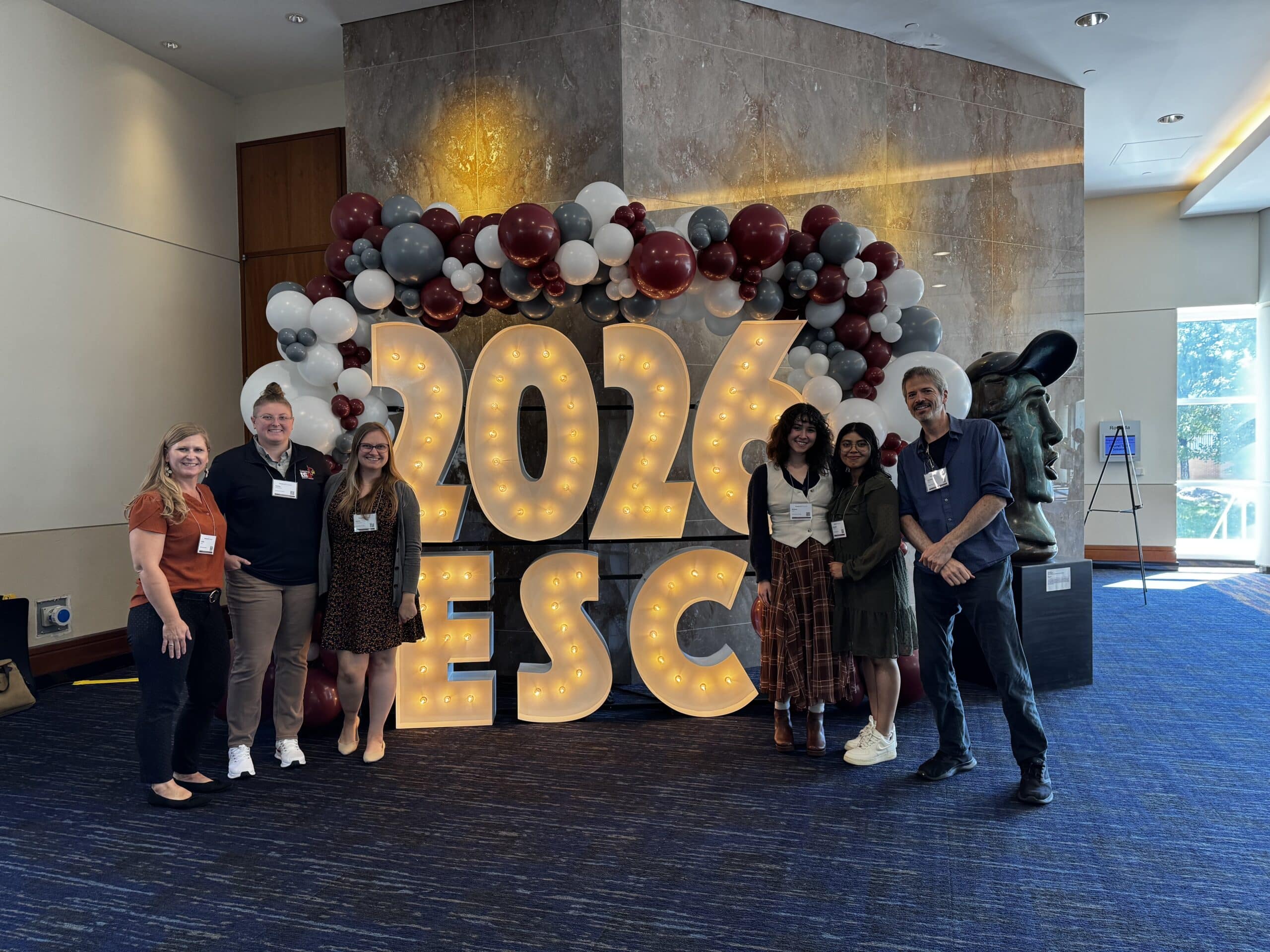
This fall semester, the duo recently attended the annual meeting of the Engagement Scholarship Consortium. Faculty members from kinesiology and recreation, creative technology, and information technology, as well as a graduate student in biology, also attended.
This was the first time that Illinois State attended the meeting with other universities that have been actively pursuing community engagement and scholarship, according to Ashley Lauren Sparks.
“We had a very diverse group of disciplines as part of that. The meeting provided a lot of opportunity to talk about what the overlaps are between things and how we could be working more interdisciplinarily between those different groups and also with the community,” she said.
Exploring what civic engagement might look like
Although funding for the professional development series has formally ended, the duo is keeping the momentum going. They are seeking to discover what works and what doesn’t in engaging with faculty.
Potential initiatives that may spring from this effort include an engaged scholarship series or a coalition-building framework in which faculty can champion this type of work and help create a community of practice, according to Waring Sparks.
According to a presentation made by the duo at October’s Engagement Scholarship Consortium, potential activities include developing learning communities where faculty and students can discuss literature, engage in peer mentoring and create interdisciplinary connections; cultivating networking opportunities between campus members and the broader community to explore partnerships and project ideas; and working with resources outside of Illinois State to expand participants’ perspectives and their scholarly networks.
“We’re focused on building capacity for faculty to do engaged scholarship with community partners, and then we are hoping that by faculty doing this engaged scholarship, they will then mentor undergraduate researchers in practices of community-engaged scholarship,” Waring Sparks said. The office helps build local and national connections by connecting faculty and community members in the Bloomington-Normal area and beyond, including Chicago and international partners.
They also hope to host a panel at Illinois State’s Center for Integrated Professional Development’s annual symposium in January to bring more people into the conversation. The panel will seek to invite attendees to participate in some shared visioning of what community-engaged scholarship could look like in their discipline, and it may also discuss the kind of support faculty would need from the institution to conduct community-engaged scholarship.
While citizen science may be the most logical option for some researchers when thinking about how their disciplines interact with the broader community, “we are really encouraging folks to partner directly with community organizations because those people are working so hard and have a limited number of resources to accomplish their goals,” Waring Sparks said. “And as a public state institution, especially a rural-serving institution, it’s really important to us that we contribute to our community directly through partnership with those organizations as well.”
For instance, one of the faculty participants who came to last semester’s workshops and also attended the recent consortium conference is working on a proposal to work with some elder care facilities in the area to investigate how information technology, sensors and other smart tech can be used to support people’s goals of aging in place, Waring Sparks said.
Some faculty have even taken steps towards civic engagement by submitting applications to the Engagement Scholarship Consortium’s annual grants program, which provides seed money to faculty members doing community-engaged scholarship.
“We know that our faculty want to do this work, and civic education literature also tells us that faculty want to do the work. There is just a learning curve and supports that are needed, and perhaps some other barriers that we, in our roles, can help ameliorate so that they can do this work that they want to do,” Waring Sparks said.
She continued: “We’ve seen, in our time as researchers and in the STEM disciplines, that sometimes you can get so locked in on a topic and on a research agenda that the public impact falls to the wayside. That has also driven our interest in really bringing that public impact front and center: helping faculty and graduate students, and then undergraduate students as faculty and grad students mentor them, think about the public impact at the beginning of their research agenda, so that when they’re designing projects, they’re thinking about how this project is going to benefit society or how I can work with a community partner to put my STEM skills into practice and achieve my research goals while also providing mutual benefit for a community organization.”
What follow-on actions did the insights above spark for you?


Joanna Marsh is a freelance writer and journalist based in Washington, D.C. For The Civic Science Observer, she reports on new developments across the citizen science landscape, covering both new research and on-the-ground practice. Her work highlights how local communities are engaging with scientists to contribute to ongoing scientific research and lessons being learned by the involved stakeholders.




Illinois State experiments with workshops to help STEM faculty explore the civic nature of their disciplines

Did You Know: Rice University has launched a new center for science communication called SCOPE?

How Canadian early-career researchers organized to improve funding for future scientists

Photo Essay: Junior Scientists at Harlem BioBus celebrate a year of discovery

US-based nonprofit Engineers & Scientists Acting Locally (ESAL) receives a $100k unrestricted gift to support its civic engagement work

Did You Know: A museum dedicated to the brain is being developed in Southern California?

Did You Know: Boston’s Museum of Science is opening a Public Science Common? Here are some questions to consider
US-based nonprofit Engineers & Scientists Acting Locally (ESAL) receives a $100k unrestricted gift to support its civic engagement work
How Canadian early-career researchers organized to improve funding for future scientists
Photo Essay: Junior Scientists at Harlem BioBus celebrate a year of discovery
Did You Know: Boston’s Museum of Science is opening a Public Science Common? Here are some questions to consider
Did You Know: A museum dedicated to the brain is being developed in Southern California?

STEM Unbarred: What the initiative is learning about hands-on science for incarcerated youth

Exploring workforce needs and intergenerational learning in informal STEM education

Making a Mini-Forest: participatory science afforestation across the globe
Contact
Menu
Designed with WordPress