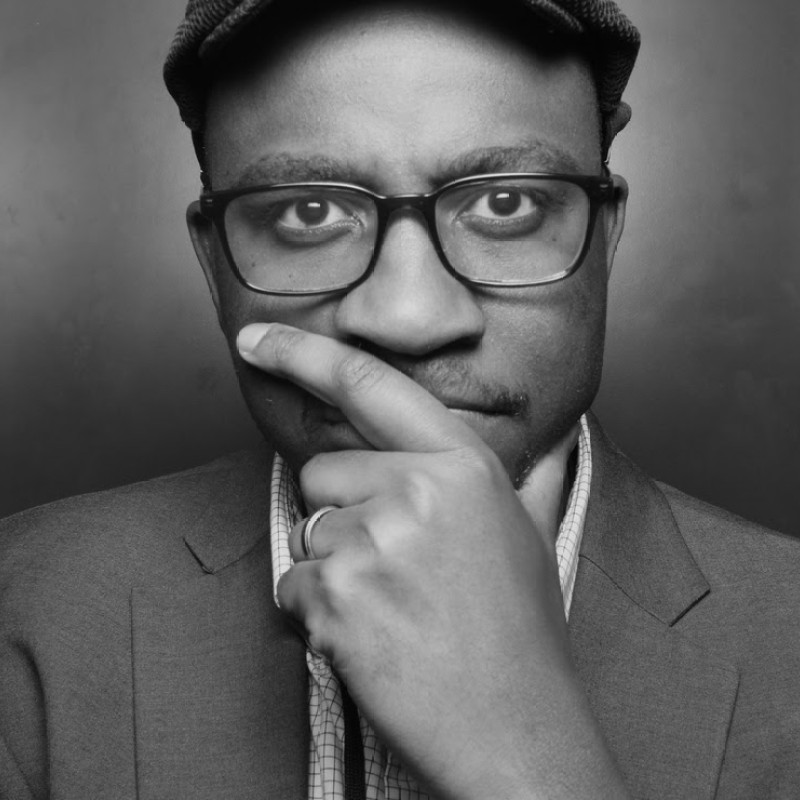
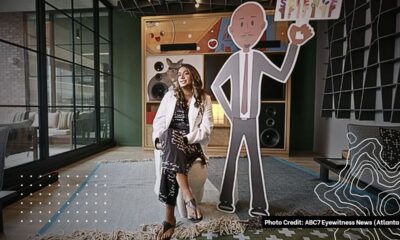
Fanuel Muindi
Sarah, let’s start at the beginning. How did the Observer project come about, and what led your team to focus on the act of observation?
Sarah Goodwin
It came about in a variety of ways. First of all, the filmmaker and director, Ian Cheney, who we’d worked with previously, had always wanted to make a film about observation, so he’d had this idea in his head for a while. Then, toward the end of the pandemic, around 2022, we had an opportunity.
We had just finished a feature-length film, Human Nature, which you mentioned before, about CRISPR and gene editing. That project was partially funded by the Gordon and Betty Moore Foundation. We had a conversation with program officers there about the distrust in science and the challenges facing science communication during the pandemic, which were really in full force. We started wondering: Is there a way to give people more insight into science and scientists? Is there a way to study how people make connections with science and scientists?
This full project, which I’ll describe in a second, was really born out of that conversation. You can make a film about vaccines. You can make a film about climate change. But what if we go back to observation, which is something everyone can relate to? Everyone can observe. They can observe in their backyard, as you see with Dallas Hudson, who observes in his backyard. It’s a fundamental way that humans understand their environment, but it’s also a foundational aspect of science.
So we decided to propose a film about observation as an entry point into science, and about seeing scientists as humans, how they think, and how they collaborate. They’re not always in their labs. They’re out questioning unfamiliar spaces.
From the beginning, a major part of the project was a research study. The goal was to understand three things. Whether people trust scientists, whether they feel their values align with them, and whether they can identify with scientists as people. We also wanted to know how a film can spark deeper engagement and broaden people’s ideas of what science can be and who can do it.
I’m happy to say that we have a peer-reviewed publication from the study that will be coming out soon in Science Communication, Open Access. We also completed a full film report, which is available on our website. We just haven’t really shared it out yet, but I can share the links with people who attended.
The last thing I’ll say is that we had a big engagement campaign built into the project this past year, because we really feel that film is a way to bring people together and be in dialogue with each other. Especially if you’re doing it in person in local communities, but also virtually, it can be a community builder.
We did a series of engagement events that were also studied as part of the research. I actually have some props here. We had red squares, and we developed observation activities that people could do with or without tools. We even developed an observation kit.
That was interesting and successful in different ways, but one unexpected outcome was that educators were really drawn to the film as a way to teach their students about observation and to allow them to be their own scientists, observing the world around them. And that’s been very rewarding.
Fanuel Muindi
Love that. Unexpected outcomes.
One thing that really struck me was that you had so many different types of observers in this film—astrobiologists, a birder, an artist, a herpetologist, a phenologist, an ornithologist, and of course the filmmakers themselves, right? The point of view of the filmmaker doing this really foundational thing of observing.
So, unexpected outcomes. Tell us more about that. What else did you see, and what have you learned in this process?
Sarah Goodwin
Yeah, one of the big findings was that people connected with the observers through relational, human qualities like curiosity, authenticity, attentiveness, and the way someone communicates, rather than through credentials or demographics. That’s actually the central finding of our paper. It was things like, “Oh, I share their curiosity,” or, “This person has so much care for their environment, and I relate to that.” The connection with scientists is built on common ground.
A lot of people related to the poet because of the way she thought about community and observation and being in a place. People also related to the Indigenous knowledge holders in the film who shared their own ways of understanding place. And so that was really interesting.
When we set out to do the film, we spent a lot of time during pre-production thinking through these questions. How many observers should we include? Scientists versus other ways of observing? How do we put them together? How do we make sure they’re together in the same film and valued equally? How much time and space do we give everyone? Who are they encountering?
We really wanted to elevate local knowledge and allow different ways of seeing to feel distinct, because everyone brings their own lens to things. All of that emerged as we were developing the film and the characters.
But I think what has been most fascinating is seeing how people relate to one another and find common ground. And that was a big part of what we have published in the film study and in the research paper that will be appearing in Science Communication.
Fanuel Muindi
Yeah, so you talk about educators using the film in their classrooms. I imagine that’s something you’re tracking pretty closely as well, right? Beyond educators, what else have you seen? How are other people using and engaging with the film?
Sarah Goodwin
Yeah, I think what has been really exciting is that you never know how a film is going to be received. And this is, as you said, a very meditative film. It’s very different from a lot of the content that’s out there, which is kind of snappy and constantly trying to keep your attention.
What has felt really good is that people have valued the opportunity to just sit in that meditative space. They can make their own observations through the film. It’s very artistic.
I actually wear a Garmin, and I remember doing a screening of the film. My heart rate was up beforehand, and then during the film I was sitting there watching it, and my heart rate dropped so much that my watch thought I was taking a nap because I was so relaxed. We don’t often get the chance to just be in that space, and people really valued that.
It’s funny. The film ends, and people want to throw their phones out the window and go sit in their backyard or go spend time in nature. I think that’s been really rewarding in an age where every conversation seems to be about technology and how technology is going to affect our lives. It’s like, no, we can be human. We can be in the world, observe it, learn something from it, and share that with other people. That’s a good thing. In many ways, that’s what humanity is all about. And so that’s been really nice.
The one other thing I’ll say is that the first chapter has really resonated with people because of the science. You have two scientists seeing completely different things through the square. One of the activities we do asks, “What does a friend see?” People go out and notice different things.
People have described that activity as a way to create empathy. Everyone comes to something with their own background, thoughts, and values. Can you come together and share those differences by looking through the square with different lenses?
That’s something teachers have really appreciated because it’s valuable for their students. But we’ve found that adults really enjoy that aspect of it as well.
Fanuel Muindi
Yeah, which I think is another interesting piece here—bringing people together from different points of view to observe something and have a conversation around it. You mentioned that there’s a publication coming out. Do you have plans to continue tracking the kinds of follow-on actions that emerge from the film?
Sarah Goodwin
Yeah, absolutely, and we already see those actions in the data. Most viewers named something the film made them want to do, and more often than not it was to change how they observe the world: to slow down, pay closer attention, use more of their senses. One thing I find especially meaningful is that the people who came in least connected to science were the most likely to shift how they think about science and scientists. That’s exactly who we hoped to reach. The formal study is done, though we still have data we haven’t fully analyzed, and we’d love to keep that work going while also exploring other ways to get the film out into the world.
The Gordon and Betty Moore Foundation funded the film, the distribution, and the research, which was amazing. And now we’re asking, what are the next steps for the film?
We are talking to the Jane Goodall Institute about a collaboration. They’re interested in using the film and the observation activities in their programs. We’ve also been talking with other partners because, as you saw, the film is chapterized.
I should mention that in classrooms, teachers are often picking one or two chapters to show. And I think that’s one of the beauties of the film. It works well as a complete film and has a lot of value in that format, but you can also pull out individual chapters depending on your goals. It’s very adaptable to different settings, and we’ve really encouraged that.
And I should mention that the film is available for free to educators through our website, and we’ve helped facilitate that process for people who want to use it in their classrooms.
So hopefully that kind of work will continue, and new things will emerge from the different connections we’ve made. We’ll see.
Fanuel Muindi
Are there plans to make the film publicly available?
Sarah Goodwin
Yeah, there are plans to make it so. It’s very challenging, actually, to get films up on these different distribution platforms. So we’ve just started that process where you could rent it or buy it.
Especially for educational purposes, we’ve tried to facilitate that being available. So if there are any educators who want to use it, we help facilitate that. Hopefully it’ll become more widely available very, very soon.
Fanuel Muindi
Yeah, and you mentioned one of the challenges—you alluded to the amount of data that you still have to analyze. Can you give us an example of that?
Sarah Goodwin
Yeah, we collected data in two ways.
The first was through full-film screenings. People watched the whole film and we surveyed them afterward, and there was also a survey for people who used the observation kits. Those came from a set of screening sites around the country. We also held five daylong events where people gathered locally, watched the film, did observation activities, and engaged in dialogue, and we studied those more deeply from a community-building angle. The film itself, of course, screened far more widely than the research sites.
One challenge was that the day-long events were invitation-only. We tried to bring together a diverse group of participants, but they were relatively small, usually around 20 people. And the screenings attracted whoever decided to come see a science and nature film, so there was some audience self-selection.
To address that, we ran a national survey through a survey company, which gave us a much more demographically diverse group. You can’t really ask people to watch a whole 90-minute documentary, so we assigned each person an individual chapter at random, and everyone answered the same questions about trust, value alignment, and identification with the characters. That turned out to be really valuable.
What made the analysis so complicated was that we used both closed-ended and open-ended questions. We might ask, “Do you trust someone in the film?” and people would answer yes or no. But then we’d ask why, and that’s where you get this really rich qualitative data in people’s own words about why they trusted someone, felt aligned with them, or identified with that particular chapter.
Because we had so many responses, we ended up doing an in-depth analysis of four chapters, and we were very deliberate about which four we selected. But we still haven’t completed the qualitative analysis for the other four chapters.
I’m curious whether additional themes will emerge, because each chapter is so different. The ways people connected varied enormously, but the underlying pattern, connection through shared, human qualities, held remarkably steady across chapters, which has been really interesting to see.
Overall, it was a very large research project, and at some point you have to choose a direction and analyze what you can with the resources you have.
Fanuel Muindi
Please share some more of the challenges.
Sarah Goodwin
Yeah, it was tough. There were two chapters that didn’t make it into the final film, and there was a lot of experimentation with the order and even the emphasis of different sections. Sometimes we’d watch an edit and say, “Yes, you nailed it.” Other times we’d say, “No, not quite. Can we push this a little further to bring out these themes?”
For example, the Atacama section and the more in-depth astrobiology themes were edited almost until the end of the process because we felt like we needed a better understanding of who these people were as scientists. We had a good sense of who they were as people, but we wanted to understand more about how they thought as scientists.
So there was a lot that was tweaked along the way, and it was tough.
Ian came up with the idea of using the red square as a motif throughout the film because you have all of these very different scenes, and you need some kind of through line. The idea of returning to Maine, where he lives, as a kind of home base was also important.
And then there was his voice. Originally, there wasn’t any narration. The film simply moved from chapter to chapter, and it just wasn’t working. We realized that we needed a voice to carry viewers from one chapter to the next, and so that was added.
And he’s wonderful. Ian is this really fantastic writer. He has a Substack and is very philosophical and funny, and I think you’re seeing his true personality come through in the way he speaks in the film. I think that’s great because it’s very relatable.
Fanuel Muindi
I mean, there’s just so much in this film to dissect. One line that even appears in the trailer is Manu Prakash saying, “There’s a universe everywhere you turn.” And sometimes people might miss this, but the Foldscope paper microscope he uses—that’s a whole thing people should look into.
So my question to you is, thinking about the other science communicators that are out there, and because the film is broken down into standalone chapters so that people can use different pieces of it, what opportunities do you see for stakeholders? You mentioned educators using it in the classroom, but what about science communicators? What about scholars of science communication?
Sarah Goodwin
I think that, for this specific project, we’re very open to collaboration. So if anyone has ideas for the film, activities, or potential partners, definitely let me know, because we’re really interested in exploring those opportunities.
More generally, the clearest, most consistent takeaway across all our studies is this: when scientists show their humanity, their excitement, their failures, the uncertainty, people relate to them. What it really comes down to is helping people form a relationship with scientists, and our research shows that happens in distinct ways. People come to trust scientists, identify with them, and feel their values align. Foregrounding scientists’ human, relational side is what makes all three possible, and that can happen in so many different ways, as we’ve been learning through the Observer Project and our other work.
One thing we’ve learned is that you have to be authentic and bring yourself to what you’re sharing. I’m a former scientist, as you mentioned, and we’re never really taught to talk about our science that way. We’re taught to be clear and avoid jargon, but we’re not taught to say, “This was the best day of my life in the lab, and here’s why.” Or, “I worked so hard, and then I had this incredible moment in the microscopy room when I saw something that supported my hypothesis.”
You just don’t talk that way.
And it’s not about saying, “Hey, I run, so you should relate to me because I’m a runner.” It’s more about asking: What is it about science that you’re excited and passionate about? How did you get there? How do you think about science?
Science is full of uncertainty, failure, collaboration, and conversations, and I think bringing more of that into how we communicate is really important.
What we’ve consistently found is that when you do that, people genuinely relate to scientists, whether that’s through scientists speaking directly themselves or through the ways they’re portrayed in media.
And that’s really the big message I take away from all of the studies we’ve done.
Fanuel Muindi
Yeah, I mean, as we’ve mentioned, there’s so much more we could talk about, and we’re suddenly almost out of time. So thinking about the future, Sarah, what’s in store next? Are there any projects you’re willing to share or give us a hint about?
Sarah Goodwin
Well, we have a few short films coming out, and I’m really excited about them. We’re still rolling out a series of short films that came out of an NSF grant that ended a few months ago.
We released one called Life Recombined a few months ago. It’s about recombinant DNA and was built from interviews we conducted for Human Nature that ultimately didn’t make it into the film. It’s a really nice story about science and society, and about how a scientific advance prompted scientists to pause, talk with one another, and engage with society.
All of our short films are freely available on our website and on our YouTube channel.
We also have another film coming out soon about controls and experimental design, featuring former NIH scientist Dr. Kevin Hall, who studies ultra-processed foods. It explores how he conducts his nutrition studies, which are really difficult to do, and gets at the process and nature of science.
Then we have another film coming out in the fall featuring Bonnie Bassler, a faculty member at Princeton who studies quorum sensing. If there’s a film that really captures enthusiasm, passion, and the human side of science, I think hers does that beautifully.
We’re really excited about those projects.
Beyond that, our work with educators has been incredibly fulfilling. Science education, especially in K–12 settings, faces a lot of challenges right now. There’s tremendous emphasis on math and reading, and many school districts across the country are dealing with budget pressures, so science often gets pushed to the back burner.
Because of that, we’ve been doing a lot of work with educators around different ways to teach science and how to help students see themselves as scientists and feel like they can do science. That’s been really rewarding, because you’re reaching them when they’re young and helping them imagine themselves not only as scientists, but also as people who can engage with science.
A lot of our work recently has been focused on that.
Fanuel Muindi
Yeah, what gets me excited, even when I think about this film, is that in my lab we observe the ways in which practitioners like yourself engage with diverse publics. For me, it’s that pure joy of sitting there, like Manu Prakash, with his portable microscope, looking through it and seeing action in real time and change happening in real time. It just gives me so much joy.
Sarah, we are sadly out of time. Thank you for joining us for this screening and for sharing your insights. It has been wonderful.
Sarah Goodwin
Thank you for having me!