
CSML Newsroom
Did you know? Students are using community science to track invasive hemlock pests and guide forest conservation in the northeastern U.S.

Did you know that students are at the forefront of protecting forests on the East Coast from an invasive species?
The hemlock woolly adelgid is a small insect native to Japan. According to the United States Forest Service, this pest was first introduced in the eastern United States back in 1951. Since its initial, unintentional introduction, the hemlock woolly adelgid has wreaked havoc on the North American hemlock tree population, but it has yet to be found in northern Maine.
I spoke with Maggie Harvey, a senior program manager at the Gulf of Maine Research Institute, about the Hemlock Woolly Adelgid Project. It’s one of the many community science research projects that the institute currently supports in this unique, biodiverse region.
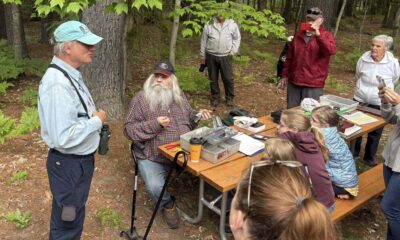
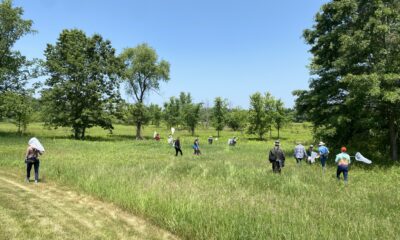
Each year, around 35 to 40 communities stretching from Massachusetts all the way up to Maine and even Nova Scotia, Canada, participate in collaborative research projects as part of the Ecosystem Investigation Network. Maggie told me this includes between 5,000 and 7,000 classroom students.
These projects are designed for community members, including educators and their students, to participate in hands-on, shared research that investigates how climate change is affecting their local ecosystems.
As part of the Hemlock Woolly Adelgid Project, students monitor changes in tree health over time and document signs of woolly adelgids on hemlock trees in their local environments. This data is collected in a publicly accessible database that helps track the spread of this invasive species over time.
So, it’s actually pretty easy to figure out which trees have woolly adelgids on them. According to the Maine Forest Service, the adelgid produces a white, woolly substance around its eggs, and you can typically find them on the underside of hemlock needles. Now, if a hemlock tree is infested, its needles will turn a grayish-green color and become very dry before eventually falling to the ground.
While it’s difficult to see forests suffering from the spread of this invasive pest, Maggie told me that the Gulf of Maine Research Institute tries to focus on actions that are hopeful and positive and that bring people together, even in the face of these rapid changes.
According to Maggie, the data collected by these community scientists has shown that there is a strong link between temperature changes and the spread of the adelgid. During cold snaps, adelgid populations decrease. But as temperatures rise and winters become more moderate in the Gulf of Maine, adelgid populations are surging and continuing to spread further and further along the East Coast.
The data collected by students participating in the Hemlock Woolly Adelgid Project is currently being used to inform decision-making about forest maintenance and stewardship as communities work together to prevent the spread of this invasive species.
And Maggie says that the community science element is vital to this effort. She told me that one of the reasons is that no one observes, notices, or is prepared to document change in a community quite like somebody who lives and works there.
So, when it comes to long-term research into the impacts of climate change on local environments, she says having people who are invested in that place and who know it well is critical to documenting the changes we’re seeing in our communities and ecosystems.
To learn more about the Ecosystem Investigation Network and the other community science projects being spearheaded by the Gulf of Maine Research Institute, you can visit investigate.gmri.org.
And if you’re an educator who’s interested in getting your classroom students involved, you can find the Gulf of Maine Research Institute’s science learning resources at teach.gmri.org, or you can talk to Maggie herself by emailing m.harvey@gmri.org.
Thanks for tuning in, and I’ll see you next time on Did You Know.
What follow-on actions did the insights above spark for you?


I am a producer for a science radio show and podcast, with over three years of experience in audio production and science journalism. I have a background in biochemistry, journalism, and science communication.




Did You Know: A museum dedicated to the brain is being developed in Southern California?

Peer teaching as empowerment? Exploring NeuroBoricuas with Dr. Christian Bravo-Rivera

STEM Unbarred: What the initiative is learning about hands-on science for incarcerated youth

San Francisco Bay Area climate resilience group helps local communities talk about extreme heat

Did You Know: Kirtland’s Warbler Festival in Michigan is engaging the local community in celebrating and conserving the once-endangered songbird through educational events

Questions, biology-based environmental stewardship, and accessibility are at the center of Bio4Climate’s annual conferences
Did You Know: Kirtland’s Warbler Festival in Michigan is engaging the local community in celebrating and conserving the once-endangered songbird through educational events
San Francisco Bay Area climate resilience group helps local communities talk about extreme heat
STEM Unbarred: What the initiative is learning about hands-on science for incarcerated youth
Peer teaching as empowerment? Exploring NeuroBoricuas with Dr. Christian Bravo-Rivera
Did You Know: A museum dedicated to the brain is being developed in Southern California?
STEM Unbarred: What the initiative is learning about hands-on science for incarcerated youth

Exploring workforce needs and intergenerational learning in informal STEM education

Making a Mini-Forest: participatory science afforestation across the globe

18 months later, Casey Lardner from Genspace says, “we’ve been really focused on building systems”
Contact
Menu
Designed with WordPress