
Civic Science Observer
In South Boston, three organizations team up to cultivate a sunny new green space for neighbors and pollinators alike
Last year, Boston launched a first-of-its-kind city Sunflower Beautification Grant to address the question: how can cities create and maintain green spaces for the benefit and consumption of a wide range of urban dwellers?
Through grants of up to $10,000, the city is supporting work “designed to support highly-visible, sustainable, community-led projects that enhance public spaces through the planting of sunflowers and other beautification efforts.” The grant program emphasizes environmental stewardship and building welcoming outdoor spaces.
A spokesperson for Boston Parks and Recreation described the program as “creating colorful public spaces while raising awareness about the importance of pollinators and urban greening.”
One of the funded experiments in South Boston, or “Southie,” involves three organizations that teamed up to design, implement, and maintain an installation. The collaborators, Urban Bee Lab (UBL), Recover Green Roofs (RGR) and Love and Mercy Salon, completed the plantings and installation in May.
The team is one of four recipients of the Sunflower Beautification Grant from 2025. The city covers each sunflower installation until the fall, with an option for renewal in FY 2026 before being transferred in-house for 2027.
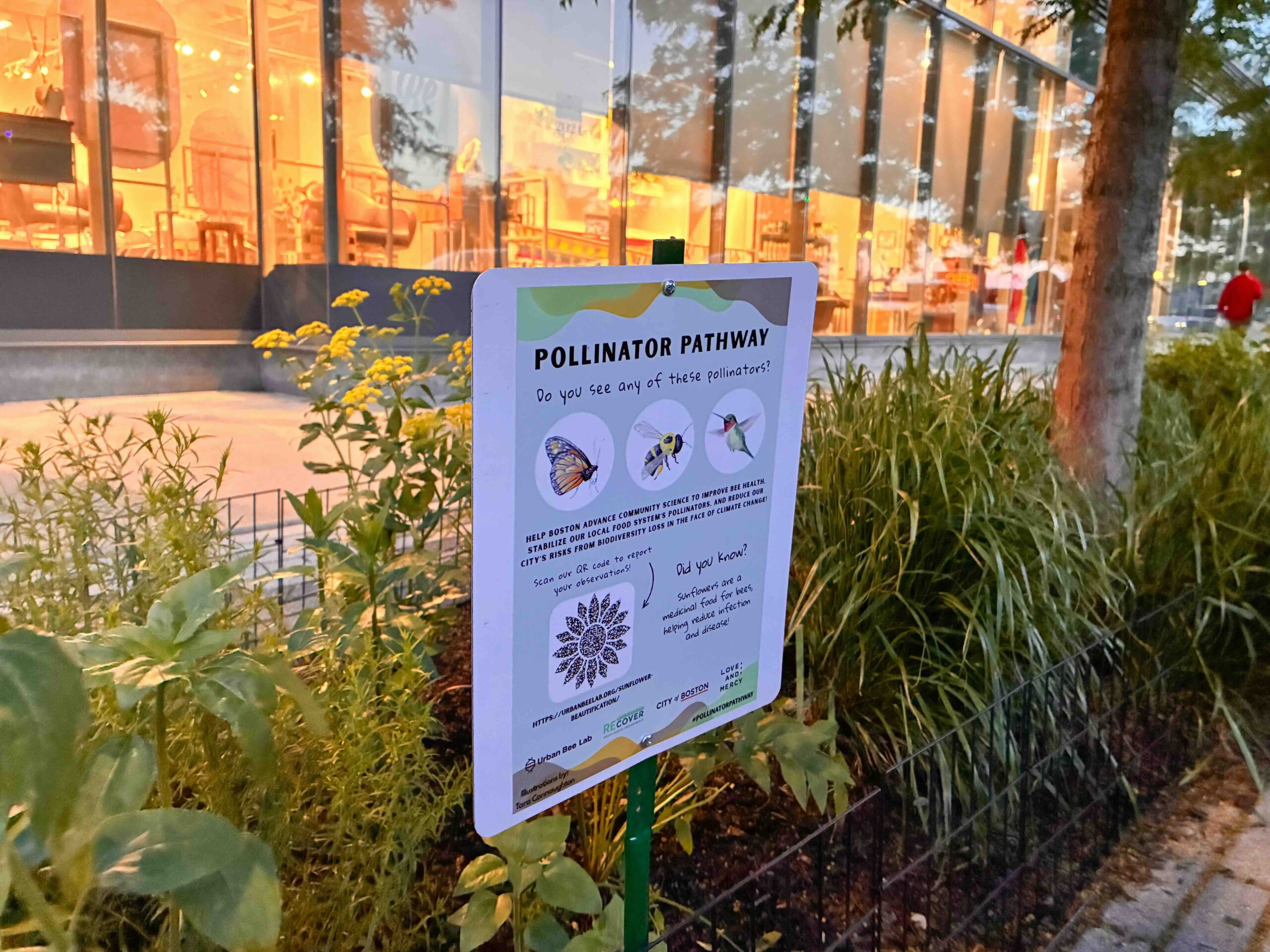
Adorned with signage designed by UBL and a strategic selection of plants chosen by RGR surrounding the sunflower, the project aims to encourage native pollinator survival by establishing a pollinator pathway site.
RGR, a landscape company specializing in ecological design and rooftop green space, chose plants “designed to maximize the ecological benefits while balancing ease of maintenance,” and included “the native cover crops alongside sunflowers as companion plants to improve pollinator health, reduce water use, and lower costs,” according to Katina Bentley, the RGR director of marketing. This included Asclepias incarnata, Monarda fistulosa, and Zizia aurea.
The collaborators also designed the site with community participation in mind.
Next to the vegetation is a sign with a QR code in the shape of a sunflower directing visitors to an observation form, alongside a custom webpage with additional information on the installation.
“We wanted a QR code that would be really attractive, so we made it in the shape of a sunflower,” said Christina Tougias, the program manager for UBL, a non-profit seeking to advance global biodiversity through pollinator advocacy, community collaborations, and research in urban areas.
The form asks visitors to specify which pollinators they observed and for how long, describe the weather and provide optional photos. The sunflower hasn’t sprouted quite yet, but is on its way.
The signage and QR code provide critical data to address the project’s major aims by providing a metric for community traffic and engagement, while determining pollinator visitation. Neighborhood engagement was a central consideration in the project.
“With [the signage], we wanted people to go to our webpage, be able to see the form, our website, [and] our webpage dedicated to the project, and [to] just to be able to contribute as much data as possible, to make it as fun and exciting as possible for people,” said Tougias.
UBL hopes to use pollinator observation data for future publications, with an emphasis on accessibility and collaboration among community science projects and initiatives.
“The Great Sunflower Project is really, you know, inspiring,” Tougias explained, in reference to a nationwide citizen science project encouraging the public to visit green spaces and record pollinator observations. “[It’s] in part, what led us to kind of think, oh, like, we could contribute any data that we get to their community science initiative as well. And so, making sure that this data isn’t just staying, isolated in different groups, and making sure that it’s as accessible in public as possible.”
QR code scans, webpage traffic and form responses will all help provide evidence of the project’s success to assess whether the approach is working. As a preliminary installation, measuring pollinator recruitment and community engagement serve as encouragement for establishing future sites.
The team had hoped to have two host sites but settled on successfully executing one for now. Expanding to other Boston neighborhoods, however, may be in their future, depending on funding.
For now, the team is focused on gathering data and understanding what lessons might inform future sites.
They strategically located this site in front of Love and Mercy Salon, a client of RGR. The salon sits on D Street in Boston’s “Southie,” across from the Thomas M. Menino Convention & Exhibition Center. The team determined the location based on foot traffic and limited proximity to green space.
“That area tends to have a lot of residential people. It also has a fair amount of young families,” said Bentley. “I think it’s fun to walk in that neighborhood and be like, oh, like, what is going on here?”
RGR is responsible for upkeep and maintenance. They visit the site weekly and added a small fence to protect the soil from pets and passersby (which was not originally in the grant proposal).
Love and Mercy Salon’s flowerbed may be the first of many. The team dreams of a pollinator pathway walking tour throughout Boston’s neighborhoods, community science lectures and gatherings, distributing bee hotel kits and even expanding to other cities.
The other Sunflower Beautification Project grant recipients include Urban Farming Institute of Boston, Digital Ready Inc., and Mission Hill Neighborhood Housing Services.
“Interested community members, everyone, should be able to access this information and just… feel like they can contribute, you know, to the science happening around them,” Tougias said.
Science is everywhere, in a college town like Boston.
The team is hosting a ribbon-cutting event on July 16, where community members and neighbors are invited to witness the plants in full bloom.
“Everyone is so excited to see what this project leads to,” Tougias reflected. “I think because this project [is] tied to community science, a grant from the City of Boston, non-profit work, and then, you know, neighborhood importance, I think everyone finds it to be very fulfilling… it’s been a really, really great collaboration.”
 +
Add CSML on Google
+
Add CSML on Google

Sofia Baah is a master’s student in the School of Journalism at Northeastern University’s College of Arts, Media and Design (CAMD) and a Marketing, Communications, and Events Coordinator in the Bioengineering Department at Northeastern University. She is passionate about accessible science and sustainability, with interests in science writing, science education, conservation, nonprofit work, and the biological sciences.



In South Boston, three organizations team up to cultivate a sunny new green space for neighbors and pollinators alike

Lessons learned from OBSERVER: A post-screening conversation with Sarah Goodwin

A participatory science project during an eclipse studies how awe in nature fosters science identity and belonging

Meaghan McKasy on using humor to spark conversations on tough scientific issues

Engineering stories for community impact: Lessons from a mission-driven filmmaker, Greg Hemmings

12 companies invest $180k to keep Letters to a Pre-Scientist free for students

SciArt behind the scenes: The hows, whys, and whats of the science artists — a research digest
Meaghan McKasy on using humor to spark conversations on tough scientific issues
Engineering stories for community impact: Lessons from a mission-driven filmmaker, Greg Hemmings
A participatory science project during an eclipse studies how awe in nature fosters science identity and belonging
Lessons learned from OBSERVER: A post-screening conversation with Sarah Goodwin

What it takes to include Deaf voices in scientific research

Risa Schnebly’s journey to researching ecological grief and telling its stories

“Science is something that we do together.” Benjamin Richards on how OceanEyes collaborates with citizen scientists to monitor deepwater fish in Hawai’i

Melanie Brown: “If you listen, people want to share things that are important to them.”
Contact
Menu
Designed with WordPress