
Civic Science Observer
12 companies invest $180k to keep Letters to a Pre-Scientist free for students


The founding chief executive officer of Letters to a Pre-Scientist (LPS), Lucy Madden, recently shared on Linkedin that 12 companies put $180k behind the program this school year, more than doubling support from the prior school year. Madden added that about 75–100% of their corporate partners return each year, stating that this “has become a powerful, predictable growth engine for our work.”
In the comments section, Double the Donation described that level of retention as “legendary,” noting that most nonprofits struggle with the “one-and-done” sponsorship trap. So how has LPS achieved this level of renewal?
Madden points to part of the answer. “I didn’t start LPS thinking about corporate partnerships… I am motivated by creating something awesome for the students. But if you want your mission to actually happen, sustainable revenue matters – a lot,” she wrote.
What differentiates these partnerships is that they go beyond funding. Employees from firms like Bristol Myers Squibb, Amgen Foundation, Certara, Wildlands Engineering, The Whiting-Turner Contracting Company, and MRIGlobal also participate directly as pen pals. That dual role turns corporate support into both capital and labor, embedding the program into employee engagement strategies rather than treating it as philanthropy alone. In a March 2026 LPS newsletter update, Madden noted that the program is growing from 2,500 students to 4,500, making these partnerships operationally strategic.
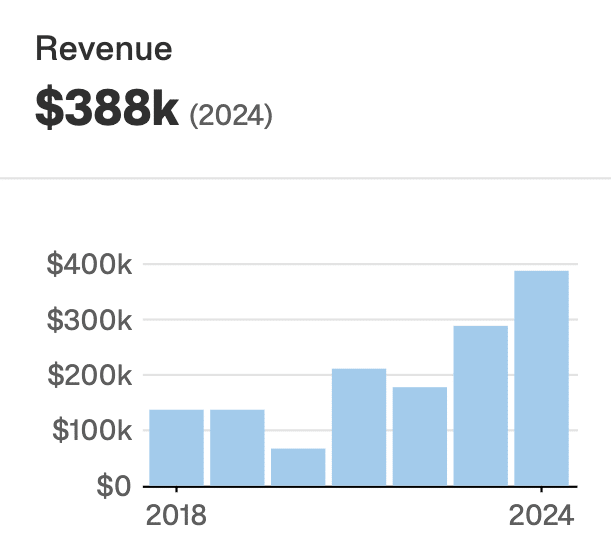
So how does this show up in the financials? Public IRS Form 990 records show that revenue at LPS (CSFINDEX: PRES) grew 62.4% from $177,736 in 2022 to $288,539 in 2023, then grew another 34.4% to $387,864 in 2024. Contributions accounted for more than 95% of total revenue in each of those years. The filings do not break out corporate partnerships, grants, individual giving, or other contribution categories.
BioBus (CSFINDEX: BIOB) offers a useful comparison. It also began as a relatively small science engagement non-profit organization, with revenue in the low six figures in its early IRS filings: $170k in 2010, $191k in 2011, $260k in 2012, and $170k in 2013. By 2014, revenue had climbed to $511k. Today, BioBus (in its 2024 IRS filing) reported $5.5 million in annual revenue. But the mix matters: even in 2024, contributions (breakdown not publicly available) still accounted for about 89% of BioBus revenue while program services made up almost 11%.
In a 2025 Questions of the Day interview, Ben Dubin-Thaler from BioBus described how that revenue model evolved over time. Early on, BioBus operated with “very little actual money equity,” he said, relying heavily on in-kind donations and volunteer labor, before generating its first earned revenue—$2,500 from a school partnership. Today, the organization’s funding mix is more distributed, he said, with the majority coming from private foundations, alongside roughly 20% from government sources, 10–15% from individual donors, and another 10–15% from earned revenue.
Zooming out, the broader question is how science engagement organizations such as LPS and BioBus can diversify their revenue sources to better weather inevitable economic downturns. LPS’s growing portfolio of corporate partnerships provides a useful case study in one approach to addressing that challenge.
That leads to another important question: What more can grant funders do to help those they fund build sustainable revenue models to enable the organizations to address community needs for the long haul? The Sandbox Fellowship from the Simons Foundation is doing just that by “equipping fellows with tools to refine strategy, reinforce financial sustainability and embed equity throughout their work.” Madden was part of the inaugural cohort of the Sandbox Fellowship in 2024.
The LPS growth story is still in its early days.
 +
Add CSML on Google
+
Add CSML on Google

Fanuel Muindi is a former neuroscientist turned civic science ethnographer. He is a professor of the practice in the Department of Communication Studies within the College of Arts, Media, and Design at Northeastern University, where he leads the Civic Science Media Lab. Dr. Muindi received his Bachelor’s degree in Biology and PhD in Organismal Biology from Morehouse College and Stanford University, respectively. He completed his postdoctoral training at MIT.






12 companies invest $180k to keep Letters to a Pre-Scientist free for students

SciArt behind the scenes: The hows, whys, and whats of the science artists — a research digest

How Georgia Tech’s Institute for Neuroscience, Neurotechnology, and Society is integrating lived experience into research and education

Researchers examine the expanding use of participatory science data by state agencies

Scenes from Astronomy Night at the Intrepid Museum, New York City

Brain Explorers distills lessons from evaluating its neuroscience outreach programs: a research digest
Scenes from Astronomy Night at the Intrepid Museum, New York City
Researchers examine the expanding use of participatory science data by state agencies
How Georgia Tech’s Institute for Neuroscience, Neurotechnology, and Society is integrating lived experience into research and education

What it takes to include Deaf voices in scientific research
What it takes to include Deaf voices in scientific research

Risa Schnebly’s journey to researching ecological grief and telling its stories

“Science is something that we do together.” Benjamin Richards on how OceanEyes collaborates with citizen scientists to monitor deepwater fish in Hawai’i

Melanie Brown: “If you listen, people want to share things that are important to them.”

Abby C. King on leveraging local wisdom and science to create a thriving environment: “Our communities are the most valuable renewable resources for a healthy planet.”
Contact
Menu
Designed with WordPress