
CSML Audio Studio
Scott Loarie says conservation science isn’t moving fast enough. He describes how iNaturalist is helping
“We’re now producing data on about 300,000 species a year… something that would take on the order of 200 years for a typical museum to collect.” – Scott Loarie
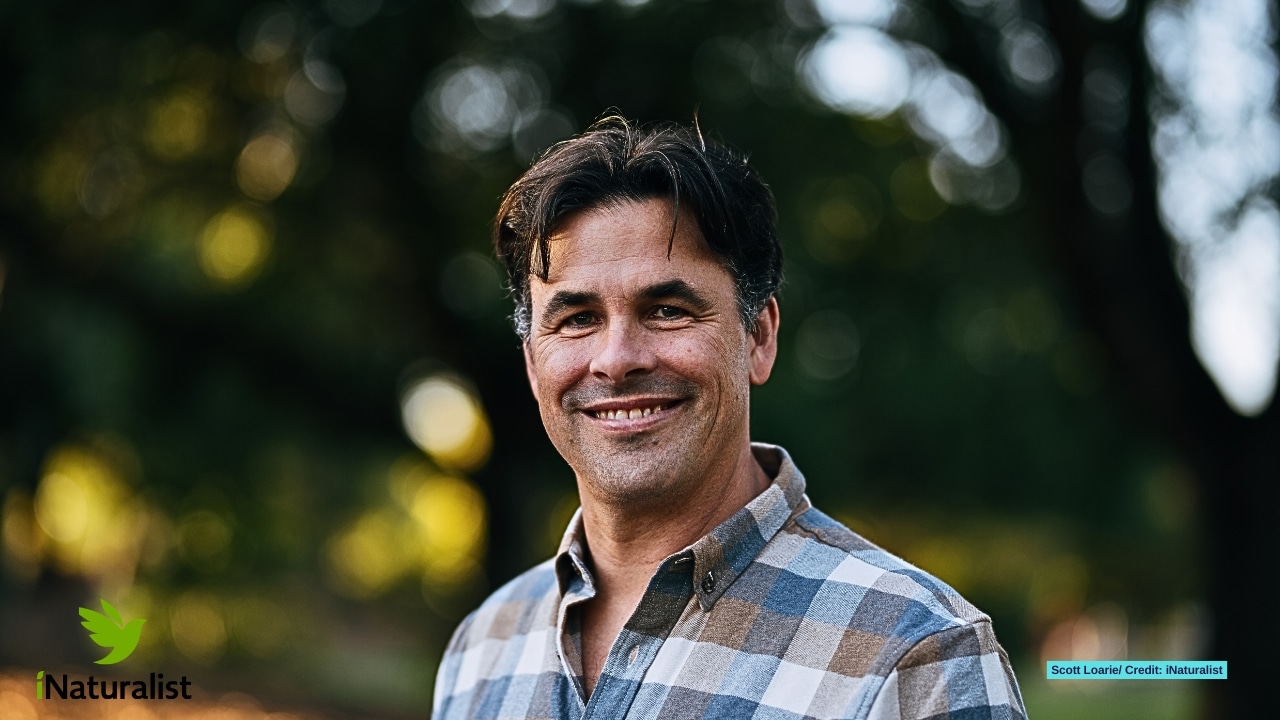
In this episode of Science Engaged, I speak with Scott Loarie, Executive Director of iNaturalist, a nonprofit organization that launched an app to connect people with nature to drive global conservation. Loarie discussed the platform’s success in engaging more than 4 million users in global biodiversity conservation. iNaturalist has documented one in four species on Earth, with 300 million verifiable observations contributing to over 7,000 scientific publications. Loarie emphasized the platform’s unique blend of social networking and scientific rigor, leveraging AI and machine learning to enhance data accuracy. The iNaturalist app currently contributes data on 300,000 species per year, something that Loarie said would take 200 years for a typical museum to achieve. He and his team aim to increase annual species documentation to 1 million per year by 2030, focusing on less studied species and expanding on grassroots stewardship.
Loarie argues that conservation science is not moving fast enough, pointing to a mismatch between traditional research models and the urgency of the problem. One key insight Loarie shares is that the platform works because “it is built on what the user wants to do… and those activities contribute to scientific output,” aligning participation with intrinsic motivations rather than only with scientists’ research goals. This shift allows scientists to operate at entirely new scales, where “you can address questions at totally different scales… not hundreds of samples, but hundreds of thousands or millions,” while also raising challenges around maintaining rigor, as Loarie asks, “how do you reduce friction so you can scale science… but still maintain trustworthiness?” He ultimately frames iNaturalist as more than a tool, describing it as “like freeways… fundamental infrastructure for science and conservation,” and emphasizes that expanding its impact will require broader participation, since “we need to expand our capacity to get information on the whole suite of ecosystems… and we need more people involved.”
Loarie also shares the challenges of maintaining the platform’s sustainability, relying on philanthropic support and the generosity of its user base. In the end, he highlights the platform’s potential to drive meaningful change in conservation efforts.
This episode is made possible by support from Schmidt Sciences and the UC Santa Cruz Science Communication Catalyst Grant. Special thanks to Fanuel Muindi for co-producing this audio program.
Here is our conversation:
Tjandra: Welcome to Science Engaged where we explore why and how scientists partner with diverse communities.
Loarie: Reality is science, especially biodiversity science and biodiversity conservation is not moving fast enough. Getting more people involved scales it. We need more people engaging with and connecting with nature. We need more data on where these species are, and we need more grassroots stewardship actions.
Tjandra: I’m your host, Kristel Tjandra, and today I’m joined by our guest, Scott Lourie. Scott is the executive director of iNaturalist, a nonprofit that connects people with nature to drive global conservation. The iNaturalist app is one of the world’s largest citizen science platforms with more than 4 million users across the world today. We’ll hear from Scott about what makes iNaturalist so successful and the lessons he learned over the past 15 years. Scott Laurie, welcome to the show.
Loarie: Hey, Kristel, thanks so much for having me,
Tjandra: Scott, you are a scientist by training with a degree in Biology from Stanford and an environmental science PhD from Duke. Can you talk to me about, you know, your background, and also how you got into iNaturalist?
Loarie: Sure. Yeah. So I’ve been always obsessed with nature my whole life. I was always really involved in and I went into academia, specifically ecology, because sort of an excuse to get next to critters. You know, I just love the idea that that job is getting into the field and getting to interact with plants and animals, and so I went into that field, but I just became increasingly frustrated by the inability for science and conservation to really scale to address these problems. I mean, we’re in the midst of an extinction crisis. We’re losing, you know, we might lose up to one in three species by the end of the century, and we just don’t have the information or the conservation action that we need to address this problem. So that was what was really on my mind, around 2008 2009, when I was a postdoc at Stanford at the time, and then I met Kenichi Ueda, who had just launched this website called iNaturalist, which was really more focused on connecting people to nature. So the idea was, you would post a butterfly photo, and someone else would say, Hey, this is a monarch. And you could kind of connect about it and teach one another. It’s a monarch because it’s, you know, orange and has black stripes. And what I really brought, I just immediately sort of left academia and jumped on to this, and a naturalist, you know, vision, and then Kenichi and I, over the last 15 years, you have scaled it into into the program and the team it is now. But um, what was exciting for me was less the let’s teach each other about monarchs, but like you, actually, at the end of this activity, you end up with really high quality data on where monarchs are, and a big constituents of people working on this problem. So I was more excited about the crowdsourcing thing. And I think what’s been great about iNaturalist is it has both aspects. It has this very sort of earnest, just people wanting to connect with other people and learn and share, but it also has this real scientific outcome. And I think that’s helped contribute to sort of what I call the big tent with iNaturalist, that we have lots of different people working together, which I think is healthy for any group working on a problem. You want to have lots to have lots of different people with lots of different incentives working towards a solution.
Tjandra: How would you describe iNaturalist as someone who hasn’t used it yet?
Loarie: So the basic idea is, this is an app that you can point at any living thing and take a photo of it, and the app will identify it, initially with AI with computer vision. But what’s really important, I think, sets it aside from a lot of identification apps, is you actually share that observation with this global community of other naturalists and scientists and experts who help vet it and put it into context and actually create research grade data. And so it’s, it’s this really neat combination, something that’s very easy anybody can do, but actually you’re contributing to something really hard, which is understanding, documenting and documenting and preserving species on the planet. So right now, we’ve had millions of people have used this, and we’ve collectively documented about one in four of all species on the planet, which is pretty cool. And one thing that I’m very proud of is that most species in the world, currently, most of the data that’s being generated on them comes from this little app, which I think is just amazing to think that just regular people getting outside, is responsible for one of the core bread and butter data sets that we have that scientists and conservation managers are using to understand and document, understand and manage the planet.
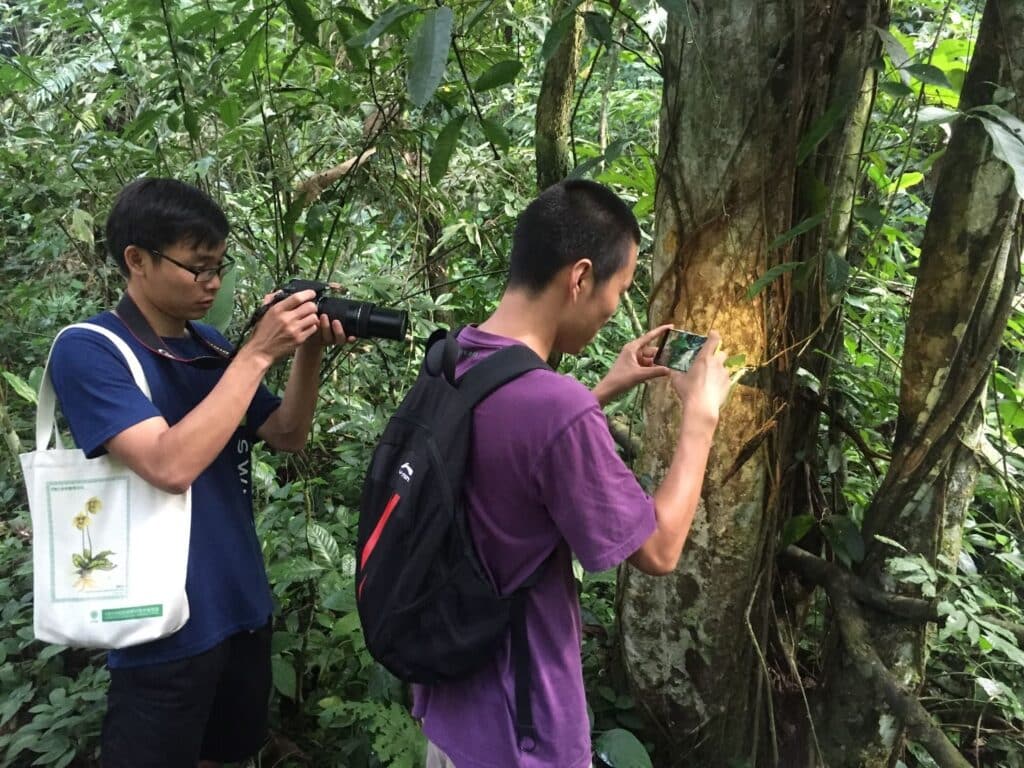
iNaturalist users in China are collecting images of plants they encounter during a hike (credit: Scott Loarie / iNaturalist)
Tjandra: Yeah, over the past decade, the platform has gathered two 50 million verifiable observations that, right, yeah, I
Loarie: I think it’s almost up to 300 million. It’s getting close, but yeah, so and those are, like you said, those are observations that have everything they need to become what we call research grade. And the research grade observations get sent to the global biodiversity Information Facility, where they really become part of the sort of the bread and butter stream of biodiversity data that’s used by scientists and conservation managers. What’s cool is that the iNaturalist data has contributed to over 7000 publications, which. You can track their GBIF, which is pretty cool.
Tjandra: Yeah, so looking back, I mean, you mentioned a bit about this. What was it about the app, or the approach that you and your team have that kept people kind of joining and wanting to contribute to these projects?
Loarie: Yeah, I think what you know you mentioned earlier about the origins of iNaturalist. I think at its origins, iNaturalist was more sort of a social network that really catered to what does the user want to do here. And in this case, the user wants to upload a photo and talk to people about it and get information. And I think that separated it from a lot of the citizen science sites at the time, which were coming more from people like me from academia, who maybe had more of a mindset that, like, all right, I’m a scientist. I need volunteers to help me with my project. And I think why iNaturalist was successful, in a way, is that it built a lot on the incentives of the regular person who wants to get involved and to structure the site such that those activities, like in the case of iNaturalist, it’s uploading observations and uploading IDs, contributes to scientific output. But we never really structured the site as like, Hey, I’m a scientist. I need everybody’s help to help me answer this question, which I think just, you know, I think that that’s really helped with iNaturalist to keep the focus on, what does the contributor want to get out of this experience?
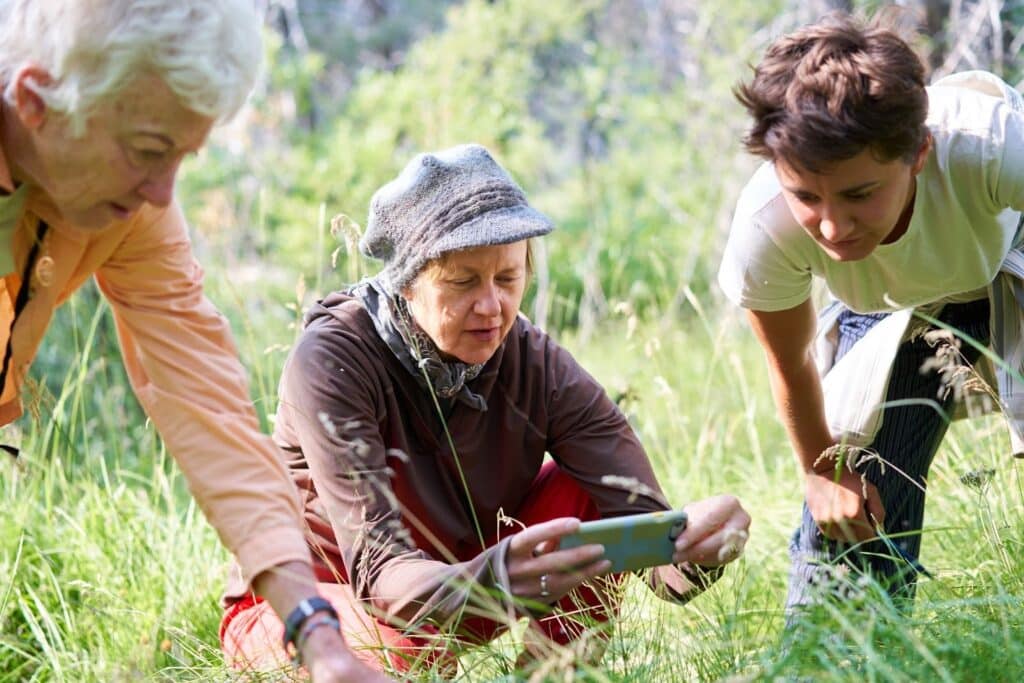
The iNaturalist app engages users of all ages in Nevada County to go out and take photos of the interesting species they encounter (credit: Tony Iwane / iNaturalist)
Tjandra: Yeah. So coming from, you know, the so called ivory tower environment has iNaturalist kind of shaped the way you think how science can be done.
Loarie: Yeah. I mean, it’s really interesting, because what’s super important about science is that, you know, it’s authoritative and that this is high quality data. One of the concerns I have, or questions I have when I was in academia was, you know, how do we scale this sort of process of making things authoritative? And one of the things I thought a lot about was peer review, you know, so in the early days, I’m maybe kind of, kind of in the early days, I’ve been at this game a long time, but you know, there was only a few journals, and if you wanted to get a paper published, you had to submit to those journals. And those journals had a group of peer reviewers that was kind of a club and and it was great, because you knew if your paper got published, it was high quality, because it went through this rigorous peer review with this club of trusted people, but it was very slow. There’s a lot of friction. And, you know, one of the things I was interested in is, how do we reduce friction so we can scale science? Science is only going to solve these problems if we can scale it. We can move faster. But it is, you know, we’ve seen with the proliferation of online journals that just don’t have that sort of peer review, and it’s and that’s what’s tricky about iNaturalist, is we’ve been trying to lean into these things on the internet that help scale. Because I think we have a huge ethical obligation to scale all this stuff so that we can actually tackle these problems. And the reality is, science, especially biodiversity science and biodiversity conservation, is not moving fast enough, and getting more people involved scales it. But at the same time, there are these questions about, How do you maintain the rigor of this, this platform, and I think this is something the internet at large is grappling with, things like Wikipedia, you know, how do you make sure that the contributions are high quality or accurate? And that requires introducing friction, but the right amount of friction in the right places, and that’s something I don’t I’m not claiming at all. We have all the answers, but I think that’s one of the things that’s been really exciting about iNaturalist, is to sort of lean into the strengths of social network, all these technologies like social networking and AI that are exciting and moving fast and have the potential to really do a lot of stuff in a short period of time, but then really trying to anchor this to science, which is all about rigor and reputation and trustworthiness, and find that sweet spot where we’re not too tangled up in the sort of traditional scientific process, but also not just spinning out into craziness like the internet can do with so Many of these things. Yeah.
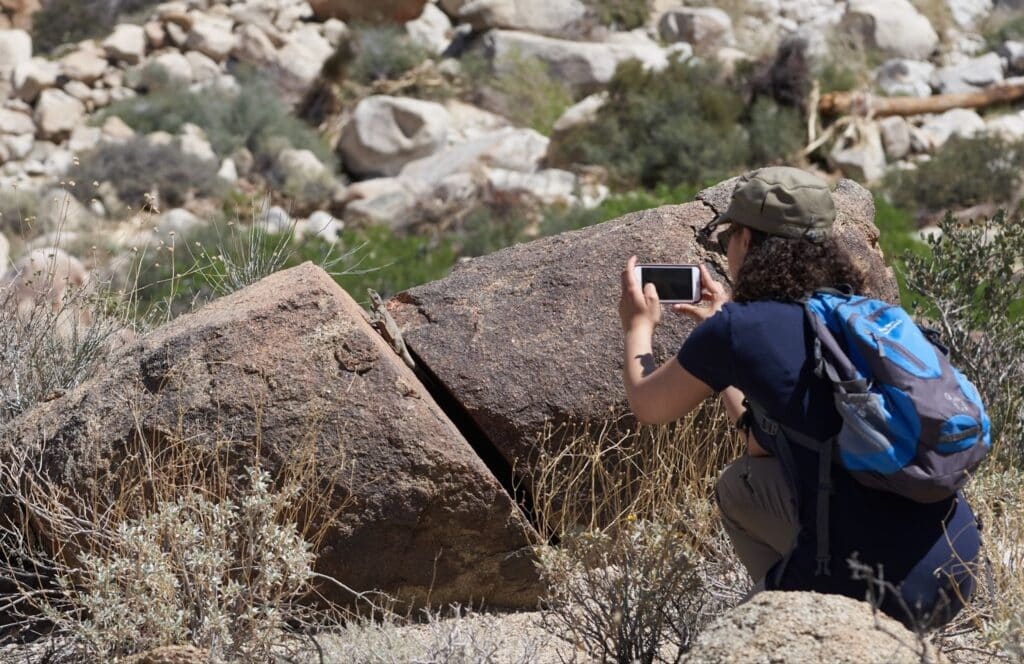
The iNaturalist app has contributed to the identification of hundreds of new species. A user took a photo of a lizard she encountered in the San Bernardino County (credit: Tony Iwane / iNaturalist)
Tjandra: So cataloging biodiversity is obviously the kind of a center central mission of iNaturalist. Can you share some of the sort of discovery stories, some of your favorite proudest moment from iNaturalist? Yeah.
Loarie: I mean, probably the sexiest are discoveries of a completely new species, which is kind of always a great story, because almost entirely what happens there is someone’s out and takes a picture of something and just doesn’t give it a second thought and post it. Maybe it’s a butterfly, like I was thinking there’s this. There was a student in Ecuador who took a picture of a butterfly on a class field trip and posted it. And then there’s a lot of scientists, and some of them, the ones who are more active and tend to spot these are maybe not the experts, but they’re like, the Collect the connectors. They’re like, Oh, this is kind of interesting. I know it’s in this family, and I know this guy in Belgium is the world’s expert on this group, and mentions them. And they’re maybe less active on iNaturalist, but they’ll respond to, you know, getting special notes on certain things. And then they. Look at this thing, go like, Oh, wow. You know this is, this doesn’t look like anything. And then there’s usually a flurry back and forth. And when that this turns in, then the scientists know that’s new, and then it does have to enter sort of the more traditional scientific process of writing a paper, and it slows down, and usually takes a couple months. But I mean, that’s just so amazing to go from someone just seeing some butterfly on a class field trip to a whole new species description, and that cast of characters that’s involved in that process spanning everyday, normal people and the world’s experts in these groups. So those, I think, are pretty exciting, but ones that happen a lot more often than the new species. I say, we get a new species maybe once a month, are really interesting out of range observations. So that’s like a species that’s never been seen. A lot of them are rediscoveries. I mean, so much of the basic cataloging of species really peaked in the 1960s but has this history that goes back to Linnaeus and Darwin. So so many species. You know, there was one museum collection that’s sitting in a museum somewhere from like 1880 and it hasn’t been seen since. And then so many of these species, their story, you know, has that point, and then 100 years of silence, and now these observations are popping up. And I think that’s that’s really exciting. And sometimes they’re popping up in weird places. You know, a species that was only known here is now being seen there. So there’s just gradients of excitement around some of these observations. But I think that sort of thrill of discovery is a large it’s kind of like I meant I mentioned that, you know, contributing to something that’s real, I think makes iNaturalist, you have a sort of a different aspect of engagement than a lot of other other things on the internet,
Tjandra: Does iNaturalist collect, like a specific demographic data on, you know, where or what age the users usually are.
Loarie: We don’t do a ton of that. And part of me feels like it would be, it would be nice to know more about, you know, who and where. We obviously tons about where these observations are coming from and when they’re coming from. But we don’t have a lot of we don’t collect a lot of personal information, right?
Tjandra: Yeah, so earlier you mentioned about iNaturalist has has been kind of the catalyst for, like, more than seven, 7000 publications. I was wondering, what, when you’re interacting with like scientists or environmental scientists, what are their views about I natural is, how do you how do they see this platform?

Loarie: I think it varies. I think, you know, there’s definitely the more traditional guard that says, Well, wait a minute. This is, you know, this stuff is, it’s coming through a different means, maybe suspicious of the data quality or things like that. But then there’s another generation of scientists that I think really are more interested in working with new approaches and new techniques. And I think what they see, which is what I saw, and what I why I was, you know, got obsessed with this idea of iNaturalist is just that you can, you can, okay, maybe a quick tangent, but my PhD advisor had this chart that just stuck with me. That was on the x axis was space, and on the y axis was time, and then there was the next axis was number of species, and it was like, where’s it, the explored space? And it was exactly like the duration of a PhD program. So it was about as much space that a PhD student could cover, about the same number of species that one PhD student could get his head around in about four years, which is like a PhD field season, right? And it was like, that’s just saturated. We know all that, but then there’s just this unknown space. And I think what iNaturalist does is it’s a lot of just these traditional ecological and conservation questions, but you can address them at these totally different scales, global scales, or across 1000s of taxa or being informing your analysis, not by the 100 samples that you were able to collect, but hundreds of 1000s or millions of samples. So it really is our ability to kind of probe some of these classic ecological conservation questions at a completely different scale that I think really excites a lot of the scientific community.
Tjandra: Yeah, you know, obviously doing this kind of work, you’ve been doing it for more than a decade now, you need funding and continuous support. How have you and your team managed to make it sustainable?
Loarie: Yeah, well, we’re a nonprofit, and I think that’s been a conscious decision. You know that this is this information that we’re generating is really important, and it needs to be accessible to everybody. It can’t be behind a paywall. We don’t want a bunch of ads and things like that, and I think being a nonprofit has really helped with that. But at the flip side, we totally rely on the philanthropic and generous support of everybody involved in our in our ecosystem. So that comes from everyday users giving us $5 to people of means giving more than that to generous grants from grants. Foundations. And I’m I think iNaturalist is in a great position as a nonprofit, because we have this really big user base, which is fantastic, but no question, any nonprofit relies on philanthropic support, and we’re no different.
Tjandra: Yeah, do you have any tips on you know how you have been successful in terms of looking for funding support, yeah.
Loarie: Well, I mean, I think, I don’t know if this is a tip, but, like, one thing I do think sets a natural society is a lot of these initiatives are one big grant with, you know, hundreds of people spring into action, and the thing lasts a couple years, and then they run out of money. Run out of money. INaturalist has gone from, like I said, this master’s project, where it literally had no money, to, I remember our first project was like $10,000 you know, which kind of got us through our first year, and then just slowly, slowly growing the team. And I think that that runway of just slowly growing, like we’ve been trying to, sort of grow about 20% per year in terms of the number of observations, the number of users, the number of staff, the budget. And that’s, I think, a very ambitious and it’s hard to keep up with that compounding growth, but it’s also very slow pace, as opposed to, and I think that’s an interesting scientific funding problem, which is that, you know, what are the right models? And I think, as you say, a lot of the sort of scientific grant projects, they sort of have this boom and bust cycle, which we don’t want, for a lot of our infrastructure, that really long term infrastructure. And then I think also the private sector tends to sort of encourage this boom and bust, you know, it’s really risky. Everybody’s looking for an exit. And what I’m interested in is just how, you know, a naturalist, a lot of ways, it’s like, it’s like freeways, you know, it’s this is fundamental infrastructure for science and conservation, and those don’t need to make money. Our freeways don’t need to make money, but they need to be sustainable, or they’ll fall into disrepair. And just what are the right models for the commons, for building open infrastructure that’s accessible to everybody that’s really helping motivate change that we want in the world. In this case, it’s people connecting to and documenting and conserving species. But there’s, there’s, it’s difficult to find sustainable, long term funding for those kind of, those kind of activities.
Tjandra: Yeah, you know, mentioned, you earlier, mentioned about, you know, data. Obviously, the quality of data is really important in order to be able to use the observations that are coming from iNaturalist in kind of a scientific forum. It’s hard not to talk about machine learning and AI, when we call, when we talk about big data, does iNaturalist have any plans on, you know, integrating some of the new tools in the data that you’ve collected? And, yeah, what are some of the kind of like, yeah initiatives in that sense, yeah, no,
Loarie: It’s great that you mentioned that. I mean, iNaturalist started is just an entirely a crowdsourcing site. So, you know, I would upload a monarch butterfly, and then you would say, Hey, this is a monarch and it was all crowdsourcing. And then in like, 2016 we got approached by a bunch of academics. Usually, we were approached by more ecological academics, you know, who were more interested in the points. And that’s what my background is. You know, more ecology, biogeography, but we got into, we got approached by all these machine learning pattern people was before. People were calling AI and they were saying we were interested in training computer vision models. And you guys have all this labeled image data, and for us, it was almost a byproduct, like, you know, what we’re interested in is a, there’s a woodpecker here at this point in space and time, and the photo is just proof. It’s kind of like the museum voucher. But they’re like, Well, we’re actually just interested in the label photo, and because I think iNaturalist has been close to the academic community, once these academic researchers were able to show that they can make these powerful computer vision models, we were the first group to have a deployed computer vision model that was more than a toy. You know, had 10s of 1000s. I think our first model had 20,000 species that, you know, millions and millions of people were using. And of course, we’ve seen since then now that technology has become very standard. And you know, Siri can do that. Google lens can do that. What I after that, we moved on to more geospatial AI, which, and again, this line between machine learning and AI, I don’t totally forget it myself, but, like I tended to kind of call this stuff machine learning, but what we did is similar to how the computer vision model takes all these labeled photos, so you give it a photo and it tells you what it is. We said, Hey, machine learning model take all these points in space and time and come up with a really good neural network understanding of where species live in space and time. That’s similar to machine learning. That’s what these machine learning models do, is they look across high dimensional, you know, hundreds of millions of data points to make these really complicated sort of pattern recognition experiences. But what’s been really cool with that is now we can any observation on the site. We can run it. Through that model and say, Does this weird? Is this unusual? And we power something called the anomaly detector. So if, like, for example, an invasive species that’s only known from Europe shows up in the United States, the anomaly detector will say, this is weird. And so in both those instances, you have something that humans are doing, which is labeling photos, or in this case, vetting where that location is in space and time. But then you can teach a machine learning model to sort of make similar predictions the computer vision model or the anomaly detector. And then the idea is that that will help accelerate this work. You know, the idea is that humans should be able to focus on more important priorities, because the machine is taking over some of the work, or it’s kind of an assistant to help accelerate this work. Like, maybe you can think of the computer vision model as like suggestions like this, but you should focus on or like, these are the observations you should look at, because they’re particularly weird places. But it also does put the human in this kind of reviewer stage. I was reading this article over the weekend about how, you know, humans, instead of being the producers of work now, are like, this is like coding, for example, with all these AI coding, they’re like code reviewers, right? And maybe that’s not exactly what people want to do, and it’s tricky, as you say, back with the citizen science community, because we can’t these are all volunteers. We’re not paying them, and someone who’s whose identity making the original, you know, the original call, like, this is weird, or this is this might not be as excited about being in this reviewer position of like, I’m reviewing what the AI thinks. So that’s no question. There’s a struggle. And this was sort of exacerbated recently when we started getting into some of these large language models, which is the new sort of wave of AI to say, let’s actually start looking at all these text comments. Because another thing with inatural is we have all these labeled photos that have latitude and longitude. And I mentioned the two way models, two AI models that we use the computer vision and the anomaly detector that use that. But we said we also have millions and millions of comments where people are writing really interesting things, like this mushroom is identifiable because of the gills. And can we actually start making predictions there that will again accelerate this work of people teaching one another how to ID and IDing some of these hard to ID species. But I think AI is getting closer and closer to home with what people sort of think of the work that humans do. And it’s going to be tension. And there’s going to be tension between people who are less accepting of change to, I think, people who are really excited about change and maybe too willing to throw the baby out with the bathwater. I think that’s, again, the balance that we’re trying to strike. And I think the path forward here is to stay focused on mission. I think why a lot of these technologies have gone bad is not because of the technology itself. It’s because they’ve been applied in a in a situation that sort of perverts the incentives. And I think a good track record here is social media itself. I mean, look what all the horrible things that social media has done to the internet and at its core, and naturals is a social media site. It’s people sharing photos, and we’ve been able to keep that from being toxic by being non commercial, by saying we’re not about selling ads or like, you know, doing this or that. We’re about mission. We’re about trying to document and accelerate conservation. So I’m fairly optimistic that even though AI is probably going to go down a similar dark path because of all these commercial and weird incentives. I think that we can rein this technology and similar to social media, in the service of our mission, but the tensions do feel stronger now than they felt in the past, especially with this latest sort of AI chat GPT type wave that we’re in where, like the humans are very struggling with what, what role does do these AI systems play in this, this internet in the commons Wikipedia had a recent experiment where they were experimenting with summarizing Wikipedia articles, and they, I think they pulled it because it was just too controversial with their editor community, yeah.
Tjandra: Speaking of social media network, you know, going back to our conversation about the motivation that led people to join iNaturalist, how would you describe, you know, what? What motivates people to take part in it? And you know, is it kind of like social media, just wanting to be in the community of people who discover something, or is it acknowledgement that they they have found something? Yeah, what? What have you observed?
Loarie: I think it really differs. And I I’m proud of and I think it’s important that iNaturalist has a big tent. I think that for us to really have the impact that I want us to have on science and conservation, we need to have a big tent. We need to be able to reach lots of different kinds of people. But the downside of that is you have different kinds of incentives. Like, I think I’m what really excites me personally about iNaturalist is kind of what excites me about Wikipedia, is that, like, if you look, if you stand back and look at Wikipedia, you have this incredible, beautiful, I. Monument to all of human knowledge that one person, no one person, can make, and yet I can participate in that by editing my little corner of it. And that’s what excites me about iNaturalist. It’s like we have this gigantic global eyes and ears on the planet like we’ve never had, that no one person could do. So it’s not an individual endeavor, but it’s made possible, I can contribute to it by observing things in my backyard and identifying so that’s what gets me going. But I realize a lot of other people, it’s a very more personal endeavor. They’re not as excited about sort of the shared thing. It’s more personal. A lot of people have a lot of privacy concerns that are in tension with generating and sharing information. And so that’s something that I think you have to approach our naturals with a lot of humility, and realize there’s lots of different people involved for lots of different reasons. And that’s what makes it, I think, really great, but it’s also what makes it really hard to process so much of the feedback we get from the community sometimes, yeah, you know, again, for me, which is maybe a oversimplification, but I’m just laser focused on the kind of biodiversity crisis at hand and how to alleviate that. We need more people engaging with and connecting with nature. We need more data on where these species are, and we need more grassroots stewardship actions, and that’s what I just want to create. And I think I feel very at peace with that, but the role that AI plays in that, the role that certain funders play in that it’s, there’s a lot of, you know, sometimes those can be, there’s going to be a lot of different opinions. And you know, we’re not claiming that we’re doing the best of navigating that, but I feel very confident in our mission, and that iNaturalist is is really helping. And I just want to expand our impact, because we can help more and just stay without, without stepping into any real quagmires and sort of some of these ethical issues.
Tjandra: Yeah, what would you say is the big goal for I naturalism, the, you know, in the five years, 10 years to come?
Loarie: Yeah, I want to get so there’s about 2 million species that have names. And so many people think that we know everything about these species, and I think that’s because you take like, the elephant or the rhino, and there’s just so much information. You know, the the IUCN, which is the International Union for the Conservation of Nature, they have this elephant specialist group, and every year they’ve got this, you know, credible team of researchers who are, you know, just producing this incredible information about what’s the status of elephants and how’s it’s changing, and what we need to do? And they’re like, Okay, we must, that must be the same for all species. And I don’t think people realize that it just goes home. And pretty much, aside from the couple charismatic mammals like lions and elephants and then birds, where we know a lot about we know almost nothing about most of those species. And so my goal is to get you very uniquely I think what iNaturalist has contributed is a lot of information on that long tail of poorly known species. Most of the species in the world are insects, followed by like plants. There’s 300,000 species of plants, maybe 400,000 named plants. There’s probably many more than that that haven’t been discovered. And so all told, iNaturalist says is producing now about information about 300,000 species a year, but that’s what the museum industry did over 200 years. It took 200 years for, like the natural history museums, to collect data on 200,000 species, and we’re now doing that annually. So annually. So for me, that’s super exciting. It’s like, okay, we have this scalable way to get information not just on these charismatic, small species, but the whole ecosystem. But then you think about it, wow. You know, 300,000 species a year is still tiny relative to those 2 million species, and that’s the easiest to get 300,000 so what we really need is just to expand our capacity to get information on this whole suite of ecosystems. And that means getting this community to focus on, you know, increasingly sort of small, little beetles and plants and things like that. It means getting off trail and getting into places that people don’t visit. It means moving more into places like the global South, where most species live in places like the Amazon, and we have fewer and fewer participants. So my goal is, I would love by 2030 to have us censusing Half of species on the planet a year. So that’d be about 1 million species a year. I think we can do that. We need to get a lot more people involved, and we need to grow the expertise, because a lot of these probably have photos of these things, but no one’s been able to identify them. And then I would really would like to get to to to expand a lot of the activities that are already happening on the site, where people are really helping steward some of these rare and endangered species through the platform. So a good example of this is, like I mentioned, a rare and endangered species like the rusty patch Bumblebee is a bumblebee in the Midwest. That’s very rare. So that’s something that comes out of this monitoring. People will say like, Oh, interesting. We have a population of rusty patch bumblebees here or or here. We feel like we should have it, but we don’t have it. But once you know that information, we see a lot of projects on the ground that are helping. They’re working hard to try to attract that species. So one of those might be remove. Invasive species or another might be planting native plants to try to attract it. So I really like this virtuous cycle between us knowing where the rare and endangered species are, but then giving the community tools to attract them. And what’s exciting to me about 20 like you’re saying five years from now, 2030 is right now. We can say like, Okay, this year we’ve been able to monitor, you know, 300,000 species. But what if we actually could say we’ve measurably improved habitats for 10,000 species? I mean, that is going all the way to conservation impact that I think we urgently need, and I’m very optimistic that the platform can play an important measurable role in achieving that. I think we’re really there in so many ways. We just need to sort of shore up the ability to sort of get these behaviors to completely, sort of, you know, get all the way to the conservation impact on the ground, and then just expand it. We just need more people involved. Yeah.
Tjandra: So some of our listeners are, you know, science communication or Citizen Science practitioner, what message do you have for people who are interested in engaging the public with research, or they’re non experts who are interested in participating in science?
Loarie: Yeah, I would say it’s just amazing the amount of things that you can get done when you involve more people like again, I was there’s some statistic about that I was crunching through not too long ago about how long it would take one person to collect all the data. Naturalist, and it would mean, you know, posting 100 observations an hour, you know, every hour of every day we’re not sleeping. And it would take, you know, years and years and years and years and years. I can’t remember the exact statistic, but it’s just totally unfeasible. And then you think that, you know, you know, you get this big community together and you can do these big things. And so I think that’s very exciting from a scientific standpoint, is that the crowd has the ability to really scale these scientific projects. I think that’s super exciting. I think that the tricky part is that people do what people want to do, and you have to structure your scientific projects around something that can make use of this human capacity, but people, you know, it doesn’t work. If you say, Hey, everybody, I want you to do this. I mean, I think that will get a certain group, but it won’t get the numbers that you can get if you say people are doing this, how do I build this activity around a question that I want to answer.
Tjandra: Yeah, that’s really helpful. Well, Scott, thank you so much for the work you do and for sharing the things that you’ve learned from iNaturalist
Loarie: Yeah, thanks so much for having me.
CREDIT
This episode is transcribed using Otter.ai. The recording features soundtrack by Lukas Got Lucky / Success Story / Courtesy of www.epidemicsound.com





“Science is something that we do together.” Benjamin Richards on how OceanEyes collaborates with citizen scientists to monitor deepwater fish in Hawai’i

Dear Colleagues: Participate in a survey on barriers researchers face when communicating with non-expert audiences

Research!America selects 17 grantees from 132 applicants for the 2026 Civic Engagement Microgrant cohort

Melanie Brown: “If you listen, people want to share things that are important to them.”

MA3 Challenge awards grants to six universities to modernize promotion and tenure processes: Here’s the question of the day.
Dear Colleagues: Participate in a survey on barriers researchers face when communicating with non-expert audiences

Scott Loarie says conservation science isn’t moving fast enough. He describes how iNaturalist is helping

Photo Essay: 2026 Stand Up for Science New York City

UNESCO-backed platform seeks to encourage information sharing among freshwater management citizen science projects
MA3 Challenge awards grants to six universities to modernize promotion and tenure processes: Here’s the question of the day.
“Science is something that we do together.” Benjamin Richards on how OceanEyes collaborates with citizen scientists to monitor deepwater fish in Hawai’i
Melanie Brown: “If you listen, people want to share things that are important to them.”

Abby C. King on leveraging local wisdom and science to create a thriving environment: “Our communities are the most valuable renewable resources for a healthy planet.”

Milky Way Project co-creator Grace Wolf-Chase says public engagement is ‘every bit as important as excellent scientific research’

Seeing is believing: Inside the BioBus revenue engine with Ben Dubin-Thaler
Contact
Menu
Designed with WordPress