
Civic Science Observer
“What are you going to do on Monday?” SNAP challenges leaders at the 2026 AAAS conference
“Our goal really is to mobilize for large-scale initiatives in science policy and science communication to reconnect scientists to the communities they came from and the ones they serve.” — Miles Arnett, SNAP Member

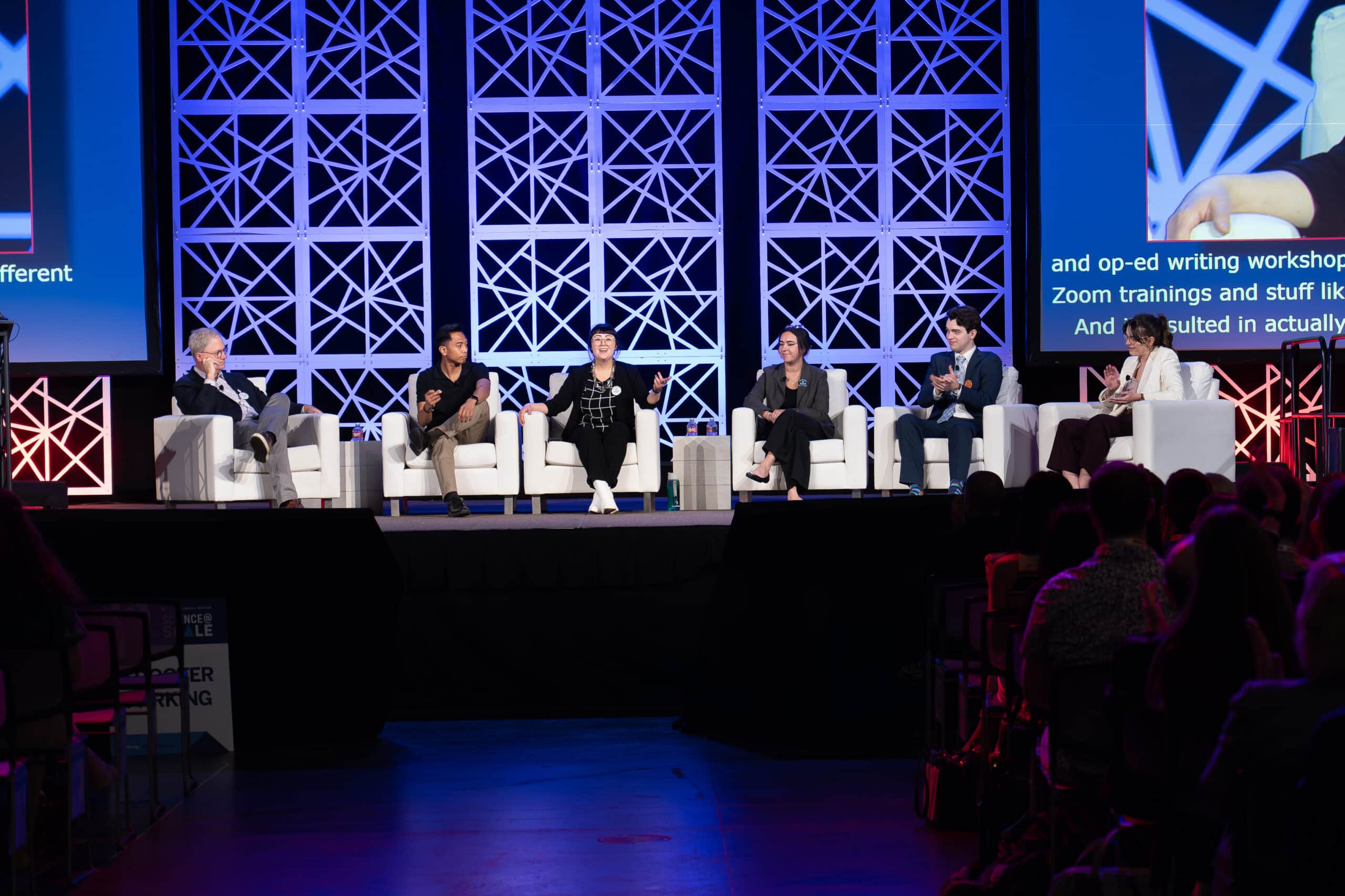
Phoenix, Arizona—Graduate students from the Scientist Network for Advancing Policy (SNAP) took the plenary stage at this year’s annual meeting of the American Association for the Advancement of Science (AAAS) in a way that was acknowledged as overdue.
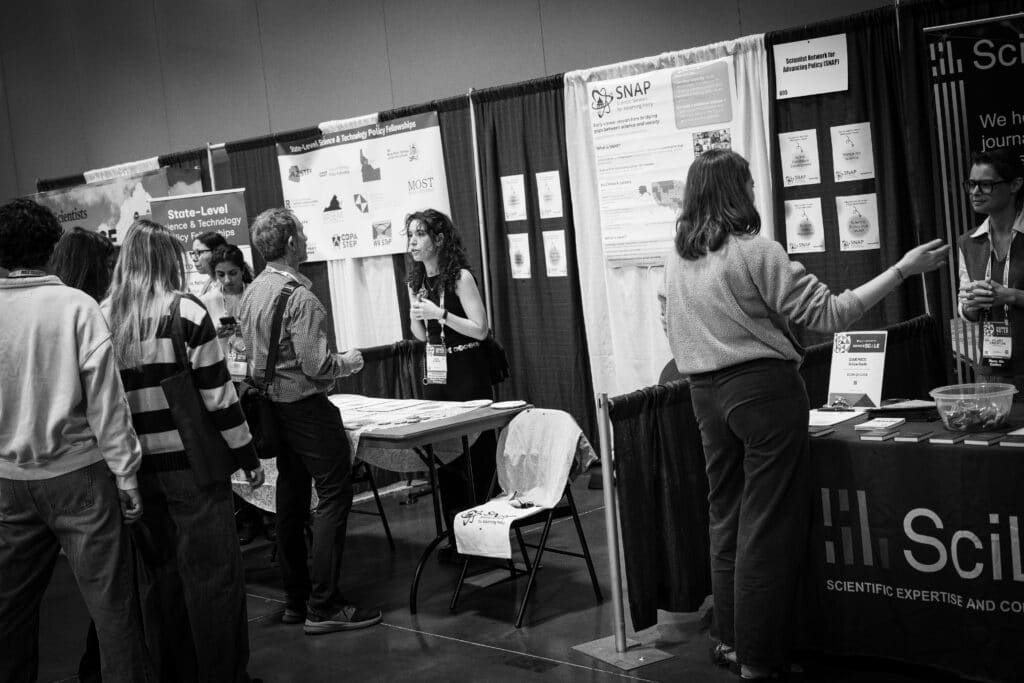
The moment reflected the growing visibility of SNAP, which almost seemed to be everywhere I went during the conference. The group hosted a booth, organized a reception, and surfaced repeatedly in many of my hallway conversations. But it was SNAP’s plenary session that provided one of the most memorable takeaways from the entire conference.
Moderated by Science Editor-in-Chief Holden Thorp, the plenary featured graduate students Miles Arnett from the University of Pennsylvania, Erin Morrow from UCLA, Alex Rich from Yale University, Isako Di Tomassi from Cornell University, and JP Flores from the University of North Carolina.
Thorp didn’t waste time asking why SNAP existed in the first place as soon as they settled onto the stage.
Panelists traced the origin of SNAP to informal conversations at the previous year’s AAAS meeting, when student science policy groups began sharing experiences and realized they were facing similar challenges without a shared infrastructure. Those exchanges quickly evolved into coordinated action, particularly amid what they described as a period of uncertainty affecting federal science funding and the scientific workforce.
SNAP was framed by the panelists as a mechanism for rapid, shared action at a moment when many early-career scientists felt that the scientific enterprise was being tested, and they wanted something beyond another discussion. Arnett described SNAP as a coalition “mobilizing for large-scale initiatives in science policy and science communication,” oriented toward creating change and “reconnecting scientists to the communities they came from and the ones they serve.” Panelists also described SNAP as creating a shared structure through which graduate students could initiate and coordinate activities across institutions. Di Tomassi explained that SNAP operates as a “non-hierarchical organization,” where any member can propose and lead initiatives. A bunch of questions popped in my mind after hearing that. Anyway, in a previous AAAS member spotlight published before the conference, Rich stated that SNAP “doesn’t have officers or official positions of leadership, allowing people to engage as they have bandwidth.”
On what they have already done in their first year.
Panelists shared that SNAP now includes more than 200 graduate students across over 20 institutions in the United States. One early flagship effort they cited was the McClintock Letters Initiative, a campaign organized in collaboration with the Cornell Advancing Science and Policy Club in response to concerns about threats to the federal scientific research infrastructure, and was timed to coincide with the birthday of Nobel Prize-winning geneticist Barbara McClintock. Di Tomassi said SNAP and partners ultimately had over 600 scientists pledged to publish, ran workshops with over 300 attendees, and saw over 200 pieces published across 45 states. For their work, the McClintock Letters Initiative will be honored on March 10, 2026, with the Meeting the Moment for Public Health Award from Research!America as part of its Outstanding Achievement in Public Health Awards. Additional outputs mentioned by the panelists include SNAP organizing 54 visits to congressional offices across 29 states.
“What are you actually going to do on Monday?”
One of the most pointed threads running through the plenary emerged when Thorp asked panelists to reflect on the role of scientific societies and the broader culture of science, and whether it is truly set up to support graduate students in the kind of work SNAP is doing. Panelists offered thoughtful reflections on mentorship, institutional incentives, and the responsibilities of scientific societies. But across their answers, the conversation kept returning to a more immediate, action-oriented question: what can be done now?
Both Rich and Flores pointed to what I’ve come to think of as the “Monday Action” test (or MAC test for short)—a simple but direct challenge to the audience, especially those in leadership roles: what can you do now? Flores captured the sentiment bluntly: “What are people in this audience going to do when they get back to their home institutions on Monday?” Some examples of the MAC test include societies doing more to bridge gaps in early-career scientists’ understanding of how scientific societies function and the resources available to them (see clip). Another suggestion is to do more to integrate science communication training into undergraduate curricula, so students develop those skills alongside their scientific training as early as possible. Panelists also highlighted the importance of institutions co-designing with grassroots organizations, like SNAP, to engage early-career scientists. In some ways, SNAP itself can be seen as an answer to the MAC test question, arising from conversations among graduate students at the previous AAAS meeting that quickly turned into coordinated actions over the following year.
Perhaps the key takeaway of the plenary and conference, the MAC test offers a useful lens for understanding SNAP’s broader effort to lower the activation energy required for early-career scientists and leaders to take action. It also brings to mind the central question posed in the title of Peter Levine’s book What Should We Do? A Theory of Civic Life, which provides a framework for thinking about taking collective actions.
What’s next on their roadmap
SNAP is busy. Di Tomassi described a nationwide effort called “Stance on Science” that they are working on now, in which early-career researchers are designing questions to ask candidates running for public office at different levels. A closer look at their website shows that as part of the Stance on Science effort, SNAP will also generate a grading rubric to evaluate candidate answers for things such as ‘evidence-based decision making, willingness to listen to experts and communities, equity, and commitment to transparency’, among other things. Their site also shows plans for a science policy hackathon and the development of modular science policy courses intended to introduce students and researchers to the fundamentals of policymaking, science communication, and civic engagement.
More questions for thought
There is no question that SNAP has a lot of momentum. As an ethnographer focused on documenting the diverse practices of civic science, SNAP is now on my radar, so I will continue to monitor its progress across several dimensions as the organization evolves. Chief among them is the question of which administrative and funding models will be needed to support and sustain a fast-moving, largely graduate-student-run, and non-hierarchical organization. Central to that challenge is how SNAP will make decisions about which initiatives to prioritize and how to sustain them over time. There is also the question of how SNAP will differentiate its work within the current science policy landscape—a question that is likely top of mind for funders. Ultimately, differentiation is another way of asking about the opportunities for existing organizations to co-design with SNAP, which is something multiple panelists brought up. Finally, the MAC test points to one broader question for civic science work: how will SNAP and others in this space define what impact looks like, and how to track it over the long haul?
You can catch SNAP members who will also be showcasing their work at the upcoming 2026 Science Talk Conference in Portland, Oregon.

Fanuel Muindi is a former neuroscientist turned civic science ethnographer. He is a professor of the practice in the Department of Communication Studies within the College of Arts, Media, and Design at Northeastern University, where he leads the Civic Science Media Lab. Dr. Muindi received his Bachelor’s degree in Biology and PhD in Organismal Biology from Morehouse College and Stanford University, respectively. He completed his postdoctoral training at MIT.







In Michigan, a citizen science project tracking salamander migration is bringing a community together and building a dataset

“Science is something that we do together.” Benjamin Richards on how OceanEyes collaborates with citizen scientists to monitor deepwater fish in Hawai’i

Dear Colleagues: Participate in a survey on barriers researchers face when communicating with non-expert audiences

Research!America selects 17 grantees from 132 applicants for the 2026 Civic Engagement Microgrant cohort

Melanie Brown: “If you listen, people want to share things that are important to them.”
Dear Colleagues: Participate in a survey on barriers researchers face when communicating with non-expert audiences

Scott Loarie says conservation science isn’t moving fast enough. He describes how iNaturalist is helping

Photo Essay: 2026 Stand Up for Science New York City

MA3 Challenge awards grants to six universities to modernize promotion and tenure processes: Here’s the question of the day.
Research!America selects 17 grantees from 132 applicants for the 2026 Civic Engagement Microgrant cohort
“Science is something that we do together.” Benjamin Richards on how OceanEyes collaborates with citizen scientists to monitor deepwater fish in Hawai’i
Melanie Brown: “If you listen, people want to share things that are important to them.”

Abby C. King on leveraging local wisdom and science to create a thriving environment: “Our communities are the most valuable renewable resources for a healthy planet.”

Milky Way Project co-creator Grace Wolf-Chase says public engagement is ‘every bit as important as excellent scientific research’

Seeing is believing: Inside the BioBus revenue engine with Ben Dubin-Thaler
Contact
Menu
Designed with WordPress