
Questions of the Day Program
“What are we missing?” How the Exploratorium is learning from its communities, with Cindy Suarez
On this episode of Questions of the Day on CivicSciTV, recorded on the sidelines of the 2025 ASTC Conference in San Francisco, I spoke with Cindy Suarez, Visitor Engagement Manager at the Exploratorium museum of science in San Francisco. Suarez frames visitor engagement as day-to-day community work rather than a standalone program. Her role, she explains, is about making the museum a place where people feel welcome and seen, and where community presence actively shapes decisions about programming, access, and design. Rather than treating engagement as purely outreach, she positions it as an operational function embedded across the institution.
A central part of that work is listening. Suarez describes how the Exploratorium uses suggestion cards, phone calls, and emails to ask visitors directly, “what are we missing?” For her, feedback is not simply about measuring satisfaction, but about understanding what would make an experience better for people who may not traditionally feel represented in science spaces. This approach surfaces gaps the institution might otherwise overlook and creates an expectation that visitor input should lead to change, not just documentation.
Lowering barriers to access is another recurring theme in her account. Suarez points to ticketing as one of the most visible sites of inclusion, where economic barriers can either be reinforced or reduced in real time. Exploratorium’s several free and reduced admission programs acknowledge that cost alone can prevent families from participating, even when interest is there. By embedding access decisions into frontline operations, rather than limiting them to episodic programming, the museum treats inclusion as a core responsibility.
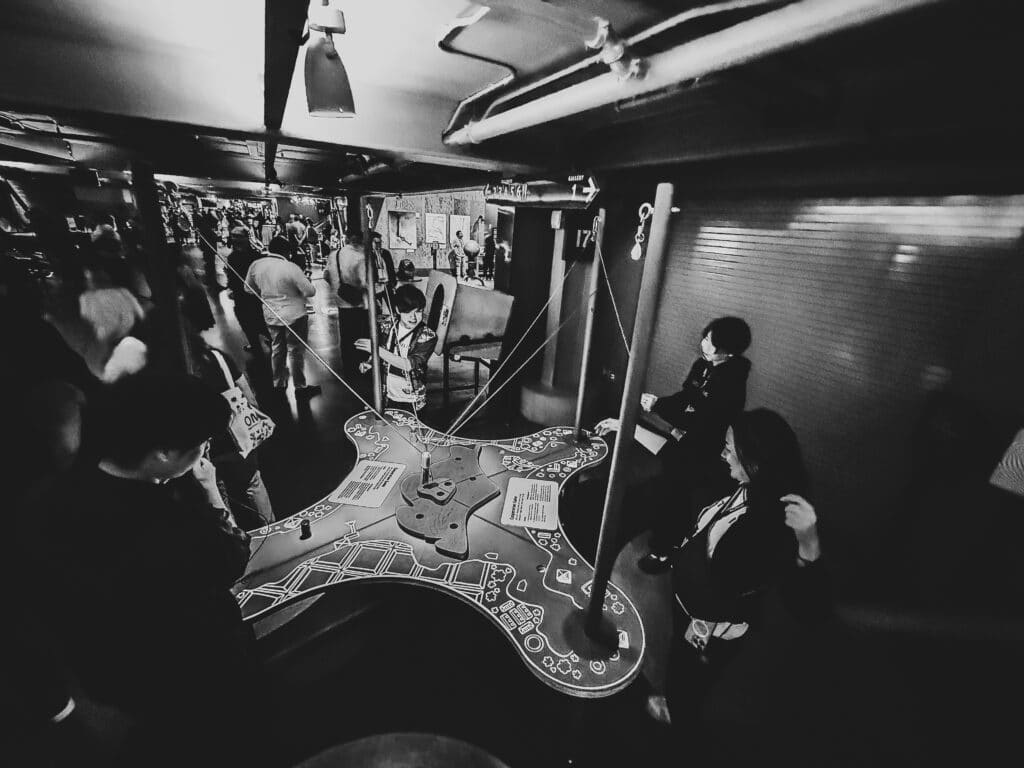
Suarez also emphasizes that engagement cannot depend solely on people coming to the museum. She describes plans to bring Exploratorium-style tinkering activities into library branches in underserved neighborhoods, particularly for families who “don’t always get to either spend money for these sorts of things or come out as much.” Going into the community, rather than waiting for the community to arrive, is a way of recognizing structural barriers related to time, cost, and transportation.
Who engagement is for matters just as much as how it happens. Suarez is explicit about centering groups of minorities and aligning actions with the museum’s stated mission. She describes how programs have been renamed to better reflect how communities identify themselves, recognizing that language and framing can either widen or narrow who feels invited.

She also highlights the Fab Lab as a space where engagement becomes co-creation. Describing it as “our mad scientist lab,” Suarez explains that it allows visitors, when possible, to be part of what is being created next at the Exploratorium. Inviting the public into early-stage experimentation shifts visitors from passive audiences to contributors who influence future exhibits and experiences.
Finally, Suarez offers a caution for other science museums noting the risk of getting into a “bubble” where internal norms and practices go unexamined. As a new ASTC New Leaders Fellow, she sees peer learning as a way to surface blind spots, strengthen facilitation skills, and stay accountable to local communities.
Fanuel Muindi is a former neuroscientist turned civic science ethnographer. He is a professor of the practice in the Department of Communication Studies within the College of Arts, Media, and Design at Northeastern University, where he leads the Civic Science Media Lab. Dr. Muindi received his Bachelor’s degree in Biology and PhD in Organismal Biology from Morehouse College and Stanford University, respectively. He completed his postdoctoral training at MIT.







In Michigan, a citizen science project tracking salamander migration is bringing a community together and building a dataset

“Science is something that we do together.” Benjamin Richards on how OceanEyes collaborates with citizen scientists to monitor deepwater fish in Hawai’i

Dear Colleagues: Participate in a survey on barriers researchers face when communicating with non-expert audiences

Research!America selects 17 grantees from 132 applicants for the 2026 Civic Engagement Microgrant cohort

Melanie Brown: “If you listen, people want to share things that are important to them.”
Dear Colleagues: Participate in a survey on barriers researchers face when communicating with non-expert audiences

Scott Loarie says conservation science isn’t moving fast enough. He describes how iNaturalist is helping

Photo Essay: 2026 Stand Up for Science New York City

MA3 Challenge awards grants to six universities to modernize promotion and tenure processes: Here’s the question of the day.
Research!America selects 17 grantees from 132 applicants for the 2026 Civic Engagement Microgrant cohort
“Science is something that we do together.” Benjamin Richards on how OceanEyes collaborates with citizen scientists to monitor deepwater fish in Hawai’i
Melanie Brown: “If you listen, people want to share things that are important to them.”

Abby C. King on leveraging local wisdom and science to create a thriving environment: “Our communities are the most valuable renewable resources for a healthy planet.”

Milky Way Project co-creator Grace Wolf-Chase says public engagement is ‘every bit as important as excellent scientific research’

Seeing is believing: Inside the BioBus revenue engine with Ben Dubin-Thaler
Contact
Menu
Designed with WordPress