
Civic Science Observer
The growing imperative for civic science journalism

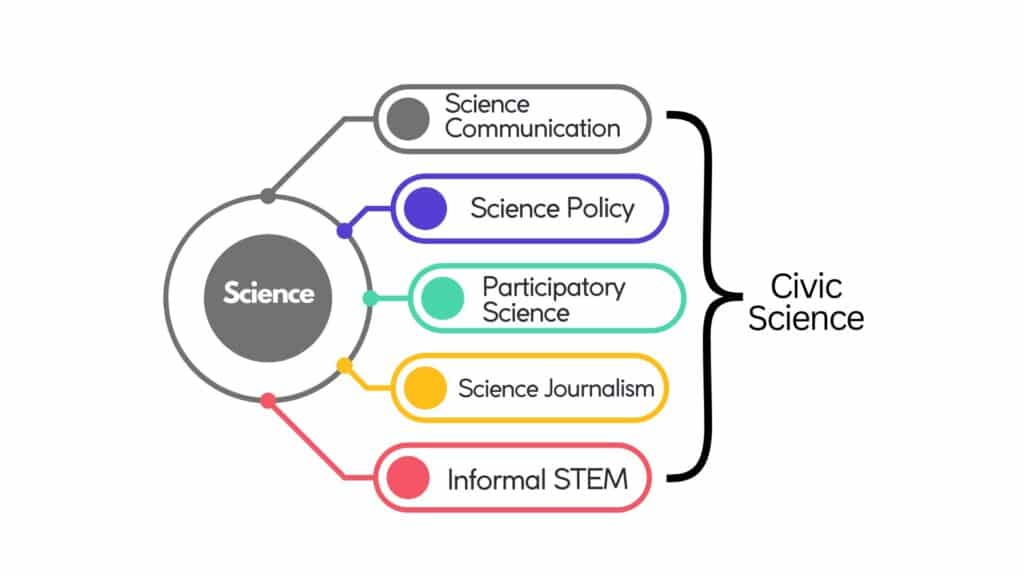
What is civic science? The answer to this question always invites this important follow-up question: Please tell me more. For me, civic science is an umbrella term encompassing science communication, public engagement, science policy, science journalism, informal science, participatory science, and related practices [1–4] (see Figure 1). Across these domains, practitioners and scholars are creatively working to strengthen dialogue pathways between scientists, local communities, policymakers, and other stakeholders to address societal challenges through collaborative, community-centered approaches. Yet, as other have noted [5,6], the knowledge emerging within civic science fields is often siloed within its respective communities. Structural, cultural, and incentive-based barriers limit the exchange of insights between research and practice, making it hard for practitioners to benefit from research, for researchers to learn from practice, and for communities outside these spaces to follow developments across the field.
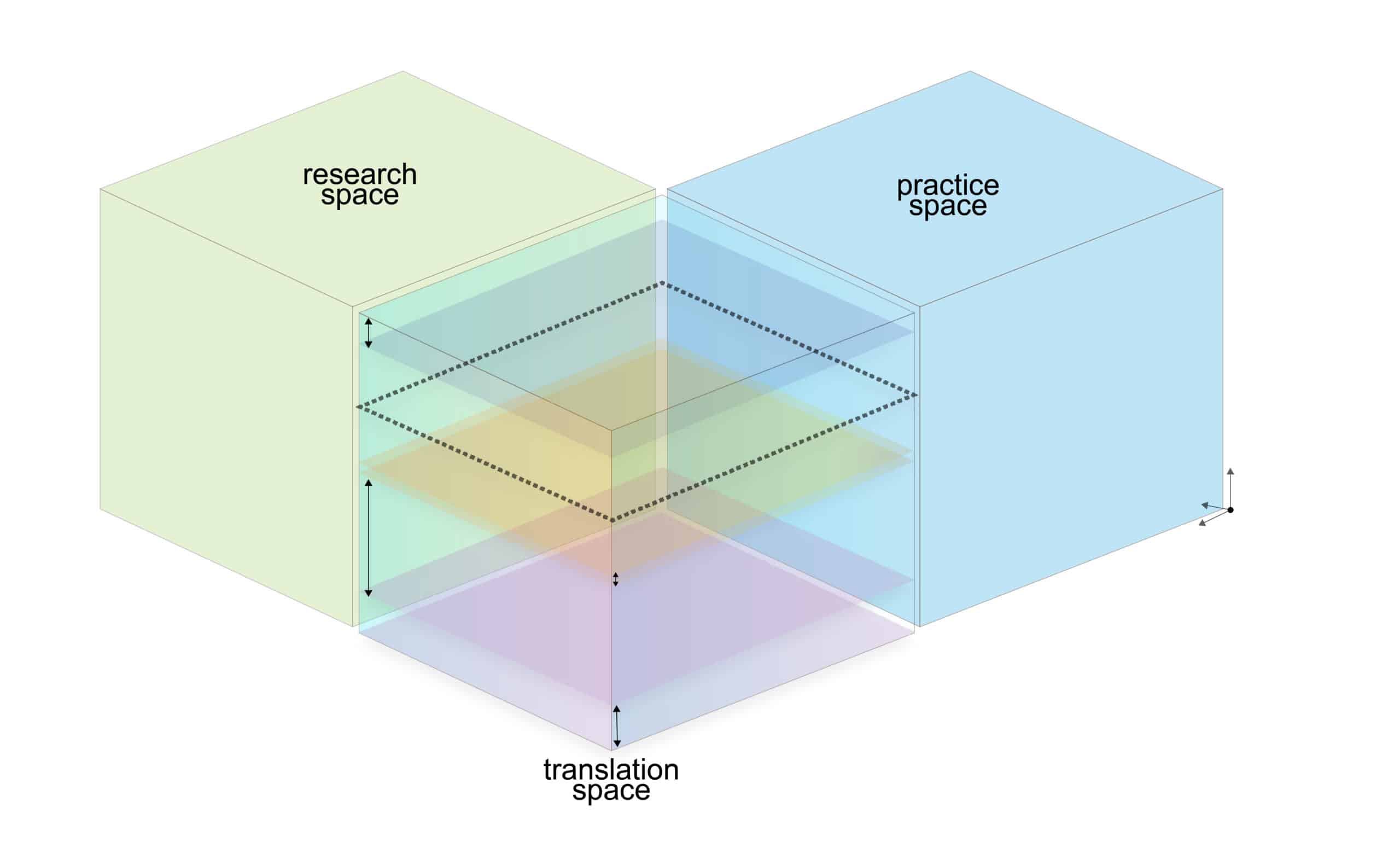
This contributes to a persistent issue: the proliferation of civic science activities has not been matched by structures that support the ongoing translation of insights across the vast landscape. More than ever, there is a need for approaches that can chronicle, interpret, and make these practices visible in real time (see Figure 2), to help prevent the loss of learning that occurs when domains operate in isolation. Civic science journalism is proposed here as one such approach—an emerging practice that surfaces connections, supports mutual learning, and helps ensure that promising insights are not lost.
So with that framing in mind, what then is civic science journalism?
Well, I describe it as an emerging branch of the broader solutions journalism existing at the intersection of three areas—civic life, science, and journalism (see Figure 3). Grounded in ethnography, the practice offers a documentation of the developing landscape of scholarship and practice across the civic science landscape. In a nutshell, it’s about covering the practice of civic science, or stated another way, the civic nature of science.

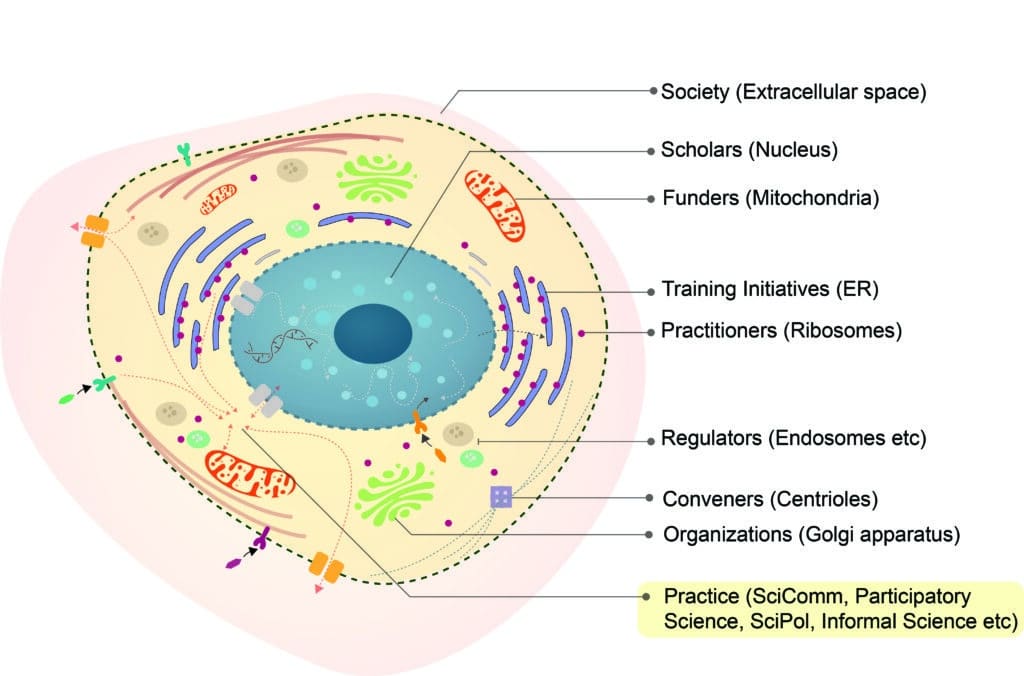
With that in mind, I believe civic science journalists would be motivated to unearth narratives and insights across the landscape, including science festivals, participatory science projects, science communication research, science policy work, and the broad spectrum of spaces where civic science practitioners are doing their work (see Figure 4). Civic science journalists would then examine the full range of activities from their conceptual stages to their execution. Their exploration might include covering the pathways in which artists and scientists are co-creating new knowledge, the impact of community citizen science projects, the launch of new science exhibits, the lessons learned from new research, exploring the experiences of practitioners that have gone unrecognized from conversations, dissecting the development of new civic science education initiatives, and so much more.
The potential topics for exploration are as diverse as the ecosystem of civic science. Ultimately, civic science journalists will likely strive to illuminate and analyze the multidimensional activities within civic science and the new insights they generate.
Yet, as civic science journalism takes its first steps, important questions must be addressed. Among these is better articulating the core objectives, which will likely vary across stakeholders. Identifying the target audiences is also critical — should this journalism be targeted just for scholars and practitioners within the field or to everyone? Assessing the impact of civic science journalism presents another challenge; it necessitates the usage of metrics that can effectively capture how it is tangibly impacting those who engage with the content. Moreover, it will be worthwhile to think about the sustainability of such journalism. For example, what type and level of support is needed to ensure its longevity and independence? Each of these questions underscores the need for a strategic framework to organize civic science journalism’s practice, principles, and boundaries.
In summary, as all these efforts take root, civic science journalists have the potential to become an important resource for civic science. There is still a ton to figure out, but similar to the original 2018 imperative for civic science, I believe there is now a growing imperative for civic science journalism.
Additional Reading
1. Navigating the Future: Civic Science Career Roadmap. Civic Science Fellows https://civicsciencefellows.org/stories/navigating-the-future-civic-science-career-roadmap/ (2023).
2. Christopherson, E. G., Scheufele, D. & Smith, B. The Civic Science Imperative. Stanford Social Innovation Review (2018).
3. Remarks by Dr. Neal F. Lane at AAAS Annual Meeting, 2/9/96 | NSF — National Science Foundation. https://www.nsf.gov/news/speeches/lane/slaaa.htm.
4. Garlick, J. & Levine, P. Where civics meets science: building science for the public good through Civic Science. Oral Dis. 23, 692–696 (2017).
5. Fischer, L., Barata, G. F., Scheu, A. M. and Ziegler, R. (2024). Connecting science communication research and practice: challenges and ways forward JCOM 23(02), E. https://doi.org/10.22323/2.23020501
6. Anjos, S., Russo, P. & Carvalho, A. (2021). Communicating astronomy with the public: perspectives of an international community of practice. JCOM 20 (03), A11. doi:10.22323/2.20030211

Fanuel Muindi is a former neuroscientist turned civic science ethnographer. He is a professor of the practice in the Department of Communication Studies within the College of Arts, Media, and Design at Northeastern University, where he leads the Civic Science Media Lab. Dr. Muindi received his Bachelor’s degree in Biology and PhD in Organismal Biology from Morehouse College and Stanford University, respectively. He completed his postdoctoral training at MIT.




In Michigan, a citizen science project tracking salamander migration is bringing a community together and building a dataset

“Science is something that we do together.” Benjamin Richards on how OceanEyes collaborates with citizen scientists to monitor deepwater fish in Hawai’i

Dear Colleagues: Participate in a survey on barriers researchers face when communicating with non-expert audiences

Research!America selects 17 grantees from 132 applicants for the 2026 Civic Engagement Microgrant cohort

Melanie Brown: “If you listen, people want to share things that are important to them.”
Dear Colleagues: Participate in a survey on barriers researchers face when communicating with non-expert audiences

Scott Loarie says conservation science isn’t moving fast enough. He describes how iNaturalist is helping

Photo Essay: 2026 Stand Up for Science New York City

MA3 Challenge awards grants to six universities to modernize promotion and tenure processes: Here’s the question of the day.
Research!America selects 17 grantees from 132 applicants for the 2026 Civic Engagement Microgrant cohort
“Science is something that we do together.” Benjamin Richards on how OceanEyes collaborates with citizen scientists to monitor deepwater fish in Hawai’i
Melanie Brown: “If you listen, people want to share things that are important to them.”

Abby C. King on leveraging local wisdom and science to create a thriving environment: “Our communities are the most valuable renewable resources for a healthy planet.”

Milky Way Project co-creator Grace Wolf-Chase says public engagement is ‘every bit as important as excellent scientific research’

Seeing is believing: Inside the BioBus revenue engine with Ben Dubin-Thaler
Contact
Menu
Designed with WordPress