
Questions of the Day Program
Seeing is believing: Inside the BioBus revenue engine with Ben Dubin-Thaler
“So much of it is just luck. I was privileged to have people around me who were able to pay my rent and help me survive during those early years.” — Ben Dubin-Thaler

On this second audio-only episode of Season 8 on the Questions of the Day program, I speak with Dr. Ben Dubin-Thaler, founder of BioBus (BIOB; CSF-INDEX), with a deliberate focus on funding to examine the organization’s financial story and how it has evolved since its founding.
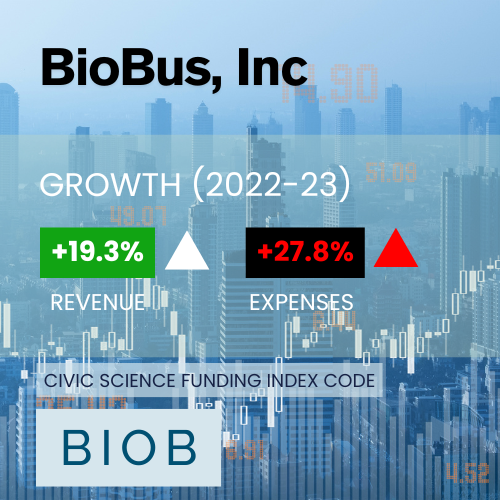
Some numbers provide context. According to IRS Form 990 filings, BioBus revenue increased from approximately $1.58 million in FY2020 to $5.52 million in FY2024 — a roughly 248% increase over five years. Expenses rose from $2.33 million to $4.26 million over the same period (an 83% increase). The organization that began with small family donations now operates at multi-million-dollar scale. Naturally, one might ask, How did they get there? I think a more useful question is this: What kind of impact data and early strategic positioning enabled them to get there?
Ben describes those early days plainly: “A family member and her friend both donated $500… we didn’t get another cash donation for years.” Much of the early support was in-kind, and “a lot of scientist friends… snuck out of the lab and spent a morning or an afternoon or a full day” volunteering on the bus. The first earned revenue came through a $500-per-day GEAR UP contract, which he describes as “the first earned revenue that we ever had… $2,500 for that week.”
What shifted the trajectory was not simply more grant writing. It was a reframing of how philanthropy works. “I had this idea early on that foundations… weren’t relationship based,” Ben tells me. “Now I know that most of the time it is very much relationship based.” Relationship cultivation, site visits, and exposure became strategic levers. “Seeing is believing,” he says. “If we can get people to come on the bus and actually see the magic that happens… they’re much more likely to understand what the heck you’re talking about.”
The conversation also surfaces constraints that are often unspoken. “So much of it is just luck,” Ben reflects, adding that he was “privileged to have people around me who were able to pay my rent and help me survive” during the early years. It took roughly three years before he could pay himself a salary. That detail alone raises a number of follow-up questions for other entrepreneurs in the space I plan to follow-up on.
Ben also tells me, “If you’re trying to build your programs out to your ideal dream program with all the bells and whistles… you’re never going to have time to network.” In other words, perfection can delay sustainability. That raises another question: when is the work good enough to begin engaging funders? What data points meaningfully signal readiness?

Today, BioBus employs four full-time development staff and tracks participation data systematically. Teacher return and recommendation rates, he reports, sit “in the 99 to even 100% range.” Government partnerships now complement foundation support. Elected officials, he notes, often “really know what the communities need… they know which schools need science the most.” At the same time, he acknowledges limits: “There’s only so much of it out there,” he says of private foundation funding.
Looking at the financials shows a significant revenue decline in FY2020, coinciding with the pandemic when in-person programming halted nationwide. Subsequent filings show revenue increases through FY2024 (see the CSF INDEX).
Questions for thought: Taken together, the BioBus financial story points to a set of questions that warrant systematic examination across the field. What revenue combinations do most initiatives in this space deploy, and how has that changed over time? What tipping points do civic science leaders typically watch for when deciding whether to expand, diversify, consolidate, or even pursue mergers or acquisitions? What capabilities should be built early versus later? How can initiatives design resilient revenue engines that can withstand macro-level shocks, such as the recent changes in the U.S. funding landscape?
Of course, there are well-established insights from both nonprofit management and venture-building literature to answer some of those questions. But it would be unwise to assume those lessons transfer wholesale to civic science entrepreneurial initiatives without careful examination of the sector’s unique constraints.
The key is in framing the right questions, and asking them at the right time.

Fanuel Muindi is a former neuroscientist turned civic science ethnographer. He is a professor of the practice in the Department of Communication Studies within the College of Arts, Media, and Design at Northeastern University, where he leads the Civic Science Media Lab. Dr. Muindi received his Bachelor’s degree in Biology and PhD in Organismal Biology from Morehouse College and Stanford University, respectively. He completed his postdoctoral training at MIT.





In Michigan, a citizen science project tracking salamander migration is bringing a community together and building a dataset

“Science is something that we do together.” Benjamin Richards on how OceanEyes collaborates with citizen scientists to monitor deepwater fish in Hawai’i

Dear Colleagues: Participate in a survey on barriers researchers face when communicating with non-expert audiences

Research!America selects 17 grantees from 132 applicants for the 2026 Civic Engagement Microgrant cohort

Melanie Brown: “If you listen, people want to share things that are important to them.”
Dear Colleagues: Participate in a survey on barriers researchers face when communicating with non-expert audiences

Scott Loarie says conservation science isn’t moving fast enough. He describes how iNaturalist is helping

Photo Essay: 2026 Stand Up for Science New York City

MA3 Challenge awards grants to six universities to modernize promotion and tenure processes: Here’s the question of the day.
Research!America selects 17 grantees from 132 applicants for the 2026 Civic Engagement Microgrant cohort
“Science is something that we do together.” Benjamin Richards on how OceanEyes collaborates with citizen scientists to monitor deepwater fish in Hawai’i
Melanie Brown: “If you listen, people want to share things that are important to them.”

Abby C. King on leveraging local wisdom and science to create a thriving environment: “Our communities are the most valuable renewable resources for a healthy planet.”

Milky Way Project co-creator Grace Wolf-Chase says public engagement is ‘every bit as important as excellent scientific research’

Seeing is believing: Inside the BioBus revenue engine with Ben Dubin-Thaler
Contact
Menu
Designed with WordPress