
Civic Science Observer
SciArt community reflections spark a desire for Third Spaces
This was an incredible opportunity to learn from practitioners around the globe and highlight how Third Spaces foster forward-looking opportunities by encouraging new ways of thinking.
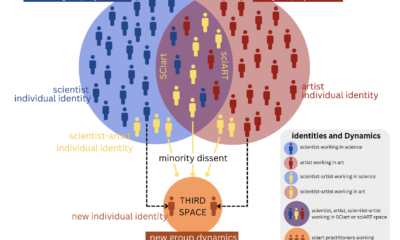
At the end of 2025, we published a JCOM paper that grew out of a particularly engaging and extremely enjoyable collaboration between Karleigh Groves, Fanuel Muindi, and myself, where we discussed how examining science and art collaborations through a social psychology lens reveals the need for Third Spaces. This essay contributes to the existing literature on the relationships between science, art, and their practitioners. In a nutshell, in our essay:
- We examine the evolving field of SciArt (Science + Art) and the personal and interpersonal challenges that arise in collaborations between artists and scientists.
- Drawing on social psychology, we argue that overcoming collaboration barriers requires more than simply intersecting the two fields within existing institutional environments.
- We advocate for Third Spaces as new, independent environments where practitioners build a shared group identity, establish group norms, and define collective goals, to promote balanced collaboration, exploration, and innovation.
From the outset, this project was never meant to be a closed-door conversation. Instead, we envisioned it as a starting point for exchange among those who are already working at the intersection of science and art, those who have already created Third Spaces, and those who are curious to see what that looks like or would like to join one.
To support this, we experimented with a different format: we shared our paper on LinkedIn and invited readers to contribute their perspectives through a short form, where we asked to share any benefits or challenges associated with Third Spaces for science and art. The response exceeded our expectations: the post sparked great engagement, with over 270 people reacting or reposting and more than 30 art, science, and SciArt practitioners and curators from diverse disciplines (e.g., biochemistry, cell biology, neuroesthetics, science communication, social sciences, graphic art, neuroscience, and environmental justice, to name a few), sharing their perspectives and reflections through LinkedIn comments or via our submission form:
Contributing practitioners (bios below)
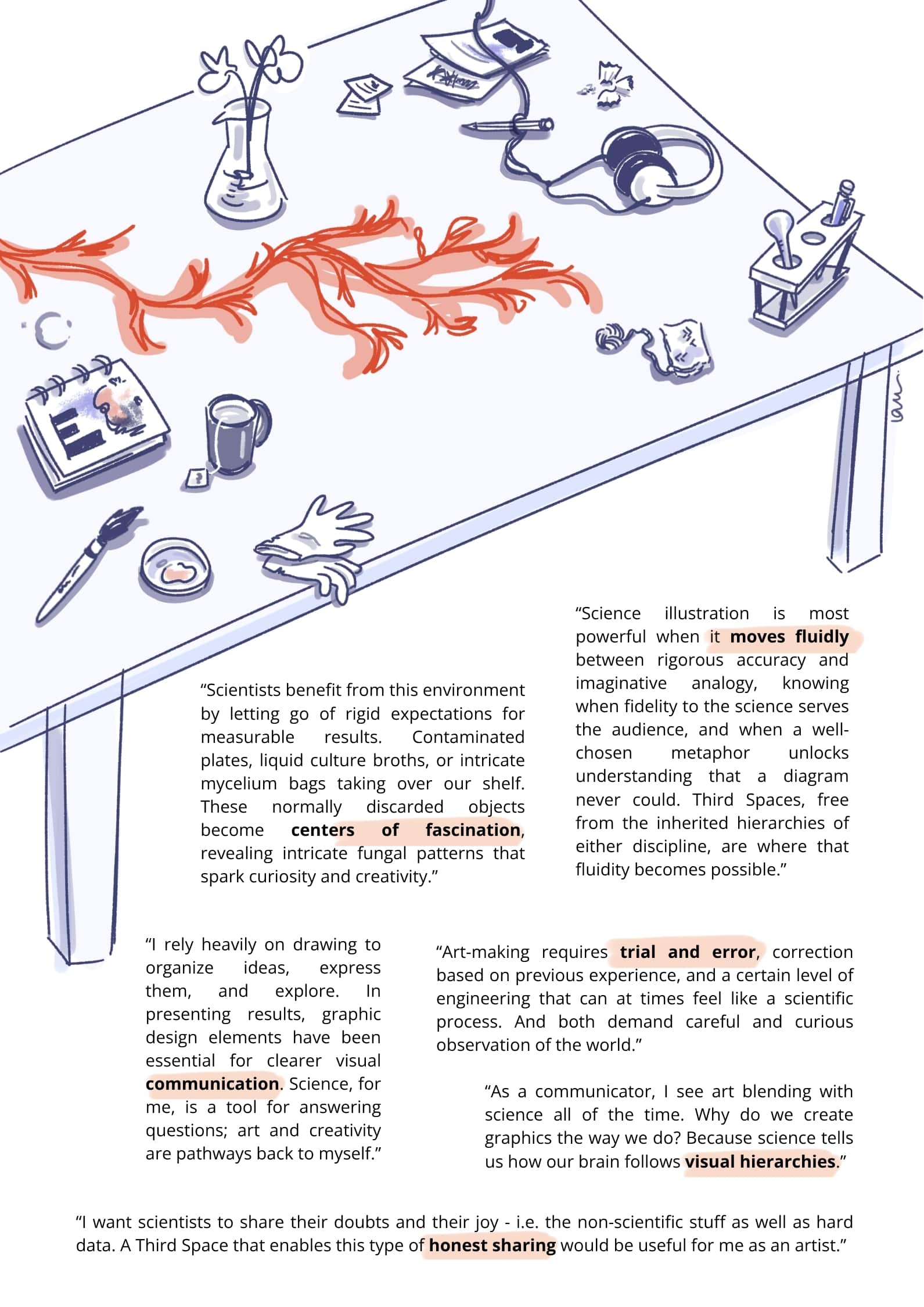
The wide-ranging backgrounds and expertise of the practitioners we engaged with is a clear sign that the SciArt community is buzzing. They reveal a clear desire and curiosity for collaborative spaces that bring together diverse disciplines, helping move beyond the science–art dichotomy and fostering more diverse ways of thinking and interacting with one another. The illustration below, created by illustrator and visual facilitator Laura Moya, captures some of the most striking contributions and gives physical form to the idea of Third Space as shaped by the practitioners themselves:
Supporting what we discuss in our essay, contributing practitioners pointed to several persistent barriers to science–art collaboration. Interdisciplinary work, they noted, is often hindered by institutional structures and hierarchical, gatekeeping cultures, in which “artists [are] treated as ‘the help’” and public-facing scientists are looked down on by peers as “less pure scientists.”

Many respondents traced these challenges back to a deeply entrenched binary model of science and art.
Breaking down this divide, they argue, requires moving beyond “prejudice,” “power imbalances,” and “rigid expectations,” as well as the fear of “failure” or of producing work perceived as lacking “significant scientific merit.” Others highlighted more structural constraints, including “constraints of habit standards,” professional “obligations,” and “profit-oriented goals or conventional funding models.”

These barriers make the existence of intersecting spaces or Third Spaces not very common and the creation of Third Spaces “a time-intensive and resource-demanding process” that “might not be sustainable or long-term.”
While these obstacles are widely acknowledged, they are often experienced as frustrating, especially due to the sense of non-belonging and isolation that some feel in siloed spaces. As one contributor put it, “I’ve never really felt like I belonged in either science or art,” while another noted, “I am too Sci-Tech-Med-Ed for Arts and too Tech-Art-Med-Ed for Science,” and a third observed, “both areas can be intimidating to get into if you’re not a professional of either.”

This shared experience of exclusion underscores the need for spaces where a “neutral ground for discussion” is promoted and that “respect both worlds.”
Taken together, hearing from practitioners who have been reimagining their own identities and community spaces underscores the need for Third Spaces and the opportunities they provide. Overall, 83% of survey respondents answered “Yes” to the question in our form that asked “Is the creation of Third Spaces beneficial for fostering more fruitful, balanced, and innovative science–art interdisciplinary collaborations?” while 17% responded, “It depends.” Practitioners emphasized that these spaces allow participants to “think laterally,” “step outside the box,” and gain “a broader perspective” by loosening methodological constraints, fostering “creativity,” and leading to “richer and more innovative outcomes.”

Third Spaces support experimentation beyond conventional boundaries, enabling collaborations to “reveal complex growth patterns and insights that would not emerge in a standard lab” and encouraging discoveries that are “richer, unexpected, and in turn rewarding.”
As one contributor explained, “bringing art and design into my daily scientific practice has opened doors I didn’t know existed.” Contributors further noted that such environments help participants communicate in a more accessible way, moving “out of our jargon mindset” and finding language that “makes sense on a human level.” Beyond practical opportunities, Third Spaces act as a catalyst for reflection and growth.

They can “unseat both scientists and artists” and encourage a “paradigm shift” toward more open-minded, sustainable, and collaborative ways of working, attracting participants “driven by passion and curiosity” who can “learn from each other.”
Overall, this was an incredible opportunity to learn from practitioners around the globe (see bios below) and highlight how Third Spaces foster forward-looking opportunities by encouraging new ways of thinking, richer experimentation, collaborative identity-building, and innovation. Such spaces hold the potential to reshape the dynamics of both scientific and artistic communities.
Contributor bios
Arianna Zuanazzi
Arianna Zuanazzi is a neuroscience researcher interested in language and multisensory processes, open science, and mental health. Dr. Zuanazzi holds a B.A. and M.A. in Linguistics, and an M.Sc. and Ph.D. in Cognitive Neuroscience, and completed her postdoctoral training at New York University. Dr. Zuanazzi is also a Resident Scholar in the Civic Science Media Lab’s Resident Collective, where she researches the space between science and art and fosters SciArt collaborations.
Laura Moya
Laura Moya is an illustrator and visual facilitator working across communication, learning, and editorial contexts. Her work translates complex ideas into clear, accessible visuals for diverse audiences. She is co-founder of LAB Madrid, a non-profit that develops participatory projects and visual resources to share knowledge.
Karleigh Groves
Karleigh Groves is a social psychology Ph.D. student in the Department of Psychology at Lehigh University. Her research interests are broadly in identity and group dynamics, with a focus in multiple identities, identity flexibility and fluidity, and how identity dynamics influence intergroup relations.
Fanuel Muindi
Fanuel Muindi is a Professor of the Practice in the Department of Communication Studies in the College of Arts, Media and Design at Northeastern University where he serves as Founder and Director of the Civic Science Media Lab. Dr. Muindi is a former neuroscientist turned civic science entrepreneur and ethnographer. He received his Bachelor’s degree in Biology from Morehouse College, Ph.D. in Organismal Biology from Stanford University, and completed his postdoctoral training in the Department of Brain and Cognitive Sciences at MIT.
Anna Anandita
Anna Anandita holds a PhD in Chemical Engineering from IIT, specializing in biosensors, microfluidics, and nanomaterials for healthcare diagnostics. Dr. Anandita’s research focuses on nanozyme synthesis, immunoassay device modeling, and enzyme-based cancer biosensors. With extensive experience in research, publications, and presentations, she is also a passionate science communicator. Anna creates accessible content for diverse audiences and leads outreach initiatives, using storytelling and cross-disciplinary approaches to enhance the impact and inclusivity of science.
Harshini Anand
Harshini Anand is a neuroscience PhD scholar, artist, and musician interested in the overlap of brain science, music, and visual storytelling. Her work looks at how music and rhythm influence cognition in children. Outside of research, she enjoys turning complex ideas into simple, engaging visuals through comics and illustrations. She strongly believes that the way something is presented changes how we understand and connect with it.
Jacqueline P. Ashby
Jacqueline P. Ashby is an educator and researcher focused on advancing medical education through curriculum design, faculty development, and responsible AI use. My work is driven by a commitment to innovation, equity, and meaningful learning in healthcare. I am especially interested in creating learning environments that support curiosity, reflection, and growth.
Zoe Chernova
Zoe Chernova is a science communicator and writer, former biochemist. Zoe is constantly searching for the line between art and science, and hopes to do something in between.
Carmelius Cohen
Carmelius Cohen is a London-based science illustrator and animator, specialising in visual storytelling at the intersection of science and art. Through his creative persona “the fictional scientist,” he translates complex research into engaging visuals for audiences of all ages across books, live science shows, and multimedia formats. He helps people not just understand science, but feel part of it.
Rachel M. Jardin
Rachel M. Jardin is an arts & wellbeing researcher from the Philippines who runs her own research consultancy firm called Whimsy Interdisciplinary Research and Development (WIRD). She holds a Master’s Degree in Neuroaesthetics from Goldsmiths College, University of London. Besides arts & wellbeing, she is interested in Cyberpsychology and mental health.
Jubeena Judi Joe
Jubeena Judi Joe is a sustainability researcher and design professional from India, currently pursuing an MBA in Forestry Management at the Indian Institute of Forest Management, Bhopal. Her work lies at the intersection of design, climate change, environmental justice, and science communication. Jubeena has contributed to international climate research initiatives, including the Net Zero Tracker (University of Oxford), and the Feinstein International Center (Tufts University), supporting climate adaptation and resilience studies. As a research intern at the Environmental Justice Atlas (ICTA-UAB, Barcelona), Jubeena documented environmental conflicts in the renewable energy sector, emphasising equitable and participatory governance. With a background in design from NIFT Chennai and experience as the Founder of Design Tree, Jubeena brings creative storytelling to sustainability and climate communication. Jubeena is passionate about creating Third Spaces that bridge science and art to foster inclusive and transformative climate dialogue, and has recently organised a Living Lab at the Adaptation Futures 2025 Conference in New Zealand, translating climate research into accessible comic narratives.
Cat Lau
Cat Lau is a former behavioural neuroscientist-turned-visual science communicator and knowledge mobilizer based in Tiohtià:ke/Montréal. With one foot in scientific research and another in art and design, she bridges these two disciplines to make information more accessible for different communities. She integrates playful illustrations into her communication deliverables and has collaborated alongside people with lived experiences, youth, family/carers, Indigenous communities, researchers, and health professionals. As a founding member of Art the Science (a Canadian non-profit SciArt organization), she helped pilot their first science-art residency by leading the evaluation to provide meaningful documentation and research to support cross-disciplinary collaborations. She is also an avid bicyclist and outdoors adventurer, who supports BIPOC representation and community in outdoor spaces.
Aaron Mayper
Aaron Mayper is a visual strategist with a background in illustration, graphic facilitation, and design thinking. For over a decade, he has helped educators and business leaders communicate complex concepts through informative imagery, and to collaborate more effectively through the power of visualization. He is the primary illustrator of BioKomix, a NSF funded Biology 101 comic text book developed by Dr. Shayla Williams of Albany State University.
Virpi Oinonen
Virpi Oinonen is a visual essayist/cartoonist/communicator for 13 years based in Finland.
Fiorella Ruiz-Pace
Fiorella Ruiz-Pace is a biologist with a master’s in statistics, currently studying a Design degree at UOC University. Fiorella works in translational oncology at VHIO as research support technician, focusing on biostatistics and visual communication.
Inês Pinto e Sousa
Inês Pinto e Sousa is an independent curator working from Lisbon, Portugal. She completed her BA in Design at IADE, Lisbon and a MA in Marketing and Communications at University of Westminster, London. She has worked as a marketing professional for the tech and hospitality industries. She also has a MA in Art History from Universidade Nova de Lisboa – FCSH, and was the recipient of the first research grant attributed by Fundação Júlio Pomar. Inês collaborates with international artists in the creation of exhibitions, artwork series, and editorial work. She has participated in artistic and cultural projects in galleries, cultural platforms and non-traditional spaces across Portugal and Europe. Inês is interested in works and artists who tell stories about our contemporary world and the human experience throughout the centuries, in projects that aim to bring art and people closer together.
Sanika Pradhan
Sanika Pradhan is a scientist by training and an artist by heart, currently working at ASCUS Art & Science – A publicly accessible third space Lab based in Edinburgh.
Kendall Rovinsky
Kendall Rovinsky writes press releases and feature stories about biomedical research and patient experiences, fields local and national media requests, and develops social media content at UNC Health and the UNC School of Medicine. She is particularly passionate about communicating science to members of the American public.
What follow-on actions did the insights above spark for you?







Did You Know: A museum dedicated to the brain is being developed in Southern California?

Peer teaching as empowerment? Exploring NeuroBoricuas with Dr. Christian Bravo-Rivera

STEM Unbarred: What the initiative is learning about hands-on science for incarcerated youth

San Francisco Bay Area climate resilience group helps local communities talk about extreme heat

Did You Know: Kirtland’s Warbler Festival in Michigan is engaging the local community in celebrating and conserving the once-endangered songbird through educational events

Questions, biology-based environmental stewardship, and accessibility are at the center of Bio4Climate’s annual conferences
Did You Know: Kirtland’s Warbler Festival in Michigan is engaging the local community in celebrating and conserving the once-endangered songbird through educational events
San Francisco Bay Area climate resilience group helps local communities talk about extreme heat
STEM Unbarred: What the initiative is learning about hands-on science for incarcerated youth
Peer teaching as empowerment? Exploring NeuroBoricuas with Dr. Christian Bravo-Rivera
Did You Know: A museum dedicated to the brain is being developed in Southern California?
STEM Unbarred: What the initiative is learning about hands-on science for incarcerated youth

Exploring workforce needs and intergenerational learning in informal STEM education

Making a Mini-Forest: participatory science afforestation across the globe

18 months later, Casey Lardner from Genspace says, “we’ve been really focused on building systems”
Contact
Menu
Designed with WordPress