
Civic Science Observer
Recommended strategies to integrate public engagement and civic science training into graduate STEMM education
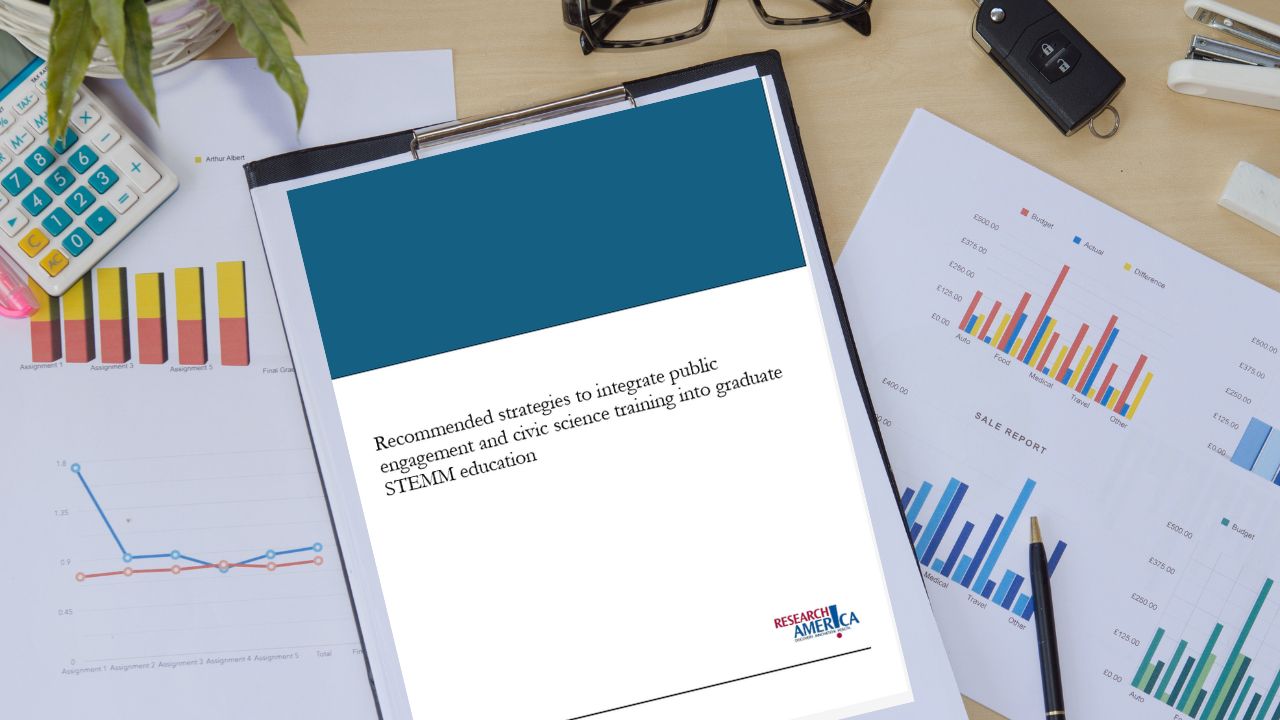
Over the past year, I had the opportunity to serve as one of the 26 advisers of a national working group convened by Research!America, co-chaired by Alan Leshner and Keith Yamamoto, and supported by the Rita Allen Foundation. Our charge was to develop concrete strategies for embedding public engagement and civic science into graduate training in science, technology, engineering, mathematics, and medicine (STEMM). The result is a set of ambitious, yet practical, recommendations for universities, federal agencies, and philanthropic funders.
The core argument is simple: Scientists should learn to engage with the public as part of their formal education. Not only because public trust in science is at stake, but because meaningful engagement with communities strengthens science itself.
Here’s a snapshot of what the working group recommended:
- Universities should declare public engagement training a core priority, integrate it into existing coursework, and provide staff and funding to support it. It should be recognized in tenure policies and supported across departments.
- Federal agencies such as the NSF and NIH can play a catalytic role. By using training grants and programs such as T32 and NRT, they can gradually phase in public engagement requirements. Just as NIH’s BEST program once modernized career training, a similar effort could prototype scalable engagement curricula.
- Philanthropies have long championed this space. The working group recommends that funders go further—embedding public engagement components in research grants and investing in the pedagogy of engagement itself, so we can learn what works, and why.
- Read the full details of the recommendations here

Fanuel Muindi is a former neuroscientist turned civic science ethnographer. He is a professor of the practice in the Department of Communication Studies within the College of Arts, Media, and Design at Northeastern University, where he leads the Civic Science Media Lab. Dr. Muindi received his Bachelor’s degree in Biology and PhD in Organismal Biology from Morehouse College and Stanford University, respectively. He completed his postdoctoral training at MIT.





In Michigan, a citizen science project tracking salamander migration is bringing a community together and building a dataset

“Science is something that we do together.” Benjamin Richards on how OceanEyes collaborates with citizen scientists to monitor deepwater fish in Hawai’i

Dear Colleagues: Participate in a survey on barriers researchers face when communicating with non-expert audiences

Research!America selects 17 grantees from 132 applicants for the 2026 Civic Engagement Microgrant cohort

Melanie Brown: “If you listen, people want to share things that are important to them.”
Dear Colleagues: Participate in a survey on barriers researchers face when communicating with non-expert audiences

Scott Loarie says conservation science isn’t moving fast enough. He describes how iNaturalist is helping

Photo Essay: 2026 Stand Up for Science New York City

UNESCO-backed platform seeks to encourage information sharing among freshwater management citizen science projects

MA3 Challenge awards grants to six universities to modernize promotion and tenure processes: Here’s the question of the day.
“Science is something that we do together.” Benjamin Richards on how OceanEyes collaborates with citizen scientists to monitor deepwater fish in Hawai’i
Melanie Brown: “If you listen, people want to share things that are important to them.”

Abby C. King on leveraging local wisdom and science to create a thriving environment: “Our communities are the most valuable renewable resources for a healthy planet.”

Milky Way Project co-creator Grace Wolf-Chase says public engagement is ‘every bit as important as excellent scientific research’

Seeing is believing: Inside the BioBus revenue engine with Ben Dubin-Thaler
Contact
Menu
Designed with WordPress