
CSML Audio Studio
Meagan Naraine reflects on the emergence of the nonprofit Culturally Relevant Science and how it aims to thrive.
In this 18th episode of Consider This Next from our audio studio, host Kacie Luaders speaks with Meagan Naraine, co-founder and executive director of Culturally Relevant Science, an Atlanta-based nonprofit developing K–12 science curriculum that centers students who have historically been left out of it. Drawing on nearly a decade as a classroom biology teacher, Naraine reflects on how the organization emerged from her experience teaching in South Atlanta and how her founder story became a competitive advantage. She also discusses why proximity to your audience is a strategic asset and what aspiring civic science entrepreneurs should know about building a venture while still working in the field. The transcript below has been edited for clarity and length.
Kacie: Welcome to Consider This Next, an audio program from the Civic Science Media Lab. I’m your host, Kacie Luaders. This show is for civic science entrepreneurs finding new ways to connect scientific knowledge with community action. Each episode, we’ll talk with practitioners who are rethinking how science gets shared, who it reaches, and what it can accomplish. Today, I’m speaking with Meagan Naraine, co-founder and executive director of Culturally Relevant Science, an Atlanta-based nonprofit on a mission to make K–12 science curriculum more representative of the students who have historically been left out of it. Meagan’s path to civic science entrepreneurship started in the classroom as a Teach For America biology teacher working with students in South Atlanta. What she found there, and what she decided to do about it, set the entire trajectory of what Culturally Relevant Science is today. In our conversation, we dig into what it actually looks like to build a science communication organization from the inside of the problem you’re trying to solve and what teachers can teach the rest of us about being in community with your audience. So on today’s episode of Consider This Next, we have a friend of the Civic Science Media Lab joining us once again. Meagan, welcome back.
Meagan Naraine: Thank you, Kacie. It’s good to be back.
Kacie: So for folks who may not be aware, would you mind introducing yourself and telling us a little bit more about what you do?
Meagan Naraine: Yeah. I’m Meagan Naraine, and I’m the executive director and co-founder of a local Atlanta nonprofit called Culturally Relevant Science. What we do is develop K–12 science curriculum for teachers to use in their classrooms that is more representative of normally underrepresented students, mainly Black and Brown students, women, queer students, really any population that has traditionally been left out of textbooks. That’s what we do. We develop curriculum, and we also train teachers on how to use that curriculum and give them a better toolkit to be more intentional about including those populations. We also do a lot of community outreach with local museums and other nonprofit organizations to expose those populations to science and STEM as a whole.
Kacie: So you are a science communicator, science educator, and science entrepreneur. I would love to chat with you about all of those paths and how they converged into what it is that you do. Starting with the science educator piece, can you tell us a little bit more about your background?
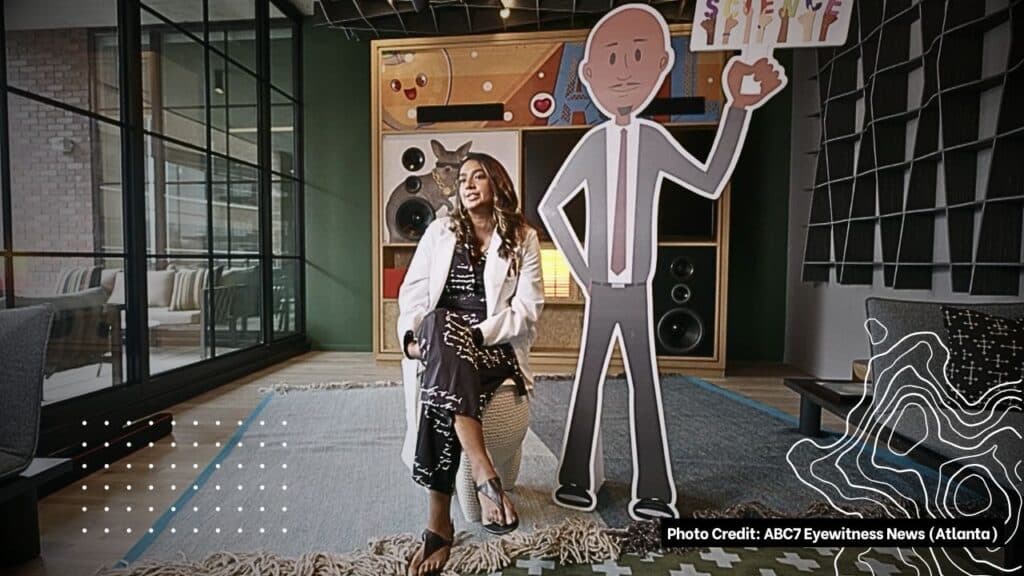
Meagan Naraine discusses the mission of Culturally Relevant Science during an interview with ABC7 Eyewitness News in Atlanta. Photo credit: ABC7 Eyewitness News (Atlanta). Watch the interview here.
Meagan Naraine: Yes. It is all in science education. I grew up in Guyana, which is part of the West Indies in the Caribbean, and I wanted to be a doctor my whole life. So I was on that track. I went to Emory and did the pre-med track, and I realized that while it was really cool, I wasn’t really passionate about it. When I graduated from Emory, I took a gap year and joined an organization called Teach For America. What Teach For America does is place either career changers or recent college graduates into classrooms or schools that are underserved, as they like to say, to fill those classrooms with people who don’t go through the normal educational track to become a teacher. I got placed in South Atlanta, South Fulton, at a school that was predominantly Black and Brown. One hundred percent of their students were deemed low income, and I got placed in the biology classroom. Biology is actually a state test in Georgia, so when you are a state-tested subject teacher, there’s a lot of pressure on getting your kids prepared and ready to pass that exam. When I was in the classroom during those years, I realized a lot of the curriculum handed to me and expected of me to teach to my Black and Brown students wasn’t really engaging or representative of them. It was outdated, boring, or lacked their colors in it. So what I decided to do, which a lot of teachers actually do, was make my own materials. Making your own materials requires developing slideshows, worksheets, and all these things and working overtime just so that your kids can understand it better and enjoy it more. As I was doing that, I met my co-founder, Tamara Mickey. He was a teacher at my school and also my instructional coach at that time. He was doing something similar, but on a video level. He was making animated videos and live-action videos to better help our students understand the science. When I saw what he was doing and what I was doing, and we were both getting phenomenal test score results, high engagement from our students, and visitors who wanted to come see our classrooms, I reached out to him and said we should turn this into something. We didn’t know what it was going to be yet. COVID had just started and we needed to go completely virtual. So we started as a YouTube channel and a small digital learning hub where teachers could get our videos and worksheets for free. It’s actually very funny, because we were both Teach For America teachers, and Teach For America saw us start this idea. We weren’t even incorporated yet as a nonprofit. We were just an idea. They saw us start it and reached out and said we should go through their Social Innovation Fellowship. That was our first time really thinking the idea could become an actual organization. My co-founder had been a science educator for over ten years, and I’m going on year nine in science education. We fell into education through life’s goals, and that’s where our passion was.
Kacie: So you stepped through the three pillars I was curious about: how you got into education, how your science communication evolved as part of your teaching work, and then how you moved into the entrepreneurship space. I would love to talk to you more about that. Your company is a nonprofit organization. Can you tell us about the pathway that led you to decide that starting your own company was the best way to solve these problems?
Meagan Naraine: Yeah. I think a lot of that came from the first fellowship we did through Teach For America. A lot of teachers fail to view themselves as all the things that they are. I remember doing an interview in a very early stage and saying, “I’m just a classroom teacher.” The person interviewing me said, “Don’t ever say that again.” Classroom teachers are therapists, babysitters, educators, project managers. They do all of these things. It took a while for me to step into the business side of things because what I enjoyed most was impacting students. In that first Social Innovation Fellowship from Teach For America, Samantha Lurie, our first business coach, really pushed us. She said we needed to incorporate and pitch at the culminating Shark Tank event. The only way we could pitch was to get incorporated, so we took those steps and pitched. That was the first form of funding we got. We won first place. My co-founder and I looked at each other and said, maybe we actually do have an idea that can scale and help more teachers and students. The support of the community, the Teach For America network, the school we worked at, and our YouTube channel growing organically all helped. Teachers from all over the country and the world were watching our animated videos. Seeing that first $5,000 prize and seeing subscribers from places like China, the Philippines, and states we’d never been to helped us make the transition.
Kacie: So Culturally Relevant Science started gaining traction through fellowships, pitch competitions, and funding. I’m sure people often ask you for your elevator pitch or value proposition. What makes you different from other companies in this space?
Meagan Naraine: I think what makes us stand out from other educational companies, curriculum providers, or ed-tech companies is our direct placement in classrooms. When we incorporated, we were both still working at a school, and I still work at a school today. People loved our founder story. We were both Black and Brown, both queer, and both people with strong science skills who were passionate about transforming curriculum into something more representative. Across grants, accelerators, and fellowships, our founder story stood out. As we developed, we also saw that no other curriculum provider focuses on representation in their curriculum every day. You might see a few activities or case studies here and there, but we want the pictures, names, activities, and scientists represented every day. We want students to see themselves in science daily. That’s still not being done consistently, maybe even less so now. So I think it’s the founder story combined with our intentionality about representation.
Kacie: You have multiple audiences you have to speak to. On the business side, you speak to funders and partners, but students are your core audience. What have you learned from the feedback or responses you’ve received from students?
Meagan Naraine: It’s funny you say that. Students are our direct beneficiaries, but teachers give us the most beneficial feedback. In a lot of the pilots we run and with early-adopting teacher customers, we include them in the curriculum development process. It goes back to teachers being viewed as professionals. Sometimes they fail to see themselves that way, and sometimes others fail to see them that way. We give our curriculum to teachers and ask what works, what doesn’t, what could be improved, and how it worked in their classroom. When you include teachers in that process, the product becomes unbeatable. If you are selling products to schools, you have to be in schools. You have to talk to teachers and students and observe whether students are engaged or bored. It’s that direct relationship and incorporating feedback into the next stage of the product that makes the difference.
Kacie: With entrepreneurship, there are always risks. You’re building something and sustaining it. In your case, you still work in a school. How do you balance building a nonprofit while continuing your professional practice?
Meagan Naraine: Balance is something I’m still learning. But when your craft and passion align with your vocation, it’s easier than starting a business unrelated to your day job. I’m lucky that I work in a school where what I create through my nonprofit can also be used at the school. They go hand in hand. For anyone working a job while starting a business, alignment makes it easier. It does get overwhelming when both are busy. Some days it’s like one has to give. I’m approaching the point where it’s getting hard to do both. But for anyone doing both right now, you’re not alone. Leave your job when you know you can sustain yourself and your lifestyle through your venture.
Kacie: That leads into my next question. In entrepreneurship we’re often asked about our three- or five-year plan. What does success look like for Culturally Relevant Science in three to five years?
Meagan Naraine: In three years, I’m giving myself two more years to keep doing both jobs. By year three, success would look like more schools and districts on recurring contracts using our curriculum, building a team that can develop more courses, and expanding across grade levels and states. Right now I’m in my team-building era. I’m figuring out what I can delegate so I can focus on what’s most important to me, which is developing curriculum. I don’t think I would ever want to give that up because that’s how I started. I want someone to handle community outreach, social media, contracting video production, and managing the tech platform we’re building. Once those roles are filled, I can focus on curriculum. With more curriculum, we can onboard more schools, grade levels, and students. Once contracts and grants grow through larger impact, by year three I can step away from my day job and run the organization full time across multiple states and grade levels.
Kacie: I’m curious if your background as a science educator shapes how you approach entrepreneurship. Is there any discipline or systems thinking from education that influences your work as an entrepreneur?
Meagan Naraine: Yes. The mission of Culturally Relevant Science is that seeing is believing. Students should see themselves represented in the path they want to pursue. No one in my immediate family has started a business at this scale. As a science educator working in schools where systems are stacked against the students you serve, yet still seeing gains and engagement, you learn to identify missing pieces. That mindset carries into the nonprofit every day. Teachers grind, often overworked and underpaid, but still committed to impact. I learned creativity from working in under-resourced schools. Going to the grocery store to buy supplies cheaply so my students could still do experiments—that mindset carries into nonprofit work. Funding gets cut and budgets shrink, but the goal is still to make the same impact. That creativity and resilience came directly from teaching in those schools. I want the nonprofit to show that representation isn’t just something for a few weeks. It’s needed every day, everywhere.
Kacie: If someone listening wants to learn more about your work or support your mission, how can they find you?
Meagan Naraine: You can find me through our nonprofit, Culturally Relevant Science Incorporated. The website is www.crsci.org. You can fill out a form there and grab my email or LinkedIn. You can also reach out to me directly on LinkedIn: Meagan Naraine. I’m always willing to meet, chat, partner, or collaborate. It’s important to talk to people who are living this work. I’m never too busy to meet, so check out our website and keep up with the work we’re doing.
Kacie: Now that we’ve heard from Meagan about building Culturally Relevant Science, if you’re a current or aspiring civic science entrepreneur, consider this next. Are you building feedback loops directly into your model? Meagan didn’t just pilot her curriculum and move on. She brought teachers into the development process as ongoing collaborators. For civic science entrepreneurs, proximity to the people you serve isn’t a nice-to-have. It’s your product advantage. What is your founder story, and is it doing work for you? Meagan is clear that Culturally Relevant Science’s competitive edge isn’t just the curriculum. It’s the lived experience behind it. When you’re pitching grants, fellowships, or partners, what positional knowledge do you bring that no one else can replicate? If you’re still employed while building your organization, how aligned are the two? Meagan’s advice is practical: the closer your day job and venture are, the more sustainable the overlap becomes. If you’re waiting for the perfect moment to go all in, wait until you can sustain yourself, and not a moment before. Finally, what’s your three-year picture? Meagan has a specific vision: recurring district contracts, a delegated team, and protected time for the work only she can do. Vague ambitions don’t survive the grind of civic entrepreneurship. What does success actually look like for you, and what do you need to delegate to get there? Before we sign off, I’d like to thank you, our listeners, for tuning in and engaging with these topics. If you found value in this podcast, please subscribe, rate, and review. Your support helps us continue to bring you insightful conversations like this one. Until next time, keep nurturing your curiosity and stay connected to the science all around you. This is Kacie Luaders signing off for Consider This Next, an audio program from the Civic Science Media Lab.
Audio programs on the CSML Network feature in-depth interviews with diverse experts who share actionable insights from their work on topical issues in civic science from multiple perspectives. The audio format provides guests with an additional way to share new insights, creating a synergistic effect with other programs on the network, on video and digital print.






Risa Schenbly’s journey to researching ecological grief and telling its stories

After School Science: Wild New York City — BioBase Harlem in pictures

SciArt community reflections spark a desire for Third Spaces

Dear Colleagues: This is why science communication needs visuals

In Michigan, a citizen science project tracking salamander migration is bringing a community together and building a dataset

Dear Colleagues: Participate in a survey on barriers researchers face when communicating with non-expert audiences

Research!America selects 17 grantees from 132 applicants for the 2026 Civic Engagement Microgrant cohort
In Michigan, a citizen science project tracking salamander migration is bringing a community together and building a dataset

“Science is something that we do together.” Benjamin Richards on how OceanEyes collaborates with citizen scientists to monitor deepwater fish in Hawai’i
SciArt community reflections spark a desire for Third Spaces
Risa Schenbly’s journey to researching ecological grief and telling its stories
“Science is something that we do together.” Benjamin Richards on how OceanEyes collaborates with citizen scientists to monitor deepwater fish in Hawai’i

Melanie Brown: “If you listen, people want to share things that are important to them.”

Abby C. King on leveraging local wisdom and science to create a thriving environment: “Our communities are the most valuable renewable resources for a healthy planet.”

Milky Way Project co-creator Grace Wolf-Chase says public engagement is ‘every bit as important as excellent scientific research’
Contact
Menu
Designed with WordPress