
Local Perspectives Program
How students become ‘farmer scientists’ in hydroponic classrooms — From NYC to Birmingham
In this episode of CivicSciTV’s Local Perspectives Program, I sat down with Manuela Zamora, the executive director of NY Sun Works, a nonprofit that has introduced more than 350 hydroponic classrooms across New York City, serving over 140,000 students. I wanted to understand how these classrooms are reshaping K–12 science education by combining sustainability, hands-on learning, and food access. As Manuela said during our conversation, “What better than growing food in your classroom year-round with your peers and teachers, and sharing that with your families?”
I started by asking how these hydroponic classrooms work in practice—how much food can really be grown in a classroom? Manuela told me that each classroom can produce hundreds of pounds of vegetables every year. The food isn’t just harvested; it’s celebrated. Students work on a rotating harvest calendar, learning not only how to grow leafy greens, tomatoes, cucumbers, and peppers, but also how to share them. Harvest days become community events where the food is distributed among students and families, and sometimes even extended to local food pantries. I could hear the pride in her voice when she described how the classrooms smell on those days—fresh, fragrant, and full of possibility.
We also explored how their curriculum was designed. NY Sun Works has built a yearlong, grade-specific, and culturally responsive curriculum that aligns with New York state science standards. Manuela explained that the real key is adaptability—some schools want more emphasis on lab work and research, others need more support for special education students, and still others look for integration with existing science programs. What impressed me is that NY Sun Works provides ongoing training and one-on-one teacher support, so schools can truly make the program their own.
Our conversation naturally turned to equity. I asked about the communities they serve, and she told me that about 80% of their classrooms are in Title 1 schools. For her, it’s about bringing quality science education where it’s most needed—and ensuring that students in underserved communities gain access to both science and fresh food.
Funding, of course, is always a challenge. Manuela explained that most of their classrooms are funded through New York City Council support, with additional resources coming from state grants, foundations, and community sponsors. Federal funding from agencies like USDA and EPA, which once supported the program, is no longer available, forcing them to be more resourceful. Still, she emphasized that once a classroom is established, the costs drop significantly in the following years, making the program sustainable even as budgets fluctuate.
I asked about the wider community impact, and she shared stories of their annual Youth Conference at the Javits Center, where thousands of students gather to present their projects. I loved hearing how fourth graders through high school students present experiments on everything from integrated pest management with ladybugs to balancing pH levels in hydroponic systems. These students are not just passive learners—they’re researchers, presenters, and problem-solvers, inspiring their peers in front of an audience of over a thousand.
Manuela also described their Controlled Environment Agriculture certification for high schoolers, which has already been recognized for credit at LaGuardia Community College. To me, this shows how hydroponic classrooms can become a pipeline—not just for science education, but for career pathways in agriculture, climate science, and sustainability.
I asked her what has surprised her after 15 years of this work. She told me that more than 90% of the students she works with are eager to eat what they grow, even foods they’ve never tried before. Some taste tomatoes for the first time in their own classrooms. Others get to grow culturally relevant crops—greens and herbs connected to their families’ traditions. For Manuela, it’s been transformative not only for the students but also for herself; she’s tried new crops she had never tasted before, often tied to the diverse cultural backgrounds of the students. It struck me that food and culture truly go hand in hand in these classrooms, becoming a point of connection between science and community identity.
Toward the end, I asked her about obstacles and unanswered questions. She pointed to the need for stronger support for principals, who play a pivotal role in sustaining these programs, but often lack resources. She also emphasized the broader need for climate education to be integrated into curricula nationwide—not just brought in piecemeal by motivated schools or nonprofits.
Finally, I wanted to know what’s next. Manuela shared their ambitious plans: adding another 100 classrooms in New York City, aiming eventually for every school in the city, while also expanding nationally. They just launched a partnership in Birmingham, Alabama, with 25 trained teachers ready to bring the program to eight schools. As she described it, their vision is to keep growing more “farmer scientists”—students who, by farming in their classrooms, learn the habits of scientists while also confronting issues of climate change, sustainability, and food justice.
Walking away from this conversation, I was reminded that hydroponic classrooms aren’t just about science labs. They’re about cultivating connections—between students and their communities, between food and culture, and between science education and the urgent realities of climate and sustainability.

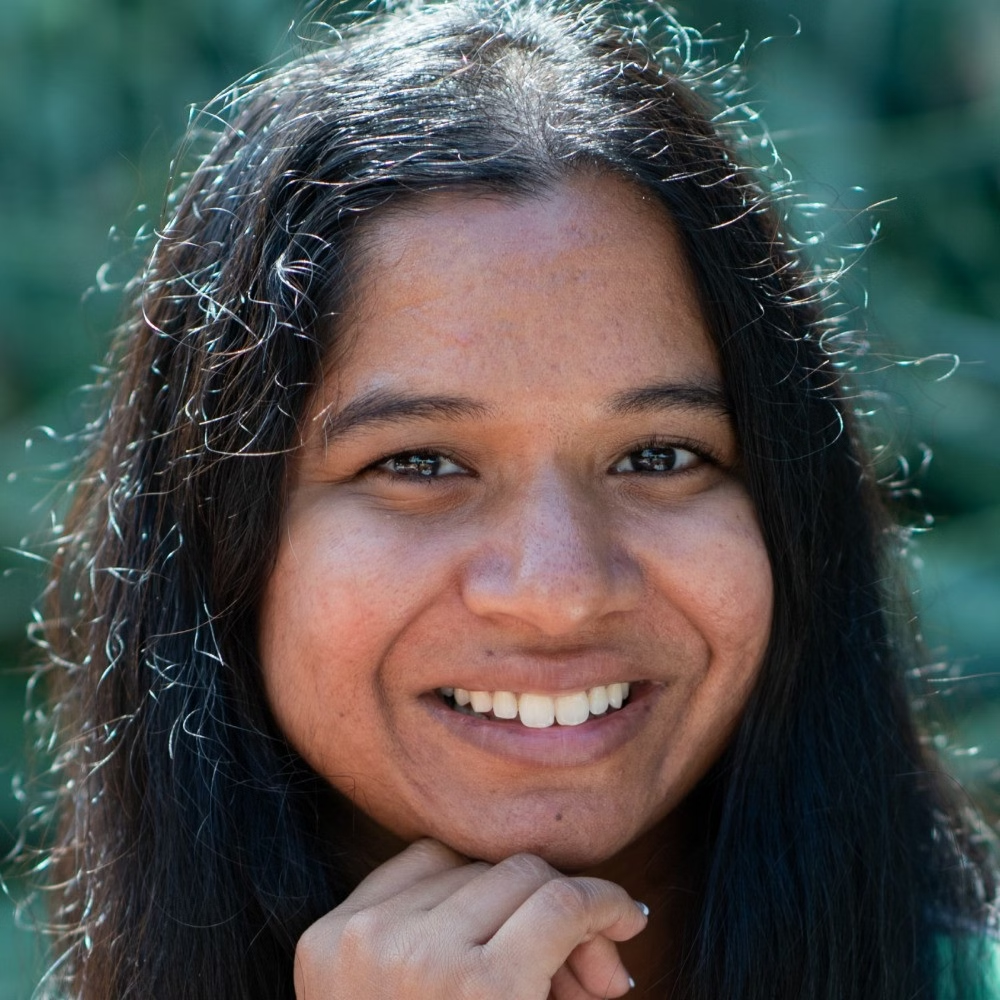
Diya is an independent science and engineering journalist. She writes opinion-editorials,blogs, explainers, and feature articles on various topics. Based in Portland, Oregon, Diya is an insightful writer with "a minimalist approach and an eye for detail," said a professional writing colleague. Her unique skillset is combining her subject matter expertise with her interest in furthering science and engineering communication with the public.




In Michigan, a citizen science project tracking salamander migration is bringing a community together and building a dataset

“Science is something that we do together.” Benjamin Richards on how OceanEyes collaborates with citizen scientists to monitor deepwater fish in Hawai’i

Dear Colleagues: Participate in a survey on barriers researchers face when communicating with non-expert audiences

Research!America selects 17 grantees from 132 applicants for the 2026 Civic Engagement Microgrant cohort

Melanie Brown: “If you listen, people want to share things that are important to them.”
Dear Colleagues: Participate in a survey on barriers researchers face when communicating with non-expert audiences

Scott Loarie says conservation science isn’t moving fast enough. He describes how iNaturalist is helping

Photo Essay: 2026 Stand Up for Science New York City

MA3 Challenge awards grants to six universities to modernize promotion and tenure processes: Here’s the question of the day.
Research!America selects 17 grantees from 132 applicants for the 2026 Civic Engagement Microgrant cohort
“Science is something that we do together.” Benjamin Richards on how OceanEyes collaborates with citizen scientists to monitor deepwater fish in Hawai’i
Melanie Brown: “If you listen, people want to share things that are important to them.”

Abby C. King on leveraging local wisdom and science to create a thriving environment: “Our communities are the most valuable renewable resources for a healthy planet.”

Milky Way Project co-creator Grace Wolf-Chase says public engagement is ‘every bit as important as excellent scientific research’

Seeing is believing: Inside the BioBus revenue engine with Ben Dubin-Thaler
Contact
Menu
Designed with WordPress