
Civic Science Observer
Research!America selects 17 grantees from 132 applicants for the 2026 Civic Engagement Microgrant cohort

Take-home points
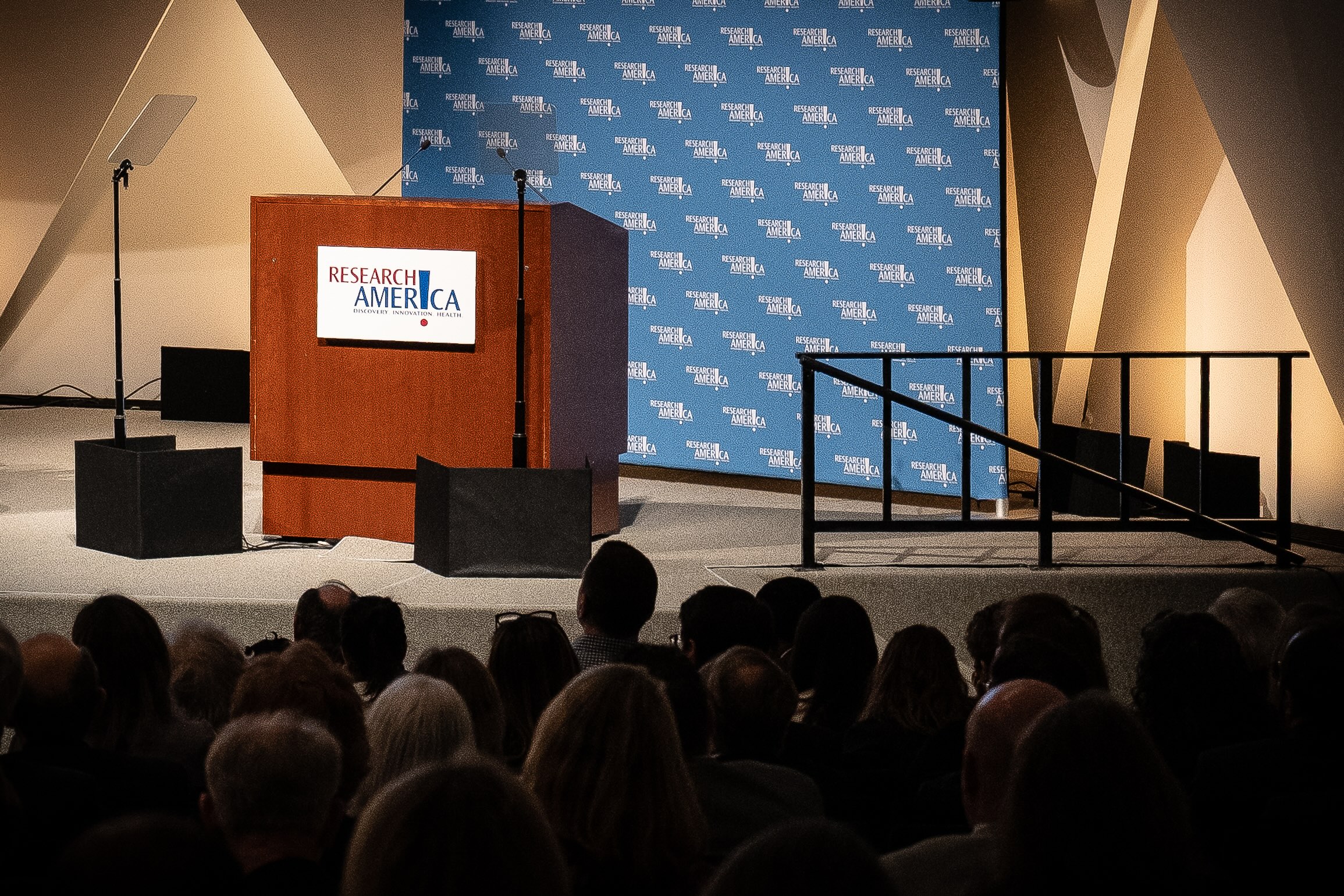
Research!America just announced its 2026 Civic Engagement Microgrant cohort, selecting 17 projects from 132 applicants to fund early-career scientists building local civic science initiatives across the United States.
Across eight cycles from 2019 to 2026, the program has funded 151 projects according to online records. Support for the program has come from multiple funders over time, including the Rita Allen Foundation, Lasker Foundation, Dana Foundation, Sloan Foundation, and HHMI.
The program provides funding of up to $4,000 to STEM student- and postdoc-led groups to “design and execute projects that create dialogue with public officials, local community leaders, and the public around issues of common concern,” while building skills in communication, program planning, and public policy through locally implemented initiatives.
Applicants apply across categories such as startup funding for new groups, community events, and digital media, and select from themes including collaborations, scaling existing projects, integrating lived experience, and neuroscience. Applications are submitted in the fall of the prior year, with funded projects ordinarily being implemented between January and June of the following year.
And awardees don’t just receive funding. The program also offers supplemental programming, including networking opportunities and training sessions focused on program management, event planning, communications, and public engagement.
Let’s crunch the numbers
Since funding its first cohort in 2019, the program has funded 151 projects across eight cohorts coming from 121 organizations, averaging about 19 awards per year (Figure 1). Research!America describes in its press release that the applicant pool for the 2026 cohort was ‘highly competitive’ (13% acceptance rate), indicating demand from promising projects exceeded available funding. Applications grew from 20 for the 2019 cohort to 132 for the 2026 cohort, a more than sixfold (~560%) increase.
To put that in context, earlier cohorts showed acceptance rates of approximately 50% (2019), 47% (2020), 38% (2021), and 28% (2022), based on this existing program report. Projects have been awarded to institutions across multiple U.S. states and territories, with each cohort including projects from approximately 13 to 14 distinct states or territories (Figure 2).
What happens to the projects that are not selected by funders? Are they able to find funding elsewhere? How many reapply in subsequent years? What formal mechanisms could be set up to redirect promising projects that fall outside the current funding priorities of one funder?
What the program has funded
Across its history, the program has supported a diverse set of civic science initiatives that reflect different pathways for scientists to engage local communities.
Earlier cohorts focused largely on science policy engagement. Projects such as “Science Matters Policy Memo Competition” (2020) at the University of Florida and “Science Briefings on the Missouri Hill” (2020) at the University of Missouri centered on training scientists to write policy memos, organize advocacy efforts, and engage directly with policymakers.
More recent cohorts include community-based STEM education programs, public health initiatives, environmental engagement tied to local challenges, and new communication formats. Examples include “SPARK – Science Projects Activities Reaching Kids” (2021) at Boston University, which delivers science programming to youth, and “The Influenzers” (2021) at the University of Pittsburgh, which focuses on community engagement around immunization. Other projects, such as “Big Lick of Science Podcast” (2020) at Virginia Tech, highlight the use of media to engage broader audiences.
In the 2026 cohort, projects include “Brains, Not Bars: Reframing Addiction Through Science and Story” (2026) at Wake Forest University School of Medicine, “UCSF Anatomy Learning Center Open Lab (ALCOL)” (2025, 2026), and “Science Outside the Lines” (2026) at Johns Hopkins University. These projects span K–12 education, teacher training, and public-facing events. Across these examples, a consistent feature is the emphasis on innovations that create spaces where scientists, community members, and policymakers engage with one another on shared concerns.
-
While the geographic distribution provides a useful view of where awarded organizations are based, it does not capture how the types of projects being funded vary over time. Future visualizations might consider incorporating a time-resolved view by project type and geographic distribution.
Zooming out
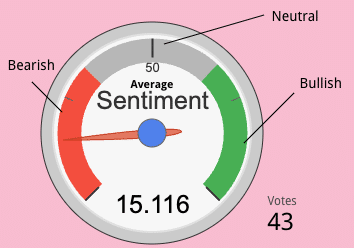
The program operates within a broader U.S. funding environment for public engagement, with a future outlook squarely in the “bearish” territory (Figure 3), reflecting limited optimism about securing funding to support the work. (Click here to learn more about the sentiment gauge in Figure 3)
Research!America is not alone in offering a dedicated microgrant funding program. Another notable program is Society for Science STEM Action microgrants, which provide small grants of up to $5,000 to “bolster and support community-driven nonprofit organizations that are working to enhance the public’s understanding of science and to increase participation in STEM in their communities.” Between 2016 and 2024, the STEM Action microgrant program provided over $1.15 million (nominal) in grants to 144 organizations.
Another example is Riley’s Way Foundation, which provides up to $5,000 in funding to youth-led projects that “inspire kindness and strengthen their local, national, or global communities,” alongside mentorship and leadership development. While its focus is not specific to public engagement with science, several funded projects fall within that domain.
In a 2025 interview, Dr. Christine O’Connell, Executive Director of Riley’s Way Foundation, told us that the foundation had over 700 applications [in 2024] and was able to fund only 45 projects. She added that “we’ve seen a steady influx of projects that are STEM related in some way, projects that are about increasing representation in STEM fields, projects that are about increasing communication in STEM fields.”
Other microgrant funding programs to support public engagement initiatives can be found within scientific societies (see the COMPASS Outreach Grant program from the American Society for Cell Biology, which awards its members up to $1,000 for projects).
Of course, there are important differences in focus and criteria across these programs. Taken together, they highlight an important feature of the funding landscape: microgrants provide vital entry points for early-stage projects that can provide the preliminary data needed to apply for larger, longer-term funding.
Back to Research!America
Alongside the microgrant program, Research!America also offers Public Engagement Content Awards, a newer program launched in 2024 that focuses on training rather than project implementation. As a disclaimer, I had the opportunity to serve on the review committee for the past two cohorts. These awards provide stipends (note they are not grants) of up to $5,000 to support “open access curriculum development in science communication and other public engagement skills,” with the goal of expanding training opportunities for scientists.
While the microgrants fund local engagement activities, the content awards importantly focus on developing tools, curricula, and training materials to support public engagement efforts more broadly. A total of 8 content awards were announced alongside the 2026 micrograntees.
Questions of the Day
A central challenge for all these microgrant funding programs is documenting impact across a portfolio of projects that differ widely in scope, audience, and intent.
Each funded project defines success differently across time. For some, impact may be measured through participation or engagement. For others, it may involve driving timely science policy discussions or building relationships between scientists and communities whose outcomes take longer to manifest. Each funded project is essentially an individual experiment testing different hypotheses. In some cases, the experiments are structured with clear interventions and measurable outcomes. For example, the STEM Unbarred program hosted within The Petey Greene Program and recipient of a microgrant in 2024, mobilizes scientists to run hands-on STEM demonstrations in youth correctional facilities. At a poster presentation during the 2025 Research!America National Health Research Forum in Washington, D.C., Jade Williams from The Pettey Greene Program shared with us that the initiative has engaged over 500 youth and tracks changes in participant interest and knowledge using pre- and post-program measures, with early results indicating increases across both metrics.
A central question is whether any single funder has the capacity to track impact over time and across contexts. Doing so is resource-intensive, suggesting that coordination among microgrant funders could help aggregate time-resolved impact data across the many ‘experiments’ being supported each year. In turn, these data could serve as priors to refine questions and generate new hypotheses for future projects.
As highlighted earlier, the current sentiment across the funding landscape for public engagement with science is trending fully in bearish territory given the high levels of uncertainty with the broader funding landscape for science in general. Obviously, not all such projects need money to run. The key question is how the current negative sentiment is affecting those seeking funding to support projects with a focus on engaging the publics. Are applications for funding down, up, or the same compared to previous years? For those applying, how are current conditions changing the types of projects they are seeking funding for?
What follow-on actions did the insights above spark for you?


Fanuel Muindi is a former neuroscientist turned civic science archivist and documentarian. He is a professor of the practice in the Department of Communication Studies within the College of Arts, Media, and Design at Northeastern University, where he leads the Civic Science Media Lab. Dr. Muindi received his Bachelor’s degree in Biology and PhD in Organismal Biology from Morehouse College and Stanford University, respectively. He completed his postdoctoral training at MIT.





Did You Know: A museum dedicated to the brain is being developed in Southern California?

Peer teaching as empowerment? Exploring NeuroBoricuas with Dr. Christian Bravo-Rivera

STEM Unbarred: What the initiative is learning about hands-on science for incarcerated youth

San Francisco Bay Area climate resilience group helps local communities talk about extreme heat

Did You Know: Kirtland’s Warbler Festival in Michigan is engaging the local community in celebrating and conserving the once-endangered songbird through educational events

Questions, biology-based environmental stewardship, and accessibility are at the center of Bio4Climate’s annual conferences
Did You Know: Kirtland’s Warbler Festival in Michigan is engaging the local community in celebrating and conserving the once-endangered songbird through educational events
San Francisco Bay Area climate resilience group helps local communities talk about extreme heat
STEM Unbarred: What the initiative is learning about hands-on science for incarcerated youth
Peer teaching as empowerment? Exploring NeuroBoricuas with Dr. Christian Bravo-Rivera
Did You Know: A museum dedicated to the brain is being developed in Southern California?
STEM Unbarred: What the initiative is learning about hands-on science for incarcerated youth

Exploring workforce needs and intergenerational learning in informal STEM education

Making a Mini-Forest: participatory science afforestation across the globe

18 months later, Casey Lardner from Genspace says, “we’ve been really focused on building systems”
Contact
Menu
Designed with WordPress