
Civic Science Observer
Sentiment gauge on the Civic Science Funding Index (CSF-Index) holds firm in bearish territory since Q2 2025
The sentiment and general outlook are pessimistic about the availability of funding for civic science work.


Sentiment for the civic science funding environment continues to trend pessimistically, according to preliminary readings from the Civic Science Funding Index’s (CSF-Index) sentiment gauge. With 40 submissions logged since the gauge was introduced this past spring, the overall average remains firmly in bearish territory (Figure 1). The gauge is currently in a beta phase on the CSF-Index, and early feedback has been encouraging regarding its potential usefulness in providing a shared read on the funding environment. Outreach will expand next quarter to bring in a larger and more diverse set of contributors.
Tracking began in Q2 of 2025, when 10 entries produced an average bearish sentiment. As a reminder, the sentiment gauge is powered by a short backend survey that allows anyone involved in civic science—funders, grantees, scholars, and practitioners—to submit their outlook. Respondents rate their current sentiment for the funding conditions on a scale from 0 to 100: Bearish (0–33), Neutral (34–66), or Bullish (67–100) (read more here about the gauge).
Survey submissions increased in Q3 to 20, with an average bearish sentiment similar to that of the previous quarter. Nearly three-quarters of all respondents to date (73%) identify as grant applicants, meaning the gauge currently reflects applicant-side expectations rather than funder-side signals—an important factor when interpreting the bearish pattern. Q4 has so far recorded 10 entries, with sentiment still in the bearish range, extending the trend across all three quarters.
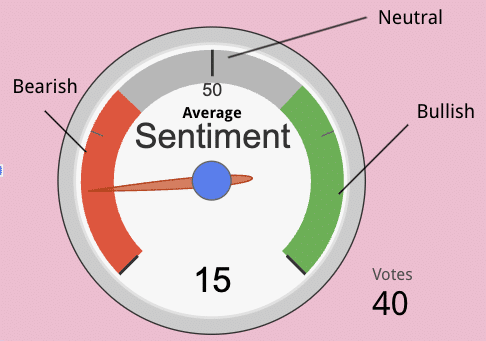
These numbers support what we are hearing from our ongoing conversations across the civic science universe, which point to caution, uncertainty, and concern about the availability of funding for civic science work. Of course, the broader economic sentiment indicators have also reflected a more cautious macro environment.
As mentioned previously, the gauge is designed to surface ongoing perceptions of the funding conditions for civic science and stimulate new conversations. Ultimately, it will be important to understand how applicants are adjusting to shifts in funding conditions as they continue their work engaging local communities. The limited number of entries on the survey so far reflects our limited early outreach efforts as we continue to experiment with the gauge on the index. The plan is to expand this outreach in the next quarter and beyond to increase the number of sentiment entries and allow for additional segmentation.
2 Grant opportunities we are currently watching:
(1) Sloan Foundation YouTube & TikTok grant opportunity: To advance public understanding and engagement with science by supporting innovative content creators on YouTube, as well as TikTok and other major long and short-form video platforms.
(2) National Science Foundation STEM K-12 funding opportunity.

Fanuel Muindi is a former neuroscientist turned civic science ethnographer. He is a professor of the practice in the Department of Communication Studies within the College of Arts, Media, and Design at Northeastern University, where he leads the Civic Science Media Lab. Dr. Muindi received his Bachelor’s degree in Biology and PhD in Organismal Biology from Morehouse College and Stanford University, respectively. He completed his postdoctoral training at MIT.




Dear Colleagues: This is why science communication needs visuals

In Michigan, a citizen science project tracking salamander migration is bringing a community together and building a dataset

“Science is something that we do together.” Benjamin Richards on how OceanEyes collaborates with citizen scientists to monitor deepwater fish in Hawai’i

Dear Colleagues: Participate in a survey on barriers researchers face when communicating with non-expert audiences

Research!America selects 17 grantees from 132 applicants for the 2026 Civic Engagement Microgrant cohort
Dear Colleagues: Participate in a survey on barriers researchers face when communicating with non-expert audiences

Scott Loarie says conservation science isn’t moving fast enough. He describes how iNaturalist is helping

Photo Essay: 2026 Stand Up for Science New York City

MA3 Challenge awards grants to six universities to modernize promotion and tenure processes: Here’s the question of the day.
Research!America selects 17 grantees from 132 applicants for the 2026 Civic Engagement Microgrant cohort
“Science is something that we do together.” Benjamin Richards on how OceanEyes collaborates with citizen scientists to monitor deepwater fish in Hawai’i

Melanie Brown: “If you listen, people want to share things that are important to them.”

Abby C. King on leveraging local wisdom and science to create a thriving environment: “Our communities are the most valuable renewable resources for a healthy planet.”

Milky Way Project co-creator Grace Wolf-Chase says public engagement is ‘every bit as important as excellent scientific research’

Seeing is believing: Inside the BioBus revenue engine with Ben Dubin-Thaler
Contact
Menu
Designed with WordPress