
Civic Science Observer
Dear Colleagues: Share your journey in science and win cash
We are looking for scientists at all stages (high school and undergraduate lab assistants all the way to full professors) to share your journeys in science!

Dear Colleagues,
Communicating science cannot be an afterthought. Public funding for research depends on public engagement and support. But to appreciate the power and promise of science, people need a deeper, more nuanced understanding of the processes of science. As practicing scientists know, authentic research is much more varied, dynamic, and creative than the scientific method most of us encountered in school.
Science historian, educator, and IF/THEN Ambassador Jocelyn Bosley approached Galactic Polymath with a vision to enrich the ways we think, talk, and teach about how science works. That’s why we created the SciJourneys framework—a reimagining of the scientific method that better reflects the complex, multitudinous paths of scientific research, presented with a playful, choose-your-own-adventure aesthetic. This framework is at the center of our unit for grades 6-8+ called “SciJourneys: Building Resilience in Science.” It’s also at the center of this competition, which aims to produce a large repository of short, social-media-friendly videos to give the public a window into the real work of science.
What? An award for scicomm?
Science communication (#scicomm) requires a blend of expertise, language skills, empathy, and creativity, and it often goes under-appreciated. That’s why we created the 2025 #MySciJourney Challenge!
Winners will not only get a rare science communication award to add to their CVs, but they will also help teachers and students across the US, as well as the general public, understand what’s at stake and what we stand to lose by the current efforts to undermine US scientific funding agencies. Winners will also get the opportunity to have their story featured on the Smart Tea Podcast!
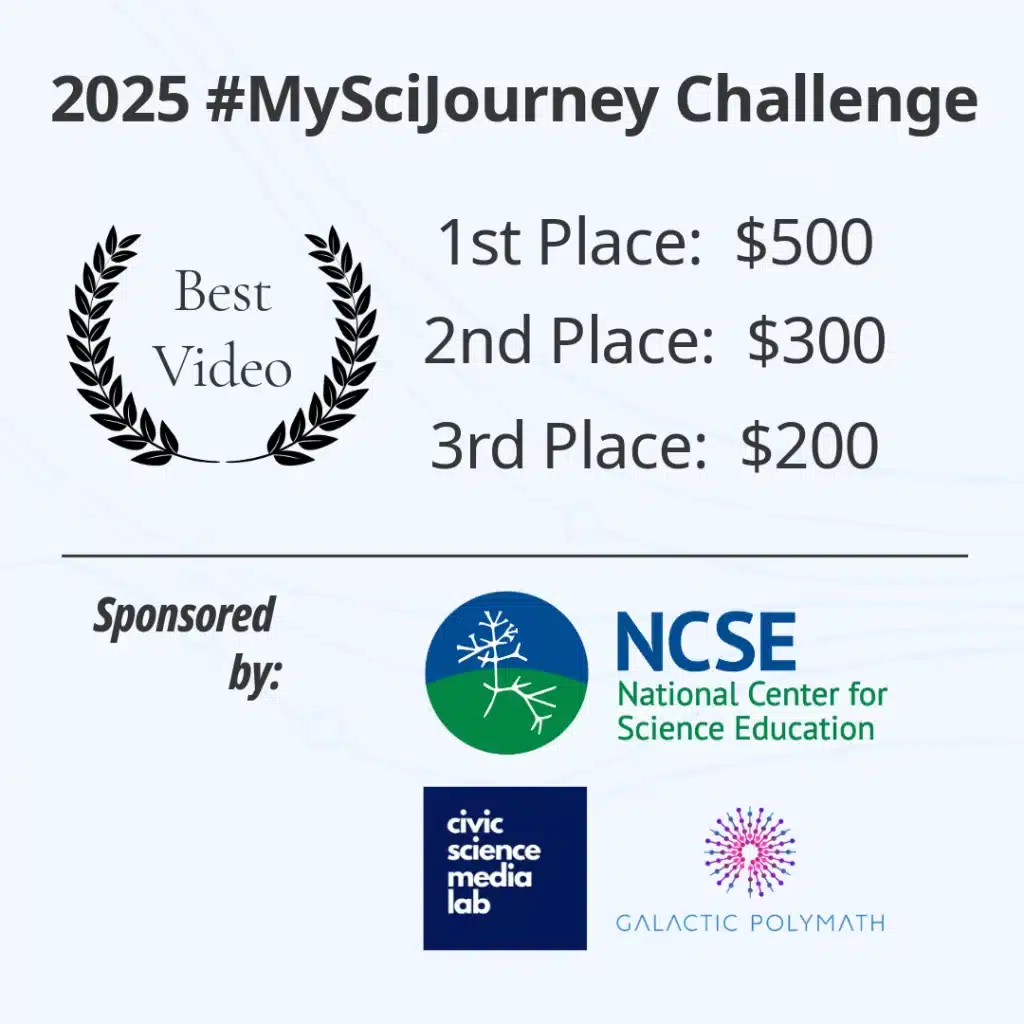
We are looking for scientists at all stages (high school and undergraduate lab assistants all the way to full professors) to share your journeys in science! Cash prizes will be awarded to first ($500), second ($300), and third ($200) place for videos with the most likes across Galactic Polymath’s YouTube and Instagram.
Tell me more!
Science is way more fun, creative, and human than the scientific method typically taught in school. In fact, I would argue that there is no single scientific method. Instead, there is a set of processes (Ask Questions, Hypothesize, Collect Data, Analyze, Interpret) that scientists rely on as they navigate the adventure of real-life research, repeating and remixing steps as needed.
At the center of these scientific processes is Communication. While not typically included in the scientific method, communication is key to science at every stage—we share our questions, hypotheses, data, and early interpretations with labmates, colleagues, and mentors throughout our investigations, and their feedback plays a crucial role in how the research progresses.
In your #MySciJourney submission, you can focus on any step(s) you choose. The goal is to convey who you are and what authentic research is actually like. Some things you might share:
- What are your research questions?
- How did you come up with them?
- How do you answer them?
- Why is communication essential to science?
- How are you affected by efforts to defund and disassemble scientific agencies in the United States?
Submission details
Format: A 2-3 minute vertical video (1080px wide x 1920px tall) like these examples (which are not considered part of the competition)
Deadline: September 30, 2025
Audience: 12 years old and above
Tone: Lively, approachable, authentic
Use of your video: When you share your video through the submission form linked in the Procedure below, we will evaluate the quality and fit of your video for our target audience. If the committee does not deem it a good fit, we may not include it in our library—though of course, you may choose to share it with your own network.
If your video is accepted, we will add it to the SciJourneys collection on Galactic Polymath’s YouTube and we will promote it through our partner networks. You will maintain copyright over your work. In the video submission form, we will ask for your permission to post your video on our social media platforms and for the funding organizations to be allowed to edit/remix this content for the purpose of promoting STEM education, engagement, and advocacy.
Resources to help with your video

- (Recommended) Watch our introductory video introducing SciJourneys to get a sense for the nonlinear scientific methods framework and tone we’re looking for.
- (Required) Use the Presentation Template: For continuity, we’d like you to use the SciJourneys map and aesthetics, but you are welcome to rearrange the order and add your own images and video. Create your own slideshow presentation with the SciJourneys Template (Click “Use Template” to copy to your Google Drive) or (Download PPTX)
- Important: The #MySciJourney examples from Matt & Allison were made by screen recording while presenting the Google Slides presentation with a paid Google Workspace account. This allows the Speaker Spotlight bubbles to show up on slides in specific areas, which is nice, but not possible if you have a free Gmail account or if you download to Powerpoint.
- It is highly recommended that you do embed video of your face in the presentation, as this will build greater viewer engagement. This will be easiest if you can use Google Slides under a paid Workspace account, but is possible with a number of other applications like Tella (see below) that let you place your camera image on the screen recording when editing the video.
- (Optional) Shoot us an email to express your interest in submitting. We will keep you informed about any changes, updates, or advice for submissions. While we can’t do troubleshooting for everyone one-on-one, if you share questions or issues, we will try to update this document and alert folks to potential solutions for common challenges.
- (Optional) Use this script template (Google Docs / DOCX). Draft your script before you even start the slideshow to help lay out your narrative and get feedback from others about diction/jargon, effectiveness of hooks, and amount of content.
- Procedure:
- Build your slideshow with the template above.
- Practice, perform, revise, practice, perform, revise.
- Make sure you have a good, quiet setup for recording with the best microphone and natural lighting available.
- Present locally on your computer (ideally using Google Slides with Speaker Spotlight to show your face in the presentation)
- Record your screen and microphone audio in vertical HD video format (see below for tips)
- Edit the video if necessary to tighten up performance, add sounds, and make sure it’s as short as possible within the 3 min limit
- Export to MP4 as (1080×1920)…make sure you’re not exporting to wide format with black margins on the sides…it must be a vertical video.
- Submit your MP4 with the button below!
- Recommended applications: Most screen recording programs will want to record in HD wide format (1920×1080). You’re going to need a program that lets you record natively in portrait (1080 x 1920) or manually select the vertical box on your presentation when you’re presenting.
- Tella is a great option for screen recording across operating systems! They also have a 6 month free plan for educators. We especially appreciated the really efficient text-based-editing that allows you to auto-transcribe text from your speech and delete sections of video based on the transcriptions. Super cool! Also allows you to easily add captions to the video like I did here.
- Allison used OBS to record her video here. This is also a nice tutorial for using OBS to record vertical video.
- On a Mac, Quicktime can work, as shown here. Explore the FAQs here.
Good luck!
We can’t wait to see your video and learn about your SciJourney! Let us know your thoughts or questions in the comments.
Related Readings
Human Narratives in Science: The Power of Storytelling – Muindi, Fanuel J. et al.Trends in Molecular Medicine, Volume 26, (2020) Issue 3, 249 – 251
Published by The Civic Science Observer (CSO), Dear Colleague Letters are guest essays that feature calls to action by stakeholders from across the civic science landscape. Please note that the opinions expressed in these letters are those of the authors and do not necessarily reflect the views of the Civic Science Media Lab and/or its partners. If you are interested in sharing your perspective, please email us at mlab@civicsciencemedia.org.

Dr. Matt Wilkins is the Founder and CEO of Galactic Polymath LLC, an education studio that turns current research into high-quality, open-access lessons for grades 5–12. Originally from Huntsville, Alabama, he now lives in Minneapolis, Minnesota. His diverse background includes receiving his PhD from the University of Colorado at Boulder, a postdoc at Vanderbilt, building houses with AmeriCorps, conducting biological research in seven countries, and teaching at all levels from elementary school to graduate education.





Dear Colleagues: This is why science communication needs visuals

In Michigan, a citizen science project tracking salamander migration is bringing a community together and building a dataset

“Science is something that we do together.” Benjamin Richards on how OceanEyes collaborates with citizen scientists to monitor deepwater fish in Hawai’i

Dear Colleagues: Participate in a survey on barriers researchers face when communicating with non-expert audiences

Research!America selects 17 grantees from 132 applicants for the 2026 Civic Engagement Microgrant cohort
Dear Colleagues: Participate in a survey on barriers researchers face when communicating with non-expert audiences

Scott Loarie says conservation science isn’t moving fast enough. He describes how iNaturalist is helping

Photo Essay: 2026 Stand Up for Science New York City

MA3 Challenge awards grants to six universities to modernize promotion and tenure processes: Here’s the question of the day.
Research!America selects 17 grantees from 132 applicants for the 2026 Civic Engagement Microgrant cohort
“Science is something that we do together.” Benjamin Richards on how OceanEyes collaborates with citizen scientists to monitor deepwater fish in Hawai’i

Melanie Brown: “If you listen, people want to share things that are important to them.”

Abby C. King on leveraging local wisdom and science to create a thriving environment: “Our communities are the most valuable renewable resources for a healthy planet.”

Milky Way Project co-creator Grace Wolf-Chase says public engagement is ‘every bit as important as excellent scientific research’

Seeing is believing: Inside the BioBus revenue engine with Ben Dubin-Thaler
Contact
Menu
Designed with WordPress