
Civic Science Observer
NASEM Panel: Informal science educators must stress the importance of collaboration as they seek funding

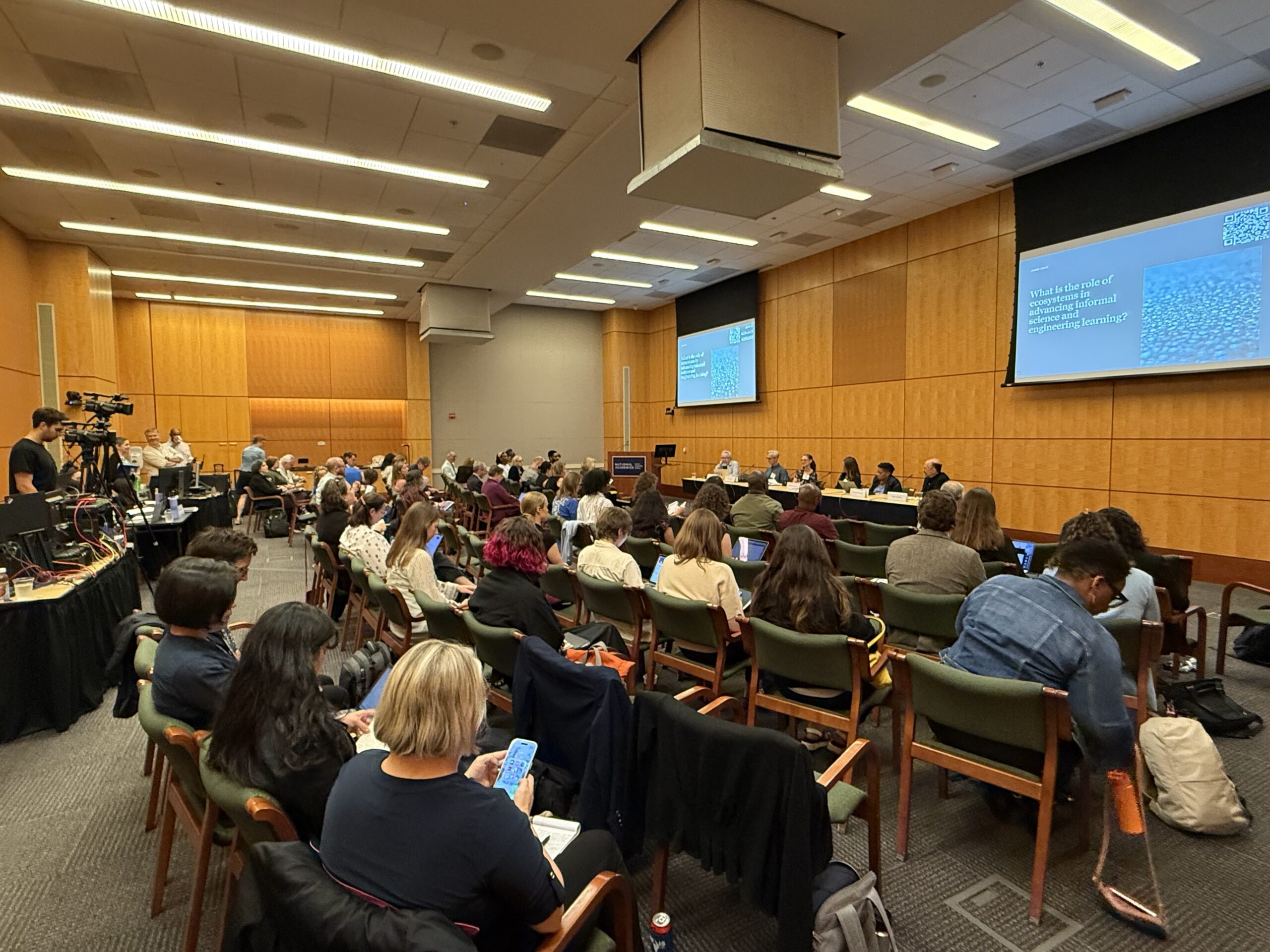
As the science and engineering community seeks to secure funding streams for science opportunities outside traditional school settings, they should emphasize to funders the importance of approaching science through a collaborative and interconnected lens, according to panelists speaking at the 2025 Convocation on the Status of Informal Science and Engineering Education hosted this past June by the National Academies of Sciences, Engineering and Medicine (NASEM) in Washington, D.C. The convocation gathered researchers, practitioners, policymakers, and funders to reflect on progress since the 2009 National Academies report Learning Science in Informal Environments.
“One thing that I would encourage us to think about what as we think about coalition building, is also the bipartisan component we need to represent, not only the different contexts in which kids learn, but we need to be intentionally bipartisan, especially in this moment, as we reflect on what the agenda is that’s going to take us forward and what the ideal field looks like, and that includes across learning spaces, models, geographic context as well,” said panelist Melissa Moritz, senior advisor for the Alliance for Learning Innovation, at the convocation. “I would love to be able to see us work on these, on breaking down silos even further.”
David Sittenfeld, director of the Center for the Environment at the Museum of Science in Boston, likened this collaborative approach to playing a team sport, where teams solve problems together. “Highlighting the fact that everyone plays crucial roles in issues like addressing infectious disease or environmental hazards can be really unifying in a way that I think is really needed in this moment,” Sittenfeld said. “A lot of careers can be positioned as STEM jobs if we demonstrate the connectedness across systems. That can really increase the relevance of STEM content for everyone.”
Moritz, Sittenfeld and the other panelists used the June 18 session to discuss the role that informal science, such as afterschool programs or participatory science opportunities, has had in supplementing and enhancing the formal settings of schools and research organizations.
While informal science can potentially benefit the STEM and engineering workforce by cultivating interest in science among future scientists and engineers, there are other ways that the sectors can benefit. For instance, even if a student doesn’t pursue the sciences, they may be given the language to communicate and respond to scientific ideas.
“Yes, we do need more scientists and engineers to enter the workforce to solve these problems, but we also need people who are more deeply engaged in thinking about [science in] their own roles… as consumers, as caregivers, as voters, as teachers, as participants in a socio technical society,” Sittenfeld said.
He continued, “Even the federal government has hired science museums to get people together to explicitly consider and think about problems that perhaps previously were only the domains of engineers and scientists. Now we realize it’s important to make clear that scientists are not the only voice that are needed to solve these problems equitably.”
Within participatory science, professional scientists and engineers can benefit from perspectives from the broader community because they might offer points of view not previously considered, according to Sittenfeld.
“How do we show people that… if you’re the kind of person who goes out and participates in the great Christmas bird count, [that] we also want to hear about what you think is important based on that data that you’re helping to create. Or if you’re the person who comes out to a public meeting to talk about a policy proposed for your neighborhood, you can also share what you know about that neighborhood because you live in a particular place that may have certain characteristics, and you can help science know how to make that place as healthy and thriving as it can be,” Sittenfeld said.
“So, as educators, we need to design and create offerings that activate people… [and] community members in framing and defining those problems as they see as most important to solve,” he continued. “I think that’s a big shift we’ve seen since 2009, explicitly recognizing that the knowledge and wisdom that communities [bring], whether we’re talking about local knowledge or traditional ecological or indigenous knowledge, [and that it] is essential for identifying issues and topic selection. And then it’s on us to form a team of experts who can help address those issues in ways that make a difference.”
While collaborating with students outside school and the wider public through citizen science opportunities is one way to cultivate support for the informal sciences, collaboration among scientific peers is another way, according to Moritz.
This collaborative approach is helpful in crafting research and development opportunities, she said.
“I think we need multiple R&D agendas. We should, at first, have such a broad field that works in so many different settings and so many different contexts, I think it would be selling ourselves short if we had a sole R&D agenda,” Moritz said.
The question about whether we are one field or actually many fields, “is a good one, because that draws to the question of how we make an R&D agenda: whether we need to speak to policymakers with one united voice, or whether the museum community should ask for their set of asks, and the after school community should ask for their set of asks,” Moritz continued. “Ultimately, we don’t want to mistakenly perpetuate or grow any of the silos that we have worked so hard to break down and make progress towards. So the question for me becomes, what is the larger field, and then, what are the asks that we must make of policymakers? Which comes back to the question… [of] what is the essential role that we need federal, state and local policymakers to play in order to enable us to achieve this goal of a STEM-literate citizen for a productive STEM workforce and for our larger society?”
R&D agendas can also drive program quality and encourage improvements based on program goals and settings, Moritz said.
“We heard earlier that there’s a set of questions that practitioners want the answers to, how do I get more kids into my program? How do I get families more involved? What’s the right dosage in order to ensure that kids are having the kinds of career exploration opportunities here and there and again, that’s going to vary by setting?” Moritz said. “It’s going to vary by discipline. It’s going to vary by whether you want to do a science program or an AI program or a tech-heavy program, or this or that. And so we do need to figure out some of these overarching pieces, but I don’t want to lose sight of the fact that we do need to, especially in this moment, talk to policymakers, federal, state and local, about the field, about what we need, about the resources that they can provide.”
As scientists explore R&D for informal science opportunities, they should consider having adequate data infrastructure in place that enables sufficient tracking of results that “empowers us to do a whole lot of things. It empowers us to do research. It empowers us to do evaluation. It empowers us to be able to make claims about the benefits for young, all learners,” Moritz said. “We need to figure out the data infrastructure piece that most programs don’t have the time, resources or capacity to be able to collect the kind of data and then be able to put in central systems.”
Meanwhile, the benefit of federal involvement is that it can facilitate larger evaluation efforts, fund initiatives across state lines, and help distill some of these evidence-based practices, according to Moritz.
Panelist and consultant Erika Shugart, whose firm supports leaders involved in science and education nonprofits, discussed the impact of policy on informal science and engineering education over the last decade.
Through her research, she found that informal settings have different goals than those found in formal science education, and they are often called upon to help supplement what is lacking in the formal sector.
For instance, informal science has blossomed particularly in the afterschool arena, finding support not only from federal grants but also from private funders, according to Shugart. That afterschool arena can also draw in families who want to support their students, she said.
The question now is, “as that funding winds down, how do we make sure that we can maintain continuity in this area?” Shugart said. “We also see that, in this area, we brought in a lot more families. [The Covid-19 pandemic] helped to drive the fact that families are really central [to] learning. And so, there is more support, more interest, in how we integrate families, and therefore adult learners.”
Other areas that have grown over the last decades include the proliferation of community-based organizations and a greater ability to access the digital space and computer science, Shugart said. “Originally, we had a lot more science funders. Now, the big tech corporations are really moving in and funding more,” Shugart said.
James Brown, executive director of the STEM Education Coalition, agreed with Shugart’s assessment.
“One of the biggest opportunities I see in this space is the fact that the growth in the demand for afterschool [programming] is outstripping the supply,” Brown said. This desire for more afterschool programming is reflected by the number of states that now have dedicated afterschool funding streams, he said. Major employers and foundations are also taking more strategic actions to fund the space, or they are choosing to volunteer in the community, according to Brown.
However, while state funding of informal science opportunities is helpful, the challenge is that the federal government may decide to lessen funding support since some states have been a viable funding stream, Brown said.
“It’s a mixed bag of the fact that so many states are now adopting their own funding streams, because if I’m a cost-conscious federal legislator, I could take that and say, well, of course, the states are running with it. They provide most of the funding for education. Why are we, as the federal government, supporting it?” Brown said. “But I also might thoughtfully think, if the federal government doesn’t have to be the first provider of resources for state level and local level informal education programs, maybe we can devote ourselves to spending some of those dollars on things like figuring out the workforce issues and the underlying R&D issues and the other things that are more long term.”
Furthermore, as federal funding prospects seem less oriented toward promoting diversity, equity and inclusion initiatives, those involved with informal science, such as the afterschool programs and those support families, are starting to think about “how do we get stability—whether it’s from other funders, whether it’s from working in our communities. That is definitely going to be a challenge in the coming years,” Shugart continued.
Indeed, in addition to asking how to invest in these intermediaries that provide informal science opportunities, such as after-school programs, science and education communities must also be those who should invest in these intermediaries, the speakers said. If investments come from various government levels, lawmakers should consider crafting policies that ensure continuous funding.
“If in every high school in America you are expected to have a work-based learning experience in an academic pathway, we are now putting the expectations on the schools to navigate all these pieces,” Moritz said. “We have to invest in intermediaries, which is one of the policy areas that I think is has not caught up with the times. We do not have dedicated funding streams for intermediate intermediary organizations to help coordinate all of these pieces that need to happen in order to make sure that the learners, whether they are in school or out of school or in other places, have the supports that they need.”
She continued, “We’re seeing some movements with that, with a push on community schools, but it is insufficient. We need more policies that effectively leverage intermediary organizations, that enable all of us to then work together and have sort of a central coordination point so that individual schools, individual educators aren’t having to do that themselves, individual programs aren’t having to do that themselves, and we can have a more built out infrastructure that enables us to scale the resources and supports faster.”
What follow-on actions did the insights above spark for you?


Joanna Marsh is a freelance writer and journalist based in Washington, D.C. For The Civic Science Observer, she reports on new developments across the citizen science landscape, covering both new research and on-the-ground practice. Her work highlights how local communities are engaging with scientists to contribute to ongoing scientific research and lessons being learned by the involved stakeholders.





Did You Know: A museum dedicated to the brain is being developed in Southern California?

Peer teaching as empowerment? Exploring NeuroBoricuas with Dr. Christian Bravo-Rivera

STEM Unbarred: What the initiative is learning about hands-on science for incarcerated youth

San Francisco Bay Area climate resilience group helps local communities talk about extreme heat

Did You Know: Kirtland’s Warbler Festival in Michigan is engaging the local community in celebrating and conserving the once-endangered songbird through educational events

Questions, biology-based environmental stewardship, and accessibility are at the center of Bio4Climate’s annual conferences
Did You Know: Kirtland’s Warbler Festival in Michigan is engaging the local community in celebrating and conserving the once-endangered songbird through educational events
San Francisco Bay Area climate resilience group helps local communities talk about extreme heat
STEM Unbarred: What the initiative is learning about hands-on science for incarcerated youth
Peer teaching as empowerment? Exploring NeuroBoricuas with Dr. Christian Bravo-Rivera
Did You Know: A museum dedicated to the brain is being developed in Southern California?
STEM Unbarred: What the initiative is learning about hands-on science for incarcerated youth

Exploring workforce needs and intergenerational learning in informal STEM education

Making a Mini-Forest: participatory science afforestation across the globe

18 months later, Casey Lardner from Genspace says, “we’ve been really focused on building systems”
Contact
Menu
Designed with WordPress