
Civic Science Observer
How the American Geophysical Union is ‘leaning in and stepping forward’ to support its members in civic science
Speaking at AGU’s annual meeting in New Orleans in Dec 2025, leaders highlighted training, career support, community building, and engagement with local decision-makers.

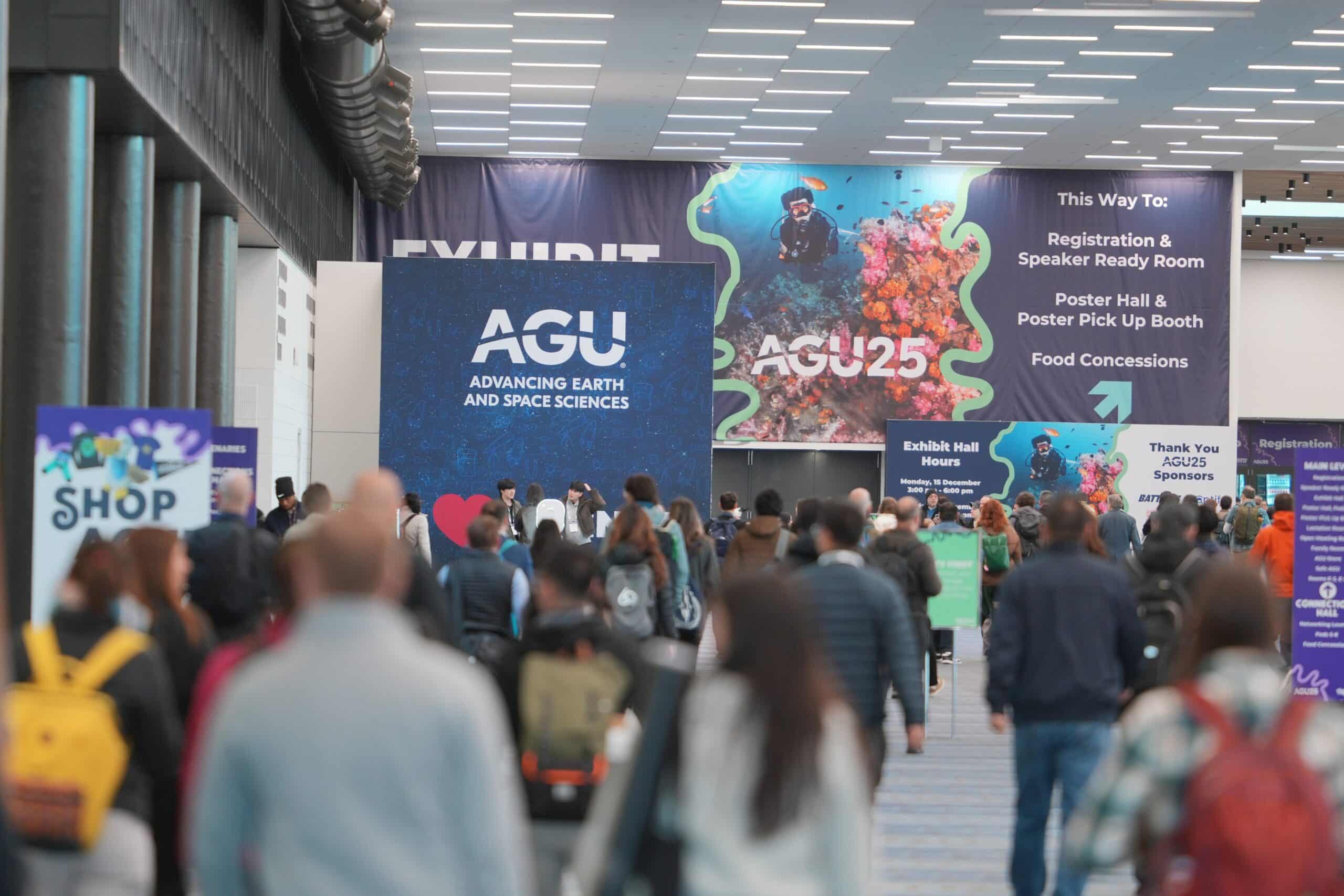
As scientists in the U.S. grapple with cuts in federal funding for research, a central question is how professional societies are supporting them during this period of uncertainty. Speaking at the American Geophysical Union’s annual meeting in New Orleans in December 2025, AGU leaders highlighted training, career support, community building, litigation, partnerships, and engagement with local decision-makers.
AGU leaders confirmed that participatory science or citizen science projects were among the victims in federal funding cuts because many of these projects received small grants promoting diversity, equity and inclusion (DEI), an effort panned by the current White House. For instance, the DEI programs administered by the National Science Foundation that dealt with community science and collaboration with non-technical or non-scientific participants were among those that saw federal support withdrawn, according to AGU President Brandon Jones.
“We might not be able to provide funding, but we can provide other forms of professional currency,” Jones said at a Dec. 16 press conference in response to a question from the Civic Science Observer about the impacts to research that involved citizen science. That professional support may include scientific expertise or career support or training on how to interface with decision makers at the local level, he said.
Indeed, interest in learning how to advocate seems to be growing among scientists, particularly as they discover that the ability to communicate with policymakers and the media can help them advance in their careers, according AGU Executive Director and CEO Janice R. Lachance.
“We have seen a greater interest in participation. We have a wonderful system where people can very easily let their views be known to their members of Congress, and we have a lot more people involved in that than we have in the past,” Lachance said.
As AGU and other societies seek to train scientists and researchers on advocacy, they are also seeking to remain involved in international scientific bodies and gatherings, such as the climate change conferences held by the United Nations, so that even if the U.S. government no longer participates in the Intergovernmental Panel on Climate Change, American scientists can still engage with international peers, Lachance said.
“We are not the federal government. However, we are not stepping back at all. We are leaning in and stepping forward,” Lachance said. “Our international response includes participating in the U.S. Academic Alliance for the IPCC,” a network of U.S. colleges and universities that are registered observers of the IPCC, she continued. This action “ensures that U.S. scientists can still participate in the global climate assessment process in spite of the administration’s withdrawal from the system. This actually protects scientific continuity, and it maintains U.S. expertise in international reports.”
AGU has also established a partnership with the American Meteorological Society to enable researchers to submit manuscripts to peer-reviewed journals covering all aspects of climate. “This effort aims to sustain the momentum of the sixth National Climate Assessment (NCA), the authors and staff of which were dismissed [in April 2025]… almost a year into the process,” AGU and AMS said in a May press release about the partnership.
“The bottom line is we are working hard to ensure that U.S. science remains visible, influential and connected internationally, regardless of what the U.S. government is doing,” Lachance said.
As AGU enters 2026, the organization will be keeping an eye on whether the U.S. will withdraw further from multilateral science bodies, Lachance said. If the U.S. pulls back, it’s unclear whether U.S. credibility will also diminish globally and whether allies will pursue new collaborations that would exclude the U.S. and even individual American scientists, she said.
For instance, the White House plans to end support for data gathering that would provide a record of the Earth’s buildup of carbon dioxide. “If that funding gets canceled, our partners around the world will have to find other means of deriving that data and forming their policies and their practices going forward,” Lachance said.
Strengthening U.S. science as scientists isn’t just about advancing knowledge. It’s about supporting the systems that communities rely on every day. — AGU President Brandon Jones
She continued: “These are long-term risks, but we believe that science is borderless. Science does not respect political boundaries, lines drawn on the map, separating one country from another, and it depends on sustained cooperation. So, we are preparing for an extended engagement to help ensure global scientific collaboration, to make sure that that system, those partnerships, are not fractured any further than they are now. And globally, we believe we must work to ensure the United States remains a leader in climate or science, not by stepping back, but by staying engaged, supporting our scientists and reinforcing their ability and opportunities at international collaboration.”
On the domestic front, AGU continues to be involved in litigation against the U.S. government over how it fired federal employees, according to Jones. That’s because the cuts to federal programs and the frozen or canceled grants have not only affected graduate students and early career researchers, but it has also impacted the federal government’s ability to accurately track climate data, he said.
“Strengthening U.S. science as scientists isn’t just about advancing knowledge. It’s about supporting the systems that communities rely on every day. So, for example, accurate hurricane and flood forecasting, clean air and drinking water, food security and agricultural planning, local climate and public health preparedness,” Jones said.
The danger in “gutting” the federal government workforce of many of its scientists is that it may take years and multiple election cycles before the government can recover, said Lachance, who previously served as the former director of the Office of Personnel Management for the federal government under former President Bill Clinton.
“I do think we’re prepared to do it for as long as it takes, and I think it’s also important for AGU to be prepared for what the circumstances will be 10 years from now and even further out,” she said.

Joanna Marsh is a freelance writer and journalist based in Washington, D.C. For The Civic Science Observer, she reports on new developments across the citizen science landscape, covering both new research and on-the-ground practice. Her work highlights how local communities are engaging with scientists to contribute to ongoing scientific research and lessons being learned by the involved stakeholders.






Dear Colleagues: This is why science communication needs visuals

In Michigan, a citizen science project tracking salamander migration is bringing a community together and building a dataset

“Science is something that we do together.” Benjamin Richards on how OceanEyes collaborates with citizen scientists to monitor deepwater fish in Hawai’i

Dear Colleagues: Participate in a survey on barriers researchers face when communicating with non-expert audiences

Research!America selects 17 grantees from 132 applicants for the 2026 Civic Engagement Microgrant cohort
Dear Colleagues: Participate in a survey on barriers researchers face when communicating with non-expert audiences

Scott Loarie says conservation science isn’t moving fast enough. He describes how iNaturalist is helping

Photo Essay: 2026 Stand Up for Science New York City

MA3 Challenge awards grants to six universities to modernize promotion and tenure processes: Here’s the question of the day.
Research!America selects 17 grantees from 132 applicants for the 2026 Civic Engagement Microgrant cohort
“Science is something that we do together.” Benjamin Richards on how OceanEyes collaborates with citizen scientists to monitor deepwater fish in Hawai’i

Melanie Brown: “If you listen, people want to share things that are important to them.”

Abby C. King on leveraging local wisdom and science to create a thriving environment: “Our communities are the most valuable renewable resources for a healthy planet.”

Milky Way Project co-creator Grace Wolf-Chase says public engagement is ‘every bit as important as excellent scientific research’

Seeing is believing: Inside the BioBus revenue engine with Ben Dubin-Thaler
Contact
Menu
Designed with WordPress