
CSML Audio Studio
Milky Way Project co-creator Grace Wolf-Chase says public engagement is ‘every bit as important as excellent scientific research’
“So evaluating the project was kind of a nightmare, but we have a very extended evaluation report that did come out of this program.” — Grace Wolf-Chase

In this episode of Science Engaged, I speak with Dr. Grace Wolf-Chase, a senior scientist and senior education and communication specialist at the Planetary Science Institute, a nonprofit organization that supports a distributed network of planetary scientists. She is also the co-creator of the Milky Way Project, a participatory science initiative that contributes to the understanding of how stars form.
In 2024, Dr. Wolf-Chase was elected as an American Astronomical Society fellow for outstanding and sustained work to bring the wonders of astronomical research to the general public. In our conversation, she explains why she views public engagement as integral to scientific practice itself, not separate from it. Drawing on her experience designing and sustaining citizen science projects, she highlights one of the central design constraints that practitioners often underestimate: while many people are motivated to contribute to science, participation is limited less by interest than by time. This reality shaped the Milky Way Project and similar initiatives to allow flexible, low-commitment participation without requiring long-term obligations.
She also offers a candid look at the structural conditions that make participatory science possible. Citizen science projects depend on sustained funding not only to support scientific analysis, but to build and maintain relationships, develop platforms, and enable public participation in the first place. At institutions like PSI, where salaries and outreach programs rely heavily on external grants, shifts in federal funding directly affect the ability to sustain these partnerships.
More broadly, Dr. Wolf-Chase emphasizes that participatory science serves as a mechanism for building trust and mutual understanding between scientists and communities. By inviting people to contribute directly to research, these projects allow participants to experience science from the inside, providing a pathway to reshape how they perceive both the scientific process and the people who conduct it.
More about Dr. Wolf-Chase’s work crowdsourcing star formation research, and the broader implications for participatory science, can be found in her review in Astrophysics and Space Science.
This episode is made possible by support from Schmidt Sciences and the UC Santa Cruz Science Communication Catalyst Grant. Special thanks to Fanuel Muindi for co-producing this audio program.
Here is our conversation:
Kristel Tjandra Welcome to Science Engaged, where we explore why and how scientists partner with diverse communities.
Grace Wolf-Chase You know, the value that the public places on science kind of depends upon how they view science and scientists, and so engaging the public is also important to inspiring the next generation of scientists. I mean, that’s what inspired me in the first place.
Kristel Tjandra I’m your host, Kristel Tjandra, and today I’m joined by our guest Grace Wolf-Chase. Grace is a senior scientist and senior education and communication specialist at the Planetary Science Institute. She’s the co-creator of the Milky Way Project that engaged 10s of 1000s of volunteers and continues to contribute to the understanding of how stars form in our galaxy. In 2024, Grace was elected as an American Astronomical Society fellow for outstanding and sustained work to bring the wonders of astronomical research to the general public. Grace, welcome to the show.
Grace Wolf-Chase Thank you so much. Kristel, I’m delighted to be here. Grace.
Kristel Tjandra I’m very curious about how your interest in astronomy and your interest in public engagement first coalesce.
Grace Wolf-Chase So, I think they’ve been part of my life like for almost ever, because I was inspired by informal science education when I was a little girl growing up in suburban New Jersey in the 1960s and 1970s, so things like museum visits and science fiction, the space program played a really strong role in steering me towards a career in science. So I think the public engagement aspect, especially as a girl growing up in suburbia in the 1960s and 1970s served to inspire me at a time when a lot of the formal education seemed to be geared at Little boys. So, you know, I’ve always been interested in interacting with public audiences.
Kristel Tjandra Yeah, why is it important for you that these two research and public engagement are not separate?
Grace Wolf-Chase So I think that it’s especially important that they not be separate, because the public deserves to know what we’re doing with their tax dollars. For one thing, I think that people need to know what where they contribute to the science, and they deserve to know. But I also think it’s very important to put a human face on science, and we do that by interacting with the public, thereby they get to know more what science and scientists are all about. And I think that that’s particularly important, and I think it’s something that has been a little undervalued with respect to just doing the research. Now, clearly, not all researchers need to be involved in all the public engagement aspects. I mean, we’re we all have different skill sets as scientists. However, that public engagement component is really, really important, because you know, the value that the public plays on science kind of depends upon how they view science and scientists, and so engaging the public is also important to inspiring the next generation of scientists. I mean, that’s what inspired me in the first place. So I think that research and public education are both very important. Not everyone has to do both, but doing both helps people better understand the whole process of research and what doing science is all about.
Kristel Tjandra Yeah, that’s such an important point, and I’d love to learn more about you know how you’ve used your scientific background in terms of public engagement in astronomy research. I know that you’re under the CO creator of Milky Way Project, which is a part of Zooniverse. Can you tell me a bit about what inspired those projects?
Grace Wolf-Chase Absolutely so first of all, the Zooniverse platform predates my involvement in all of this, but it was born out of a very popular online project called Galaxy Zoo. And what Galaxy Zoo did is it had people around the world looking at images of beautiful galaxies and classifying them by shape. Is this a spiral? Is this like a big sphere, et cetera, et cetera. And that project was so popular it inspired the Zooniverse platform. So it served as the inspiration to creating a platform that would be able to launch a whole bunch of different projects in the space sciences, but in other scientific areas. As well. So, back quite some time ago, now, about 15 years or more than 15 years ago, the CO creator of Zooniverse, Oxford scientist Chris Lintott, approached me to ask whether there would be any kind of project we could design that would help further our understanding of star formation in our Milky Way galaxy. I’ve been in star formation for many decades now, and I suggested that since stars form in these cold molecular clouds that don’t shine in visible light, but they shine an infrared light, pretty much everything shines an infrared light, that we could design a project, and that project wound up being called the Milky Way Project. We could design a project that would have people search for certain signposts that are associated with the formation of stars and how stars sculpt their environments while they’re in the process of forming. And their importance is by having people find these features. I mean, these high mass stars are so important because they not just help us understand things about individual how individual stars form, but because they they end their lives in these supernova explosions, where they distribute heavy elements that were built up during a few million years of nuclear fusion in these stars, they actually are very important in Understanding the evolution of entire galaxies. So they’re really important. So this is where we started with the Milky Way Project. The Zooniverse platform now hosts many, many different projects in science and also in the humanities. And what people do when they interact on this website is they’re typically looking through either images, like astronomical images. In some cases, they’re looking at texts in Galaxy Zoo; they were looking at images of galaxies in the Milky Way Project. They were looking at infrared images that highlight things across our galaxy. So, the idea is for them to identify or measure specific things.
Kristel Tjandra Yeah, so Grace, when you look at, you know, these projects, why do you think people want to get involved, and what are some of the motivations behind that?
Grace Wolf-Chase So that’s a great question, and there have been a number of studies done on this. And it turns out that the number one reason people like to get involved in doing these online science projects is just to contribute to the pool of human knowledge. People want to engage in meaningful activities, they want to contribute to science. And in fact, one of the things that happened during the COVID-19 pandemic is the Zooniverse leadership team received all of these expressions of gratitude from people who were stuck at home. They were housebound. They couldn’t get out, and they were looking for meaningful activities, and they participated in these online research projects, and they found a tremendous amount of satisfaction in that. And you know, it’s not just about the pandemic people. There are many people who, for whatever reason, might be, housebound, looking for something meaningful to do with their time. Also families. You know, think about in the evening. You know, maybe you’re a parent, you’ve got bunch of kids, since everyone can participate in these online projects, it’s a great family activity. It’s a way to learn together about a particular science project, and, you know, at the same time doing something, a family activity together, where everybody can learn, and everyone benefits. So that’s been the number one reason why people like to engage with these online projects,
Kristel Tjandra Yeah, what you know, as a scientist behind these projects, can you share some of the challenges in setting up the Milky Way Project? How do you get people involved?
Grace Wolf-Chase So, um, so using the platform, you know, is pretty straightforward. It doesn’t go to the website, and you read a little bit about what it’s all about, and you can create a username and participate. That’s not a big deal. One of the things that, of course, before people participate, they have to know they can participate, right? So getting the new. News out about the fact that people can do this, not just to people who say, pay attention to science, but through various different venues. Is very important, so that people know that this platform exists and they can contribute to a number of different projects. Now, some people are doubt their abilities to do this. And that’s, in my experience, that’s more older people than younger people who are really, you know, you know, into doing things online and such. But some people doubt their abilities, and they kind of need to, we kind of need the prime the pump. Get them to start participating, and then they see, oh, I can do this. You know, it’s, it’s not that difficult. I can do something, and I can contribute here. The biggest inhibiting factor, I think, for most people, is time. For everybody. These days, our attention is split across so many different things, right? So in order to decide where you want to put your time, that can be a difficult thing. So the nice thing about projects like the projects on the Zooniverse platform are that it doesn’t require an individual to make any kind of a time commitment. They can participate or not in a project. They can start to participate, say, I don’t like this, and just stop at any time there’s, there’s no a priori commitment that needs to be made. So that’s nice, right? You can participate or not. You know, as the spirit moves you so. So I think that that is something that people also need to understand. And I think that a lot of times they say, Oh, I don’t have the time for that. Well, you know, it you might, you might just have the time, and you might find it as fun as engaging in some other kind of online activity.
Kristel Tjandra Yeah, yeah. That’s definitely an important point in 2029 No 2019 in 2019 you received an 18 month grant from the Alfred P Sloan Foundation to design projects that bridge the scientific and religious communities. Tell me more about this funding and what you did with it.
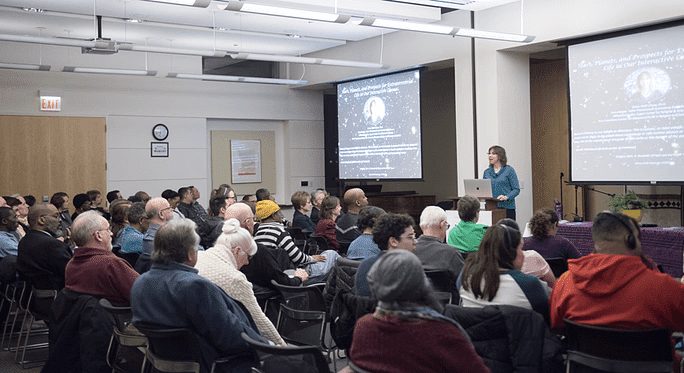
(Dr. Grace Wolf-Chase shares her work at the McCormick Theological Seminary. Credit: Daily Zooniverse)
Grace Wolf-Chase So this initiative, first of all, was done in collaboration with the Zooniverse, the current Zooniverse principal investigator, Laura Trouille, and later on, we also enlisted the help of Katie Hinman, who is director of a program called the Dialog on Science, Ethics, and Religion, or DoSER at the American Association for the Advancement of Science. And so the initial goal of this project was to create sort of intentional pathways for faith based and interfaith communities to engage with science by participating in Zooniverse projects, and we were also interested in supporting communities that might want to develop their own projects. One of the nice things about the Zooniverse platform is there is a project building tool that you can use, that communities can use to build their own projects. Now bear in mind that this project unfortunately happened completely during the COVID-19 pandemic, and that really placed a serious constraints on what we were able to do. I mean, just one of those constraints was that we underwent a large change in grant management partway through this project, and that slowed things down. Religious communities were struggling to survive, right? So it was difficult to convince people to take on new activities and new projects when they were just trying to figure out, for example, how to use Zoom, and, you know, interact through Sunday school programs and everything via zoom. So that was that was definitely a challenge, and one of the things we never got to was helping people create their own projects. It was impossible to do that. However, the good news was, I have been involved in reaching out to faith communities and in science and religion dialog for decades now, so I had many contacts among faith communities and science and religion organizations where so I could communicate this effort widely across many different audiences, and that enabled us to treat this sort of as a pilot project, to come up with some models to show how Zooniverse could be integrated into programs like public events, Youth and Family Programs, and even into seminary education.
Kristel Tjandra So Grace, one of the. Projects got seminarians working on astronomy research projects. How did that came about? And what do you think got these seminarians excited about science?
Grace Wolf-Chase So this is an example of a great collaboration. So first of all, the seminarians weren’t just working on astronomy research projects. But there are a lot of projects, science projects featured on Zooniverse that are of great interest, that that sort of intersect with theological themes, cosmology, anthropology, ecology, climate science, you know, anthropology, I might have said that already evolution. So these are all science projects of interest to theologians to seminarians. So this was a really nice confluence of interest, and it so happened that I have, through my career, served on many advisory boards for as a scientist who’s been involved in in outreach to faith communities, and I was a science advisor for a project called Science for seminaries that was actually sponsored by this dialog on science, ethics and religion, program that I mentioned at the AAAS and DoSER’s program gave money to to seminaries, or seminaries competed for grants to bring science modules like directly into their core courses. So it was important that these courses be taken by like everyone in the seminary program, so they wanted to have a big impact on this. So one of the things I was able to do as a science advisor for this program is, like during DoSER retreats, I could lead little workshops and show different seminaries how Zooniverse might be used in a seminary program. And one of the great things that came out of this on Sharon Grant’s program was terrific. So this is a seminary professor at Hood Theological Seminary. Hood is a graduate and professional school that’s in the African Methodist Episcopal AME Zion Church tradition. And Sharon was really interested in Zooniverse and how that could be used at Hood. And so a few months after I had spoken with Sharon, Laura truy and I received out the grant for our initiative to bring Zooniverse into different into different venues. And so we held a brief training workshop for Professor grant on how she could use Zooniverse in her classroom. And she was great. She organized her class into several small groups. This was a class on, like, the history of Christianity in the US that everyone took. And she had them choose between like half dozen different projects that we identified beforehand would mesh well with the with the class themes. And these students worked in small groups throughout the the spring 2020, semester on their project. So they were doing the science, and they were reflecting on how the science intersected with some of the themes that they were learning in the in the seminary class. Now I highlight spring 2020, as you know, that was a notorious time. So part of the way through that class, we were hit with the pandemic, and what initially was supposed to happen was the students were supposed to create podcasts that could be distributed widely through the seminary website. They wound up writing papers, but they were incredibly creative papers. They worked on projects such as projects that related to asteroid impacts on Earth, projects that related to how plant and animal habitat loss impacted human health, and they reflected on things like the ecological responsibility of the of the church. So I got to read some of these papers. They weren’t widely distributed. But my personal favorite, which I thought was really creative, was the group that had worked on a project that was called, I think, snapshot, snapshot elephants of Africa, or something like that. But in any event, this particular group related the behaviors, the hierarchies, the behaviors of like male elephants, to structures in the church. It was incredibly creative, and it was an example, I think, of you know, what you spawn when you get signed? Science integrated into some of these theology classes. So this was a great project, and I want to emphasize that the reason that this particular project was possible was because there was funding from two different directions. One my time was funded through this Sloan Foundation initiative, but DoSER had money to give to the seminaries to actually implement the program. So that was, that was an important aspect of the seminary, aspect of getting people involved.
Kristel Tjandra Yeah, I was just wondering. You know, after the pandemic, and right now, are you planning to continue the project again? Um, is there any plan to revive that idea?
Grace Wolf-Chase I hope so. So let, let me paint a picture for where we’re at right now, especially with my organization. So first of all, I’ve only been involved with the Planetary Science Institute since early on in the pandemic, so a little over five years now, it’s an incredible nonprofit organization that supports a distributed network of some truly world class planetary scientists Around the world, and it is a soft money institution, so the salaries of all the scientists, some who work at the main offices of psi in Tucson or in Boulder, but we’re distributed around the world, and many of us work from home. I do for that, for that matter, and I’m not actually a planetary scientist, but I’m planetary science adjacent, because I study how these things form in the first place, because planets form with stars. So, it’s soft money, and our salaries depend almost entirely. Up till now, have depended almost entirely on federal grants through NASA and NSF, and that funding landscape right now looks pretty bleak. So we are, we’re ramping up our programs that ask for donors to contribute to the various programs. I should mention that a lot of the grants that we’ve gotten in the past, the federal grants also rely very heavily on the overheads from those grants. Now, I think when some people hear overheads, Grant overheads or indirect costs, they think waste, right? No, the overheads from those federal grants are what go into paying the like HR, the IT folks, the grant management folks, all the people who make it possible for the scientists to actually do their science. So the funding landscape that we’re in right now is that both funding for research and outreach has become difficult, whether that outreach includes like Citizen Science, encouraging people to participate with science or not. Nevertheless, psi still has been tirelessly trying to support and, in large, our outreach program right now, there are programs in place that have engaged 1000s of community members in school events, in public and museum events, in educator workshops, just a few examples. There’s one program called CosmoQuest that’s headed up by a PSI staff member, Pamela Gay that creates podcasts and is looking for funding to develop more community science programs. There’s even a disability, a disabled science writers workshop that one of the psi staff has crafted. So right now we’re in a mode where we have instituted, like a donor program, where people can contribute to projects that, that they can, that they feel are very important to contribute to research and outreach. But I would having said that personally, I would like to see the program, the project that I was involved in, furthered by going down, by expanding what we had done initially. So the limits of that 18 month project were kind of imposed by we went in several different directions, sort of as a pilot project to see what would work. You know, what could we do? We created models for how Zooniverse, for example, could be used in classrooms, how it could be used with youth and family in seminary programs, etc. So as you might have. Imagine these were very different audiences, right? So evaluating the project was kind of a nightmare, but we have a very extended evaluation report that did come out of this program. So what I would like to do is a more targeted, proactive outreach program that engages some of these audiences in more depth, and I would like also, as part of that, to engage more what I call science apprehensive communities. So because this was during the pandemic, a lot of the audiences we also reached were audiences that already were favorably inclined to science, and we’re excited about pursuing some of these science programs. One of the things I found in the work that I’ve done is that there are a lot of there are many religious communities that will work with scientists across the board, it doesn’t matter to them what the faith orientation of the scientists are, but to some communities that matters a lot. One of the things that came out of all the work that I’ve done is that it’s really important to establish partnerships between scientists and, say, community religious leaders. Going forward working together. A lot of faith communities, for example, have the they trust their religious leaders, and if you can establish long-term partnerships that really model how we can work together. I mean, science and religion, in my estimation, are the two most powerful forces shaping our world today and creating partnerships can be very, very powerful. I mean, when science or religion are used to attack one or the other, everyone winds up losing, right? Science loses. Faith communities lose it’s not good. So I think by modeling the things that we’re able to do, by bringing, say, these communities together and showing we share many of the same values, you know, we want to help people and that that makes for a really powerful demonstration, but that does require time and effort, and in order to do that, we do need to fund programs that give us the time to create those partnerships.
Kristel Tjandra Yeah, that’s a great point. I was I was going to ask, you know, how, how has your interaction as a scientist with the faith community affected your perception of the intersection of science and religion. And I think you, you, yeah, you, you mentioned that really, really well there.
Grace Wolf-Chase So a quick follow up to that too is that you know the public perception of science may not mirror a scientist’s understanding of science and in a similar fashion, public understanding of religion might not mirror the way that people, for example, seminarians who’ve been educated, you know, clergy, for example, have developed mature faiths over the years. So the thing is, a lot of people pass judgment calls, looking on from the outside, oh, science is like this, or religion is like that. Well, have you ever been part of a religious community? Now, I’ve attended a few Sunday school classes. Or have you ever actually participated with a scientist? Now, the last time I took science was in eighth grade or or something like that. Well, you know, then it’s easy to sort of pass judgment from the outside. And one of the things that I like so much about engaging people in actually doing science is showing them what it’s like, what science is like, sort of from the inside. This is what it’s like to actually do science. And you know, that brings up. I love to share this quote. I learned of it a couple of decades ago, and it’s a beautiful quote. It’s a quote by the German polymath Goethe, who the English translation is the one who wants to understand the poet must walk into the poet’s land. And I love that, because that’s what participatory research does? It invites people to do research with the scientists or the, you know, the people from the humanities who are doing the research. It invites people to get a taste of that. And that’s really, if you think about it, that’s very similar to what some religious communities do, right? They say, you know, yeah, come to my church or my temple, just to see what we’re all about, not to proselytize, but to see what we’re actually like. And that’s really important, and it’s really important in establishing two-way conversations, so you know where the other person is coming from. And that kind of dialog is so important, and it takes time to build those relationships.
Kristel Tjandra Yeah, that’s, yeah, that’s definitely, you know, an important thing to consider. You know, if only we have the chance to look at each other’s world, I think there’s some commonalities in the way we do things and in our values.
Grace Wolf-Chase And wouldn’t it be great if we could all work together across different cultures? You know, in a way, I kind of look at science as the common language, right? I mean, scientists collaborate with people around the world from different cultures, from different religions. And you know, that can be very powerful in learning to know what people and what different cultures are all about, you know? So, I stand by my comment that public engagement in science is every bit as important as excellent scientific research. It’s not more important. I mean, we need excellent scientific research, but we also need to have scientists who engage with the public to just really help society see what science has actually done to their benefit.
Kristel Tjandra Yeah, well, Grace, thank you again for the work you do and for sharing your insights with us.
Grace Wolf-Chase Thank you, Kristel, it’s been a delight. Thank you for inviting me.
CREDIT
This episode is transcribed using Otter.ai
The podcast features soundtrack by Lukas Got Lucky / Success Story / Courtesy of www.epidemicsound.com
What follow-on actions did the insights above spark for you?









Illinois State experiments with workshops to help STEM faculty explore the civic nature of their disciplines

Did You Know: Rice University has launched a new center for science communication called SCOPE?

How Canadian early-career researchers organized to improve funding for future scientists

Photo Essay: Junior Scientists at Harlem BioBus celebrate a year of discovery

US-based nonprofit Engineers & Scientists Acting Locally (ESAL) receives a $100k unrestricted gift to support its civic engagement work

Did You Know: A museum dedicated to the brain is being developed in Southern California?

Did You Know: Boston’s Museum of Science is opening a Public Science Common? Here are some questions to consider
US-based nonprofit Engineers & Scientists Acting Locally (ESAL) receives a $100k unrestricted gift to support its civic engagement work
How Canadian early-career researchers organized to improve funding for future scientists
Photo Essay: Junior Scientists at Harlem BioBus celebrate a year of discovery
Did You Know: Boston’s Museum of Science is opening a Public Science Common? Here are some questions to consider
Did You Know: A museum dedicated to the brain is being developed in Southern California?

STEM Unbarred: What the initiative is learning about hands-on science for incarcerated youth

Exploring workforce needs and intergenerational learning in informal STEM education

Making a Mini-Forest: participatory science afforestation across the globe
Contact
Menu
Designed with WordPress