
Questions of the Day Program
Liz Crocker: “Our failures are on there too” — lessons from AGU’s Thriving Earth Exchange
On this first episode of Season 8 of Questions of the Day, I sat down with Dr. Liz Crocker, Director of the Thriving Earth Exchange at the American Geophysical Union in Washington DC, to better understand how the program actually works and how they are tracking impact. When Dr. Crocker describes the Exchange, she starts with its core goal: “to help people build healthier, stronger, more resilient communities using science,” but she is clear that the work begins with listening. “We start with communities,” she told me, explaining that the program focuses first on “what they care about, what’s important to them, what they need,” before bringing in scientific expertise. Over the course of the conversation, it became clear that the Exchange is intentionally designed as a connective structure—what I describe as “the glue in the middle”—that helps communities and scientists find each other, build trust, and work together over 12–18 month projects.
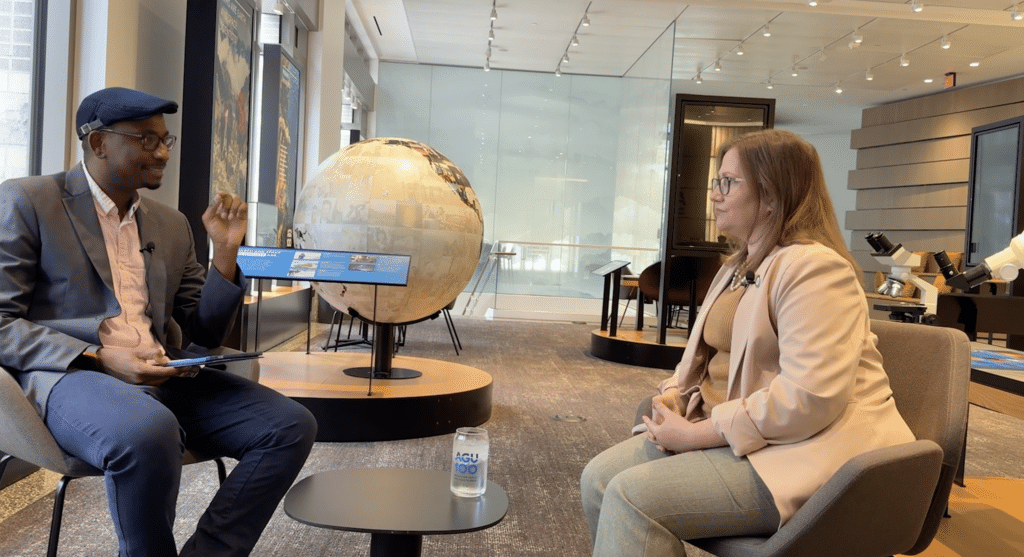
The interview took place at AGU’s headquarters in Washington DC.
Crocker walked me through how the Exchange operates in practice. Communities apply to the program and are paired with trained community science fellows who help build relationships, refine ideas, and co-develop projects. Scientists are brought in later, and importantly, “the community always gets the final say in which experts get brought on.” She emphasized that this structure emerged from years of trial and error, noting that early on AGU heard repeatedly about “that lack of ability to have a structure, that glue in the middle.” Scientists, she said, often knew their work had real-world applications but “didn’t necessarily know how to do that work with communities,” while communities struggled to translate lived experience into researchable questions. The Exchange exists to prepare both sides and support them when they “run into barriers.”
A large part of our conversation focused on impact and how difficult it is to measure. Crocker told me that impact looks different for every project, because “our first concern is, what is an impact for our community.” Sometimes that impact is tangible, like soil testing that shows where food can be safely grown, or air quality data that allows residents to advocate for change. Other times, the impact is longer term and harder to quantify, including shifts in trust and perception. She noted that participation often “changes their perceptions of who is a scientist,” and how science can be used for decision-making. One could argue that the operational infrastructure the Exchange has built is a measure of impact. Crocker was also candid about projects that do not work as planned, stressing that those lessons matter too. “Our failures are on there too,” she said, explaining that learning why a project stalled is critical for improving future work.
Looking ahead, she outlined priorities that include expanding Spanish-speaking and Indigenous community partnerships, building case studies and videos, and creating resources so communities can eventually “do this on their own” without depending on the AGU.
Questions for thought: What types of connective infrastructure are required to sustainably bring scientists and communities together? Who gets to define impact when outcomes are local, diverse, and difficult to quantify? How should lessons be documented and disseminated when projects stall, pause, or fail? How ready do communities and scientists need to be before collaboration begins, and who decides that readiness? And how should programs like Thriving Earth Exchange balance scaling themselves vs enabling others to adapt their model locally?

Fanuel Muindi is a former neuroscientist turned civic science ethnographer. He is a professor of the practice in the Department of Communication Studies within the College of Arts, Media, and Design at Northeastern University, where he leads the Civic Science Media Lab. Dr. Muindi received his Bachelor’s degree in Biology and PhD in Organismal Biology from Morehouse College and Stanford University, respectively. He completed his postdoctoral training at MIT.





Dear Colleagues: This is why science communication needs visuals

In Michigan, a citizen science project tracking salamander migration is bringing a community together and building a dataset

“Science is something that we do together.” Benjamin Richards on how OceanEyes collaborates with citizen scientists to monitor deepwater fish in Hawai’i

Dear Colleagues: Participate in a survey on barriers researchers face when communicating with non-expert audiences

Research!America selects 17 grantees from 132 applicants for the 2026 Civic Engagement Microgrant cohort
Dear Colleagues: Participate in a survey on barriers researchers face when communicating with non-expert audiences

Scott Loarie says conservation science isn’t moving fast enough. He describes how iNaturalist is helping

Photo Essay: 2026 Stand Up for Science New York City

MA3 Challenge awards grants to six universities to modernize promotion and tenure processes: Here’s the question of the day.
Research!America selects 17 grantees from 132 applicants for the 2026 Civic Engagement Microgrant cohort
“Science is something that we do together.” Benjamin Richards on how OceanEyes collaborates with citizen scientists to monitor deepwater fish in Hawai’i

Melanie Brown: “If you listen, people want to share things that are important to them.”

Abby C. King on leveraging local wisdom and science to create a thriving environment: “Our communities are the most valuable renewable resources for a healthy planet.”

Milky Way Project co-creator Grace Wolf-Chase says public engagement is ‘every bit as important as excellent scientific research’

Seeing is believing: Inside the BioBus revenue engine with Ben Dubin-Thaler
Contact
Menu
Designed with WordPress