
Civic Science Observer
Bridging research and community: Utah SciComm Symposium empowers scientists to share their story

The insights below were originally published by the Office of the Vice President for Research at the University of Utah. It is republished into our database with permission from the author.
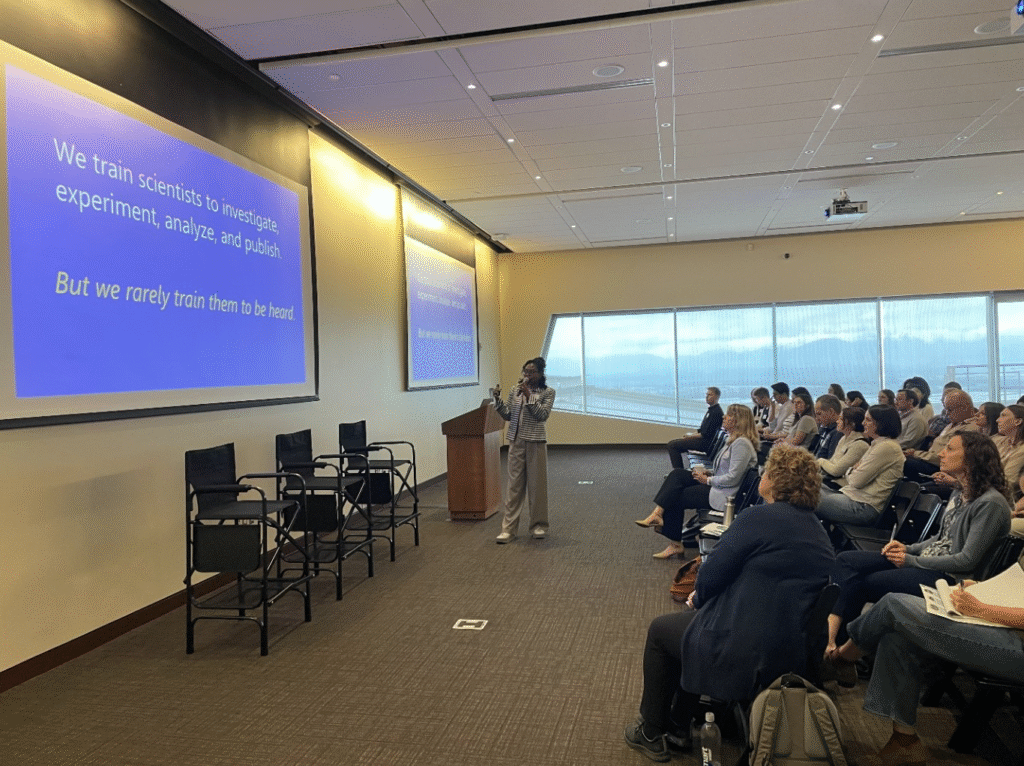
On May 5, 2025, nearly 80 students, researchers, and professionals gathered at the Natural History Museum of Utah (NHMU) for the inaugural Utah SciComm Symposium – an event designed to empower scientists to communicate their work with clarity, creativity, and relevance. Supported by the Research!America Civic Science Microgrant, this event provided a platform for showcasing innovative science communication and fostering dialogue between disciplines and communities. While scientific rigor is essential, the true impact of research depends on how effectively we share it.
The Utah SciComm Symposium brought together voices from academia, government, and journalism. Julie Kiefer, PhD, shared insights from her work at University of Utah Health, emphasizing the power of connection in making science matter.
Atim Enyenihi, PhD, offered a policy and industry lens, reminding attendees that the messenger’s identity shapes how science is received. Matthew LaPlante, PhD, drove the message home: “The challenge of science communication is not one of ‘dumbing things down,’ but rather ‘bridging our brilliances.’”
Following these talks, we hosted an Ask Me Anything (AMA) panel, where audience members submitted anonymous questions on topics ranging from career pathways in science communication to overcoming burnout, navigating misinformation, and rekindling a sense of wonder in research. This open dialogue created a space for candid conversations, making the event feel more like a community exchange than a traditional lecture series.
A centerpiece of the symposium was the SciComm Hackathon Finalist Presentations, where six graduate students showcased creative projects – including comics, visual storytelling pieces, an animated lecture, and a short-form video designed for social media – that translated their complex research for broader audiences.
These projects were the result of months of dedicated work, as students developed and refined their materials with feedback from our expert judging panel and media consultant, Julie Callahan. Julie’s experience in multimedia graphics and public outreach was instrumental in helping students shape their ideas into compelling stories. More than just a showcase of scientific expertise, these projects reflected a shared commitment to storytelling, accessibility, and meaningful public engagement.
Beyond presentations, the symposium featured interactive science activities led by Utah Brain Awareness Week members from the Department of Neuroscience at the University of Utah. Attendees had the rare opportunity to hold real human brains, learning fascinating facts about brain structure and function, while the concussion goggles module allowed participants to experience the disorienting effects of mild to severe brain injuries.
By testing their motor skills through this simulated “patient” lens, attendees also gained a deeper appreciation for the importance of protecting the brain from injury.
The event’s design reflected the ethos of public engagement: breaking down barriers between science and society through conversation, creativity, and shared curiosity. The Utah SciComm Symposium wasn’t just about presenting research – it was about creating a culture of communication, where storytelling and public engagement are seen as essential components of scientific practice.
In an era where misinformation and polarization threaten scientific trust, equipping researchers with these skills is a necessity. By fostering a culture of science communication, we aim to build a more informed, engaged, and connected community.
What follow-on actions did the insights above spark for you?

I am a Ph.D. candidate in Neurobiology at the University of Utah with a passion for neuroscience, immunology, and mentoring the next generation of scientists. My research focuses on uncovering the mechanisms behind sickness-induced hyperalgesia. Outside the lab, I mentor students at all levels and lead outreach initiatives to support underserved communities in STEMM. I aim to combine research, teaching, and mentorship to build inclusive, impactful programs that inspire future scientists. Let’s connect to collaborate or share ideas!





Did you know Boston’s Museum of Science is opening a Public Science Common? Here are some questions to consider

Did You Know: A museum dedicated to the brain is being developed in Southern California?

Peer teaching as empowerment? Exploring NeuroBoricuas with Dr. Christian Bravo-Rivera

STEM Unbarred: What the initiative is learning about hands-on science for incarcerated youth

San Francisco Bay Area climate resilience group helps local communities talk about extreme heat
San Francisco Bay Area climate resilience group helps local communities talk about extreme heat
STEM Unbarred: What the initiative is learning about hands-on science for incarcerated youth
Peer teaching as empowerment? Exploring NeuroBoricuas with Dr. Christian Bravo-Rivera
Did You Know: A museum dedicated to the brain is being developed in Southern California?
Did you know Boston’s Museum of Science is opening a Public Science Common? Here are some questions to consider
Did you know Boston’s Museum of Science is opening a Public Science Common? Here are some questions to consider
Did You Know: A museum dedicated to the brain is being developed in Southern California?
STEM Unbarred: What the initiative is learning about hands-on science for incarcerated youth

Exploring workforce needs and intergenerational learning in informal STEM education

Making a Mini-Forest: participatory science afforestation across the globe
Contact
Menu
Designed with WordPress