
Questions of the Day Program
Voices from a SciArt exhibit in Massachusetts that brought together artists to share their visions of a sustainable future

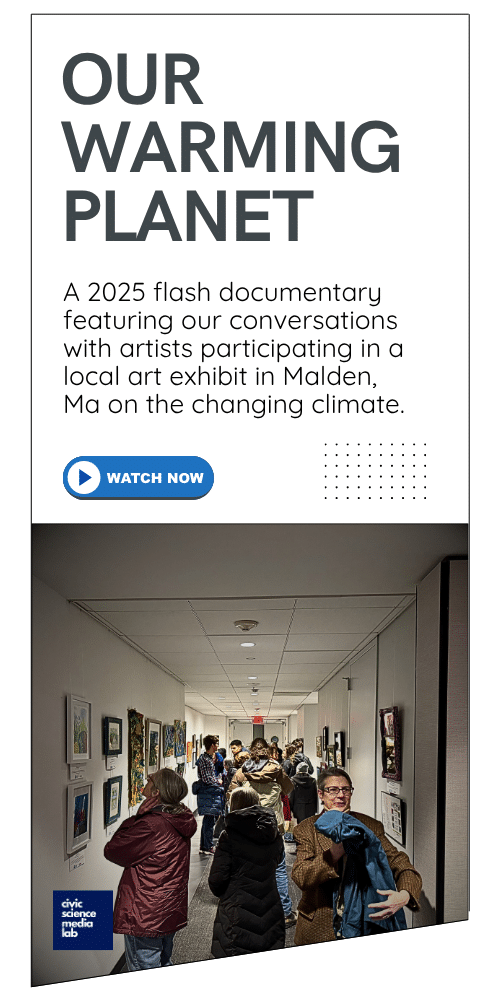
In March 2025, a science-art (more commonly known as SciArt) exhibit titled “Our Warming Planet: Visions of a Sustainable Future,” co-organized by Creative Malden and the Coffee Shop Artists in partnership with the city of Malden in Massachusetts, invited local artists to respond to Malden’s Climate Action Plan through mixed media works. Over 40 artists contributed more than 70 pieces, exploring themes from global environmental challenges to local sustainability efforts. I had the opportunity to witness the full arc of the exhibit—from its early planning stages to opening day—by engaging directly with organizers, artists, and attendees throughout.
The open-ended call for submissions allowed artists to interpret the theme freely, leading to a wide range of creative responses. Participants included environmental advocates, educators, photographers, and several first-time exhibitors. Some were drawn to the urgency of the topic; others saw it as an opportunity to connect personal values with public dialogue. “This was written for me,” said one artist who had previously worked in climate advocacy and was seeking more direct ways to communicate through art. Another described the exhibit as a rare chance to use art as a “catalyst for change” in a public setting, noting that most of their climate-themed work had been displayed “guerilla-style” due to a lack of institutional support. One first-time contributor shared how the encouragement of friends helped her overcome imposter syndrome to submit: “I didn’t start making art until 2020 to keep my sanity,” she said, “and this show was kind of a way to enter the art world.”
Others approached the theme as both a personal and conceptual challenge. “The topic is so important, and I didn’t want to just say ‘the sky is falling,’” said one artist. “I wanted to create something that could help people think and act.” Another participant, reflecting on her decades-long concern with environmental issues, shared: “I have always wanted to be more present in exhibits that dealt with climate change—and I’ve seen too few of them.” Still others were motivated by place and proximity. One photographer noted, “The location is in Malden, which is very close to where I live… I figured, why not publicize myself a little bit more and also give my fellow artists some support by participating.” For another artist, participating in the exhibit wasn’t just about displaying art—it was about encouraging people, especially young audiences, to reconnect with their surroundings. “If each one of us just takes a second look at our perspective,” she said, “we’d realize there’s so much more we can notice, protect, and act on in our own communities.”
The exhibit saw strong public turnout from Malden and nearby towns, drawing a diverse mix of residents, city officials, and community leaders—including Malden’s mayor. Attendees praised the show’s accessibility and its ability to spark meaningful dialogue. CD Collins, Poet Laureate of Malden, remarked, “Every artwork I’ve seen is so deeply thoughtful and profound—and yet hopeful—because we have to fight this fight.” Carey McDonald, a city councillor at-large involved in the development of Malden’s Climate Action Plan, reflected on the broader significance of the event: “When you talk about climate change, it can feel really big and really scary. Sometimes it can feel really intimidating because it’s very technical. But events like this that are open to the community, that really bring people in, that provide a lot of different entry points, help people see what’s possible… This is a great place to focus one’s time and energies—on your neighbors and your block and your community, doing what you can to help the planet and protect the places you care about.”
Organizers noted the unusually high number of submissions, reflecting a clear appetite for more community-centered spaces where art and civic engagement intersect. Many attendees emphasized the emotional power of the works on display, which helped make the abstract issue of climate change more tangible and locally relevant. A local high school student told me that “it’s really nice to see this [the exhibit] around here, which you don’t see a lot. To be honest, I’ve never heard of an art exhibit like this, so I think it’s really nice to see this around here, especially in Malden, which is a place that really needs this.”
The exhibit surfaces again a set of questions that past articles and reports have asked. What would it take to sustain and scale platforms like this that bring together artists, scientists, and local communities in dialogue and action? What does impact mean for such events? How can local organizations that maintain these spaces—often on minimal budgets and volunteer energy—receive more consistent support? As more cities adopt climate plans, what are the different ways art can be a tool for engagement? What kinds of infrastructure are needed to track impact, ensure continuity, and foster long-term engagement? And finally, as Bennett and Dudo observed in their landscape report, there is no one-size-fits-all for art-science initiatives. So what and where are the new synergies across initiatives?
There are also countless local stories to be uncovered at the intersection of art and science. How can we learn from these stories and make more of them visible?
Watch the whole series: https://www.youtube.com/hashtag/maldenclimateaction
Useful Links
(1) Creative Malden – https://creativemalden.org/
(2) Climate Action Plan (CAP) – https://www.cityofmalden.org/952/Climate-Action-Plan
(3) SciArt Initiative – http://www.sciartinitiative.org/
(4) Arianna Zuanazzi says research is also a form of art & shares her perspectives to recent developments – https://www.youtube.com/watch?v=utKfzg3wdP4
Additional Readings
(1) The Landscape of Art-Science Collaboration Programs – https://mediaengagement.org/research/landscape-of-art-science-collaboration-programs/
(2) Why create SciArt? An investigation into science artists’ goals and professional journeys – https://jcom.sissa.it/article/pubid/JCOM_2106_2022_A05/
(3) Examining science and art collaborations through a social psychology lens reveals the need for third spaces – https://labs.sciety.org/articles/by?article_doi=10.31234/osf.io/4xbkj_v1

Fanuel Muindi is a former neuroscientist turned civic science ethnographer. He is a professor of the practice in the Department of Communication Studies within the College of Arts, Media, and Design at Northeastern University, where he leads the Civic Science Media Lab. Dr. Muindi received his Bachelor’s degree in Biology and PhD in Organismal Biology from Morehouse College and Stanford University, respectively. He completed his postdoctoral training at MIT.





Risa Schenbly’s journey to researching ecological grief and telling its stories

After School Science: Wild New York City — BioBase Harlem in pictures

SciArt community reflections spark a desire for Third Spaces

Dear Colleagues: This is why science communication needs visuals

In Michigan, a citizen science project tracking salamander migration is bringing a community together and building a dataset

Dear Colleagues: Participate in a survey on barriers researchers face when communicating with non-expert audiences

Research!America selects 17 grantees from 132 applicants for the 2026 Civic Engagement Microgrant cohort
In Michigan, a citizen science project tracking salamander migration is bringing a community together and building a dataset

“Science is something that we do together.” Benjamin Richards on how OceanEyes collaborates with citizen scientists to monitor deepwater fish in Hawai’i
SciArt community reflections spark a desire for Third Spaces
Risa Schenbly’s journey to researching ecological grief and telling its stories
“Science is something that we do together.” Benjamin Richards on how OceanEyes collaborates with citizen scientists to monitor deepwater fish in Hawai’i

Melanie Brown: “If you listen, people want to share things that are important to them.”

Abby C. King on leveraging local wisdom and science to create a thriving environment: “Our communities are the most valuable renewable resources for a healthy planet.”

Milky Way Project co-creator Grace Wolf-Chase says public engagement is ‘every bit as important as excellent scientific research’
Contact
Menu
Designed with WordPress