
Civic Science Observer
Some of the key takeaways from the 2024 Communicating Discovery Science Symposium in South Africa
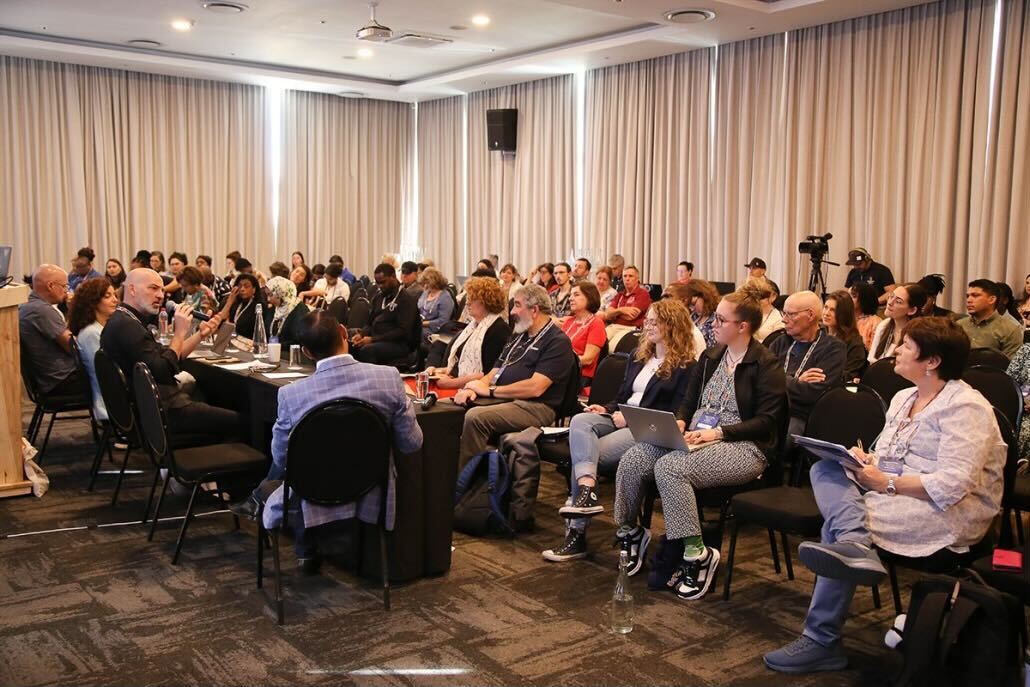
In November 2024, civic scientists gathered in Stellenbosch, South Africa to explore the differences and overlaps between communicating discovery science and other types of science at the Communicating Discovery Science symposium.
Sponsored by the Kavli Foundation, the symposium addressed key factors distinguishing the communication of discovery science and coincided with the release of a special theme issue of the Journal of Science Communication (JCOM) with the same name.

Rick Borchelt, guest editor of the Communicating Discovery Science JCOM issue, kicked off the symposium with his concern that scientists feel pressure to emphasize the utility of their work above all else. He observed that “we let them paint us into the corner that we all always had to come back and say ‘oh, in two years we’re gonna do this’… And we perjured ourselves many times in doing that, and I think that’s been a real damage to the scientific credibility and one of the reasons why scientific credibility has taken a hit in many of the western countries.”
In his speech, Borchelt shared his own experience communicating discovery science during his time in graduate school for journalism and science writing. He noted that “we were all working under the same received wisdom that to be a good science communicator, basic science or not, the first thing you have to do is figure out: Why is it relevant to your audience?”
But, when he tried to frame his discovery science writing in utilitarian terms, he realized that wasn’t the point. Instead, some science isn’t directly relevant to people’s lives. But that doesn’t mean it isn’t valuable: “It’s interesting, it’s freaking cool,” he said.
But the received wisdom remains that scientists have to justify their expenditure and the broader importance and utility of their work. According to Borchelt, “this is a very difficult and toxic situation for the funding of basic science and discovery science.” Partly, this is because a utility-focused communication strategy spread to other scientific communication practices.
In his speech, Borchelt explained that SciPEP, the special issue of JCOM, and the symposium “came about as a consequence of many of the conversations we had at SciPEP about the fact that there was no research, no best practices analysis, no thought leadership around discovery science.” He noted that they wanted to ask the question: “Was there any difference between how we communicate about discovery science than there was about applied science and technology?”
Dr. Mónica Feliú Mójer from Ciencia Puerto Rico and Dr. Nokwanda (Nox) Makunga of Stellenbosch University delivered the opening keynotes (watch many of the talks at the symposium here) on new strategies for communicating discovery science.
As a PhD student, Feliú-Mójer mentioned that she “felt pressured to justify the relevance of [her] work by connecting it to how it was useful to human health and, of course, that is important, but that’s not what I was interested in.”
To Feliú-Mójer, relevance is about more than just utility; it’s about connection. She shared that her key to communicating science is to use connection: “Just as a neuron’s true power lies in its connections to other neurons and cells, the strength of basic science communication lies in its ability to forge connections with people’s lives.”
In her keynote, Feliú-Mójer used examples of relevance-based science communication to connect audiences to Indigenous sciences and foster a sense of belonging by leveraging culturally responsive science communication. Because, according to Feliú-Mójer’s approach, “relevance is very personal. And so, in order to make science relevant to any given audience, we have to center that audience or those audiences.”
Similar to Feliú-Mójer and Borchelt, the value of scientific research goes beyond “publish or perish” for Dr. Makunga. For her, connection is a key part of communicating discovery science. Her mission is to link science to society.
To Makunga, this means that public engagement is connected to public understanding: “So people need to be aware of what is actually happening in our labs.”
Her involvement in initiatives like Black Botanists Week, “allowed [botanists] to be able to communicate much of the basic science that [they] do in [their] labs” and “bring it towards a global visibility.”
Global visibility is an important piece of Makunga’s communication strategy. Makunga seeks to make science feel applicable to people who look like her, and she is keenly aware that the reason she became a botanist was because she was lucky enough to grow up with a father who was a botanist. Makunga believes that initiatives like Black Botanists Week will link science to society by making scientists, especially Black, South African, botanists like herself, visible.
Another way Makunga links science engagement to science understanding involves plants. “Most people actually don’t see plants, and hence there is this term known as ‘plant blindness’ or ‘plant awareness disparity.’” South Africa has a wide selection of unique flora, and to Makunga, educating people, young people especially, on this unique flora could be a way to build national identity.
So, if not utility, what is the key to communicating discovery science?
It could be connecting to audiences based on their personal experiences. But that’s only one approach. And as Borchelt reminded us, there is no one-size-fits-all approach to science communication.
The lectures in the symposium covered approaches in mentorship, language, and even humorous radio programs. As Borchelt said, “we have yet to explore even the beginnings of the full richness that’s out there to be able for us to use discovery science communication.”
The symposium represents a depth of research already in the field of communicating discovery science. According to Borchelt’s lecture: “This is the down payment. This is not the end of everything. This is a down payment on the change in communication strategy for the community of basic science communication.”
For access to some of the symposium highlights, recordings of key talks and speaker features, head to https://www.discoveryscience.co.za/
What follow-on actions did the insights above spark for you?

Eileen has a BA in Comparative Literature and Studio Film/Videomaking from Harvard University. She coordinates multiple programs on the CivicSciTV Network, and manages the social media posts, and newsletters.




Did You Know: A museum dedicated to the brain is being developed in Southern California?

Peer teaching as empowerment? Exploring NeuroBoricuas with Dr. Christian Bravo-Rivera

STEM Unbarred: What the initiative is learning about hands-on science for incarcerated youth

San Francisco Bay Area climate resilience group helps local communities talk about extreme heat

Did You Know: Kirtland’s Warbler Festival in Michigan is engaging the local community in celebrating and conserving the once-endangered songbird through educational events

Questions, biology-based environmental stewardship, and accessibility are at the center of Bio4Climate’s annual conferences
Did You Know: Kirtland’s Warbler Festival in Michigan is engaging the local community in celebrating and conserving the once-endangered songbird through educational events
San Francisco Bay Area climate resilience group helps local communities talk about extreme heat
STEM Unbarred: What the initiative is learning about hands-on science for incarcerated youth
Peer teaching as empowerment? Exploring NeuroBoricuas with Dr. Christian Bravo-Rivera
Did You Know: A museum dedicated to the brain is being developed in Southern California?
STEM Unbarred: What the initiative is learning about hands-on science for incarcerated youth

Exploring workforce needs and intergenerational learning in informal STEM education

Making a Mini-Forest: participatory science afforestation across the globe

18 months later, Casey Lardner from Genspace says, “we’ve been really focused on building systems”
Contact
Menu
Designed with WordPress