
Civic Science Observer
3 early career neuroscientists share their journeys in public engagement
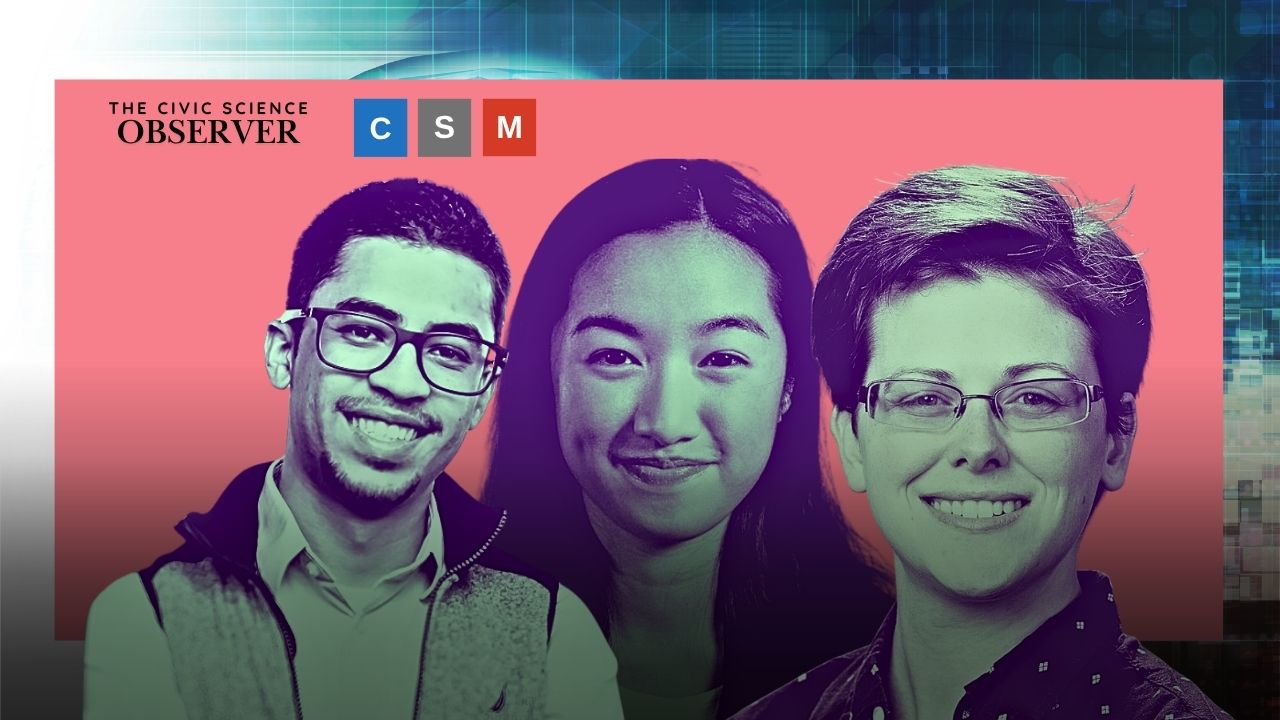
“Hi, I’m a neuroscientist and I study poop.” Monica Tschang, a third-year PhD candidate at the University of Washington, often begins by saying this when speaking at public engagement events.
Scientists participate in public engagement activities for diverse reasons. These reasons are not static. They are dynamic. Here, I spoke with three early career researchers in neuroscience to hear their stories about doing public engagement and gain insight into their motivations.
At the University of Washington, community engagement is deeply ingrained in the very core of the Neuroscience PhD program. It’s a practice that, as Tschang puts it, brings science out of “the ivory tower of academia” and back to the people it’s meant to serve.
Tschang’s journey into neuroscience public engagement reflects a shift from introversion to connection. She once wanted to “be by myself in a lab with my pipet and not talk to anyone,” but the pandemic made her rethink the approach. A friend proposed starting a podcast to highlight undergraduate research at Rutgers. Despite already leading a “brain awareness outreach group,” she joined. The podcast, You’ve Got Potential!, sparked new confidence — as she said, “oh, I can do new things and learn how to be good at it.” She has since taken on outreach roles, engaging audiences ranging from schoolchildren to adults.
Tschang’s research on the gut microbiota explores how the brain and gut communicate with one another. She sees this same idea of two-way exchange as a guiding principle for public engagement where scientists and local publics learn from each other.
That philosophy shapes her public engagement work through the Neuroscience Community Outreach Group (NCOG) at the University of Washington where she co-leads efforts to make neuroscience education more accessible and inclusive. While the pandemic disrupted the group’s momentum, she is now focused on rebuilding its presence for incoming graduate students, managing funding, and reimagining how to engage meaningfully with the community.
One of the group’s flagship events is an annual reverse science fair, where graduate students and postdocs present their work to visiting high school students who serve as the judges. The event flips traditional roles and invites the high school students to ask the question and evaluate the presentations. Originally aimed at private schools in the Seattle area, the event has since shifted its focus toward public schools and those with limited resources (watch the video to hear Monica Tschang describe the lessons learned through their reverse science fair that was recently supported by a microgrant from Research!America).
Beyond the reverse science fair, NCOG organizes open houses, participates in local STEM nights at elementary schools, and maintains a presence at GeekGirlCon, a Seattle-based convention celebrating women and marginalized genders in STEM and pop culture. Tschang also works to connect students with internship and enrichment opportunities by inviting local programs to host tables at events.
Tschang’s commitment to public engagement spans formats, audiences, and institutions. She has delivered talks at venues like Town Hall Seattle, trained peers through the Engage Science program, and introduced audiences to neurotechnology tools at events like Evening with Neuroscience. She also co-produces Are You Smarter Than a Comedian?, a science comedy game show where researchers compete with local comedians. The event reflects her comfort with stepping beyond academic spaces. “I never imagined this would be on my radar,” she says, “but putting myself in spaces where I didn’t necessarily think I belonged and seeing what happens has been my approach to many things.” She adds, “it’s easy to get stuck in repetitive lab routines.”
Through UW Engage SciComm, a program she helped launch, Tschang trains graduate students to communicate their research to the public. Offering free workshops, the initiative supports her broader aim: to help others see public engagement as part of scientific practice, not an extra.
Reflecting on her own path to graduate school and the pandemic’s polarized climate, she explains: “We certainly aren’t lacking any of that right now,” referring to misinformation. “I believe there is a social responsibility—not to tell people what to do, but to inform them about things they may not know, or to help reframe certain ideologies away from fear-mongering and toward being either hopeful or at least informative. Science hasn’t done this well enough, as the pandemic proved.” To build connections, she tailors her approach using comedy with children and sarcasm with adults as a ‘common denominator.’
Looking ahead, she plans a nontraditional post-PhD path shaped by her values. “Whether working in education, science policy, or as a medical science liaison, I want to keep doors open. Meaningful human connection is becoming rare in an age of AI. With my psychology and neuroscience background, I aim to make ideas understandable. I hope to work at an institution or company expanding science access to diverse communities, making it less intimidating and more inclusive through youth education, outreach, or science journalism.”
On the other side of the country, Lester Rodriguez describes himself as “a Puerto Rican neuroscientist trying to leave an impact in the community and inspire students to pursue these careers and see themselves in these positions.” He has engaged audiences with science from the New Haven community to Puerto Rico.
A third-year neuroscience PhD candidate at Yale University, he served as a fellow with the Pathways to Science Program for two years and as director of OpenLabs, a student-led outreach organization.
Through OpenLabs, he helped lead three main initiatives: the Science Café, the Flipped Science Fair, and the Exploring Science Seminars. The Science Café is a family-oriented, semesterly event where students and their families explore hands-on science demonstrations on topics like neuroscience, climate change, and physics. In the Flipped Science Fair, graduate and postdoctoral researchers present posters to middle school students, who act as judges—scoring presentations on visuals and clarity, and building evaluative and critical thinking skills. The Exploring Science Seminars, held virtually three times per semester, bring together 50–80 middle and high school students to hear Yale researchers present their work via Zoom. These sessions are recorded and shared on YouTube for broader access.
Students typically learn about these opportunities through Yale Pathways to Science, which connects hundreds of local students with campus-based programming. In addition to helping run these events, Rodriguez contributed by analyzing student demographics and outcomes—tracking STEM interest and college enrollment. He notes that “many participating students later pursue STEM studies, influenced by early exposure to scientists who reflect their communities.”
Rodriguez’s motivations for public engagement are shaped by his experiences growing up in Puerto Rico and the lack of visibility into scientific careers. It’s a gap he continues to confront: “what do scientists do in their day to day, what do those careers mean, and how can you access those careers?”
As an undergraduate at the University of Puerto Rico, Rodriguez helped launch an outreach branch of the Neuroscience Student Association. The group organized school visits that opened university spaces to local communities and introduced neuroscience topics often missing from classroom learning. One of his signature events was a seminar on the effects of drugs on the brain, covering short- and long-term impacts without stigma. “Sometimes it’s hard for students to see themselves in these roles because of a lack of role models or exposure to these options,” he explains. “These discussions, often considered taboo in many communities globally, fostered bidirectional learning for both students and scientists.”
During his post-baccalaureate at the NIH, Rodriguez worked with Educando con Amor (Educating with Love), an organization supporting students from Spanish-speaking families. He led monthly science demonstrations in Spanish on topics ranging from chemistry to biology, making sure language was never a barrier to engaging with science. Despite the challenge of translating technical terms, Rodriguez remained committed to sharing science with his community and consciously ‘turned off some instincts’ ingrained through formal education.
Most recently, through CienciaPR, he gave a seminar on his neuroimaging research with human subjects—conducted entirely in Spanish—continuing his commitment to culturally relevant, accessible science communication.
For Rodriguez, outreach is a source of learning and connection. “I hope that by facilitating these experiences and talking about research, I can help students see themselves in these positions and consider pursuing these careers,” he says.
Going down south to Durham, North Carolina, Duke University’s Neurobiology PhD program shares a parallel spirit of public engagement.
Meredith Schmehl, a former PhD student in neurobiology at Duke University and now the Open Science Strategy Program Coordinator at the Howard Hughes Medical Institute, has integrated public engagement into her scientific identity, describing herself as a “bridge builder between science and society.”
For Schmehl, communication has long been a strength. “Ever since I was really young, probably in elementary school, people have been telling me that I’m good at explaining things.” But her interest in science communication also stems from her own early uncertainty. “I hadn’t taken proper biology or chemistry classes before,” she recalls of her time as a high school senior. That experience sparked a curiosity about how to make complex science more understandable. “Being able to take a step back and ask, ‘What does this person know, and how can I help them understand?’ — that’s really where it started for me.”
Her undergraduate years laid the foundation for this commitment. At Duke, she helped lead a graduate student group that organized Discovery Day during Brain Awareness Week, which drew over 500 attendees from the local community. Children had the chance to hold donated human brains. “It was a chance to bring the science I love out of the lab and into people’s hands — literally,” she says.
This experience launched her into broader science communication efforts. She began writing for Scientific American and Massive Science, and co-founded The Gastronauts Podcast, which explores how the gut and brain communicate while sharing the personal stories of the scientists behind the research. “It wasn’t just about the science — it was about demystifying who scientists are and how they got here.”
Schmehl’s work expanded into national leadership roles. At ComSciCon, a science communication training organization, she moved from attendee to planner, helping organize workshops for graduate students. At the same time, she became involved in the National Science Policy Network, leading communications to support scientists in engaging with evidence-based policymaking.
Now at the Howard Hughes Medical Institute (HHMI), she continues to prioritize openness and accessibility in science. “I’m not necessarily doing the outreach myself every day, but I’m supporting scientists in sharing their work openly and accessibly,” she explains. Outreach remains central to her work—she mentors students, helps manage projects on ethics and engagement, and edits educational materials, including YouTube videos about peer review.
Reflecting on her path, Schmehl emphasizes that there’s no need to wait for a formal invitation to get started. “It’s okay to make mistakes and learn as you go. Find a group or some friends and just start. That’s how you discover where your strengths and passions lie.”
Looking ahead, Schmehl points to the evolving digital landscape as both a challenge and an opportunity. “We’re in a transition between platforms, and we need to figure out how to reach people who don’t already follow us — not just preaching to the choir.”
These stories here represent just a small fraction of the diverse ways neuroscience trainees are engaging their local communities. Their motivations share a common thread: a belief that science should be more accessible, inclusive, and reciprocal.
As more of these stories emerge, they offer more detailed resolution into the personal journeys trainees undertake to engage their local communities.
And they inspire more questions.
What do these individual paths reveal about how early-career neuroscientists come to see engagement as part of their identity? What moments, mentors, or barriers shape their decisions to integrate public engagement work? What kinds of engagement activities do they pursue and what kinds of futures do they begin to imagine as a result?
There is a lot of room for those stories.
What follow-on actions did the insights above spark for you?


Asmita Adya is an undergraduate senior at Northeastern University majoring in Behavioral Neuroscience. She conducts research on ovarian hormones and affect with the Interdisciplinary Affective Science Laboratory and previously completed a co-op at the Hart Lab at Rutgers University. Asmita is passionate about making science accessible to the public and hopes to dedicate her future career to advancing both scientific discovery and clinical care in service of the community.


Did You Know: A museum dedicated to the brain is being developed in Southern California?

Peer teaching as empowerment? Exploring NeuroBoricuas with Dr. Christian Bravo-Rivera

STEM Unbarred: What the initiative is learning about hands-on science for incarcerated youth

San Francisco Bay Area climate resilience group helps local communities talk about extreme heat

Did You Know: Kirtland’s Warbler Festival in Michigan is engaging the local community in celebrating and conserving the once-endangered songbird through educational events

Questions, biology-based environmental stewardship, and accessibility are at the center of Bio4Climate’s annual conferences
Did You Know: Kirtland’s Warbler Festival in Michigan is engaging the local community in celebrating and conserving the once-endangered songbird through educational events
San Francisco Bay Area climate resilience group helps local communities talk about extreme heat
STEM Unbarred: What the initiative is learning about hands-on science for incarcerated youth
Peer teaching as empowerment? Exploring NeuroBoricuas with Dr. Christian Bravo-Rivera
Did You Know: A museum dedicated to the brain is being developed in Southern California?
STEM Unbarred: What the initiative is learning about hands-on science for incarcerated youth

Exploring workforce needs and intergenerational learning in informal STEM education

Making a Mini-Forest: participatory science afforestation across the globe

18 months later, Casey Lardner from Genspace says, “we’ve been really focused on building systems”
Contact
Menu
Designed with WordPress